

Your back door leads to grass, then a pool sitting alone in the yard. These 21 above-ground pool with deck off house ideas fix that disconnect for good.
Your above-ground pool with deck off the house shouldn’t feel like two separate things — a house over here, a pool way over there, and a stretch of awkward grass in between. That disconnect drives most homeowners up the wall. You step outside on a Saturday afternoon, towel in hand, and it feels like you’re hiking to the pool instead of walking to it.
Here’s what a deck running straight from your back door to the pool does: it turns that in-between space into living space. You gain a lounge area, a grilling spot, a place for the kids to drip-dry, and a walkway that keeps bare feet off wet grass. The pool stops feeling temporary. It starts feeling like it belongs.
These 21 ideas range from dead-simple weekend projects to full-blown backyard overhauls. Some cost less than a nice dinner out. Others run a few thousand. But every single one connects your house to your pool in a way that makes the whole yard work harder.
1. The Straight-Shot Platform Deck
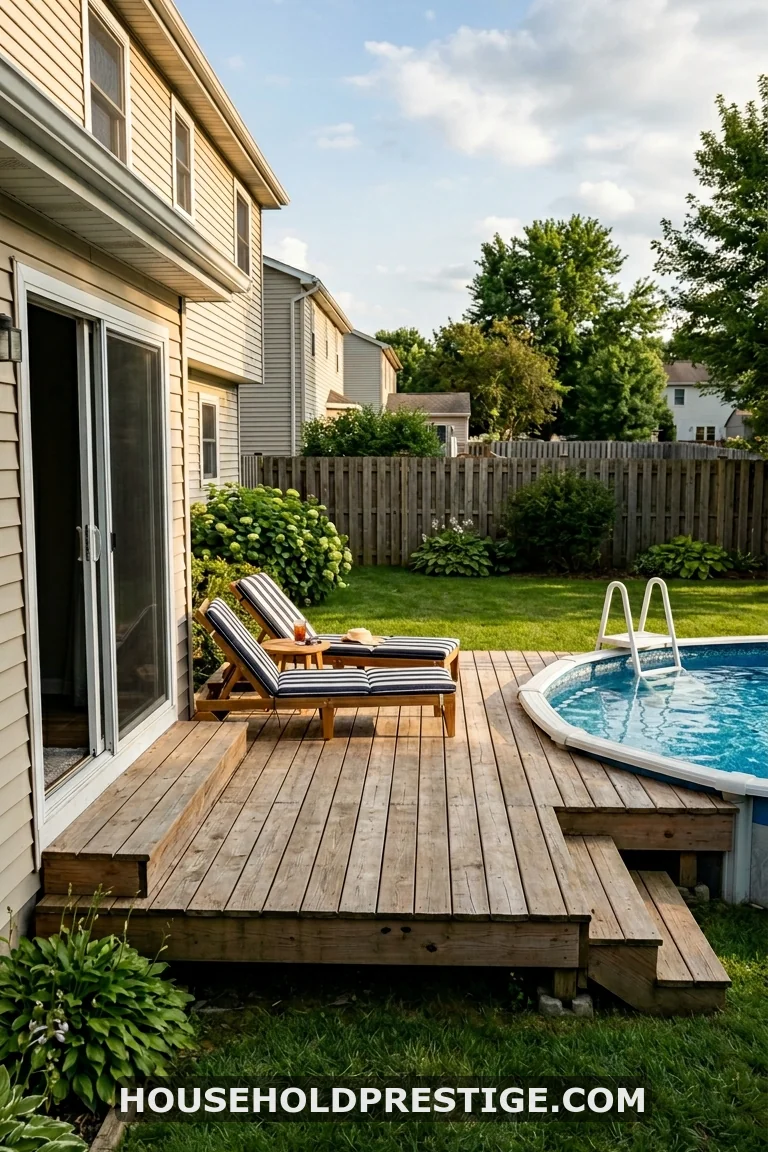
Think of this as a highway between your kitchen and the water. A straight platform — 4 feet wide, 12 to 16 feet long — runs from your back door to the pool edge. No curves. No levels. No fuss.
Pressure-treated lumber costs between $800 and $1,500 for a basic 4×14 foot platform. Lay the boards perpendicular to the house for visual length. A single handrail on one side keeps code inspectors happy without boxing in the space.
This works best when the pool sits directly behind the house, no more than 20 feet from the back wall. If you’ve got a bigger gap, you’ll want something with more presence — skip ahead to idea #2 or #7.
2. Multi-Level Deck with Tiered Steps (The Full Build)
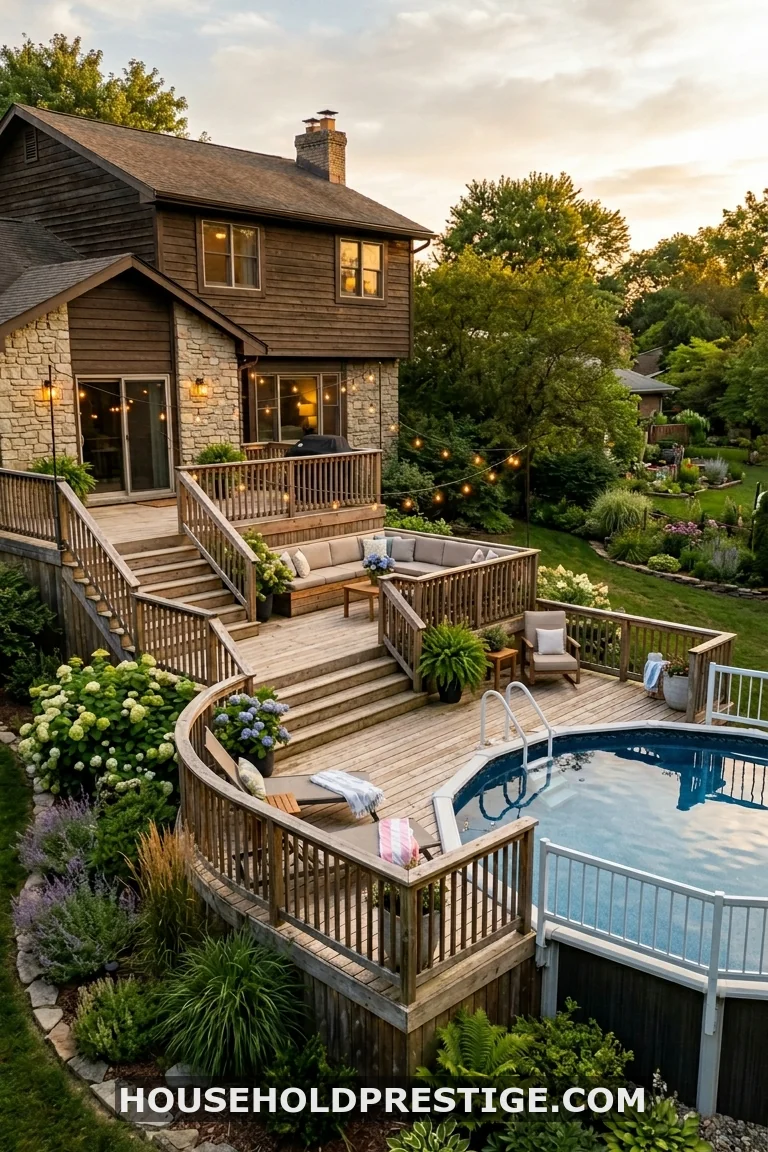
This is the project that turns a backyard into a destination. Three levels. House level at the top, lounge level in the middle, pool-height level at the bottom. Each platform drops 8 to 12 inches, creating natural zones without any walls between them.
Why It Works
The tiered design solves two problems at once. First, it eats up elevation changes between your door threshold and the pool rim — most above ground pools stand 48 to 52 inches tall, and your back door might sit 24 to 36 inches above grade. Three tiers bridge that gap without a steep staircase. Second, each tier becomes its own room. The top level holds a bistro table and two chairs. The middle level handles lounge chairs and a side table. The bottom level wraps around the pool for towel storage and entry.
Dimensions and Layout
Start with the footprint. Measure from your house wall to the near edge of the pool. Add 4 feet of clearance between the pool wall and the nearest deck edge — this gap prevents the deck from leaning against the pool and damaging the wall.
- Top tier: 10 feet wide × 8 feet deep. This sits at door-sill height and connects to the house via a ledger board bolted into the rim joist.
- Middle tier: 12 feet wide × 6 feet deep. Drops down one step (about 7.5 inches) and extends past the top tier on both sides.
- Bottom tier: 14 feet wide × 4 feet deep. Drops another step and wraps partially around the pool. The pool’s top rail should sit just above this deck surface — about 1 to 2 inches higher.
Step-by-Step Build Overview
- Pull a permit. A deck attached to a house with access to a pool requires permits in most municipalities. Expect $200 to $500 for the permit fee. The inspector will want to see your footings plan and ledger board attachment detail.
- Install the ledger board. This is the single most important structural connection. Remove siding where the ledger will attach. Install self-adhesive flashing tape behind and over the ledger. Use ½-inch lag screws or through-bolts into the rim joist at 16-inch intervals. Bad flashing here is the #1 cause of water damage where decks meet houses — do not skip this.
- Dig footings. Below frost line in your area (42 inches in the northern U.S., 12 inches in the south). Pour concrete into sonotube forms. Set 6×6 posts on post bases anchored to the footings.
- Frame each tier. Use 2×10 joists on 16-inch centers for spans up to 12 feet. Double up the rim joist on the open side of each tier. Attach tiers with stair stringers cut for the 7.5-inch rise.
- Lay decking. Leave 1/8-inch gaps between boards for drainage and expansion. Run boards parallel to the longest dimension of each tier for a clean look.
- Add railings where required. Any deck surface 30 inches or more above grade needs a 36-inch railing with balusters spaced no more than 4 inches apart. Pool-side sections need a self-closing, self-latching gate if the deck provides direct pool access from the house.
Materials and Costs
| Material | Cost per sq ft | 400 sq ft Total | Maintenance |
|---|---|---|---|
| Pressure-treated pine | $2–$4 | $800–$1,600 | Seal every 1–2 years |
| Cedar | $4–$8 | $1,600–$3,200 | Seal every 1–2 years |
| Trex composite (Enhance) | $8–$12 | $3,200–$4,800 | Wash annually |
| TimberTech composite | $9–$14 | $3,600–$5,600 | Wash annually |
Add $1,500 to $3,000 for footings, hardware, railings, and fasteners. Professional labor adds $15 to $35 per square foot.
Total project range: $3,500 DIY to $18,000+ professionally installed.
Common Mistakes to Avoid
- Attaching the deck to the pool. Never. Above ground pool walls are not structural. Decks must be freestanding or attached to the house — never to the pool itself. Leave a ¾-inch gap between the deck edge and the pool wall.
- Skipping the flashing. Water gets behind the ledger board, rots the rim joist, and you’ve got a $10,000 repair on your hands.
- Ignoring the gate code. Most building codes require a self-closing gate between the house and pool when a deck provides direct access. This is a child-safety requirement, and inspectors look for it.
3. The Corner-Hugger L-Shape
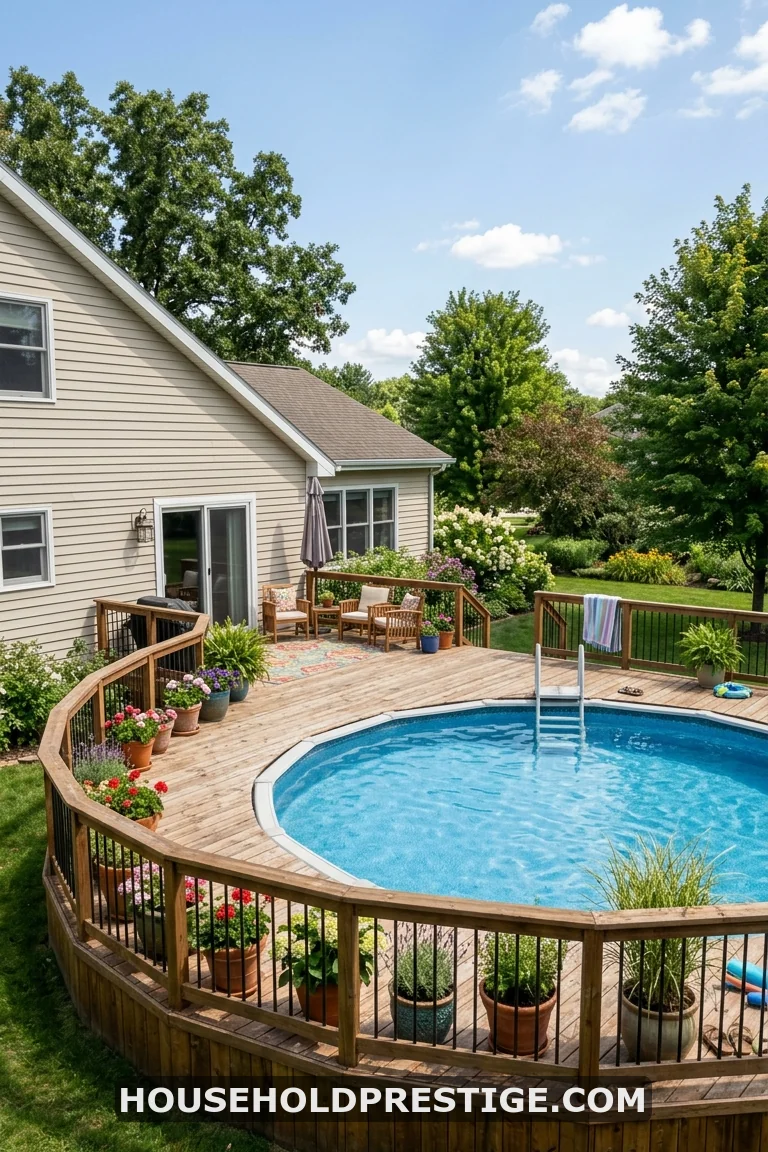
Run one arm of the L from the back door along the house wall. Run the other arm perpendicular to the pool. Total footprint: about 150 square feet. Cost: $1,200 to $2,500 in materials. The L-shape feels twice as big as a straight platform because it creates two distinct zones — one for walking, one for sitting.
4. Pergola-Covered Transition Deck
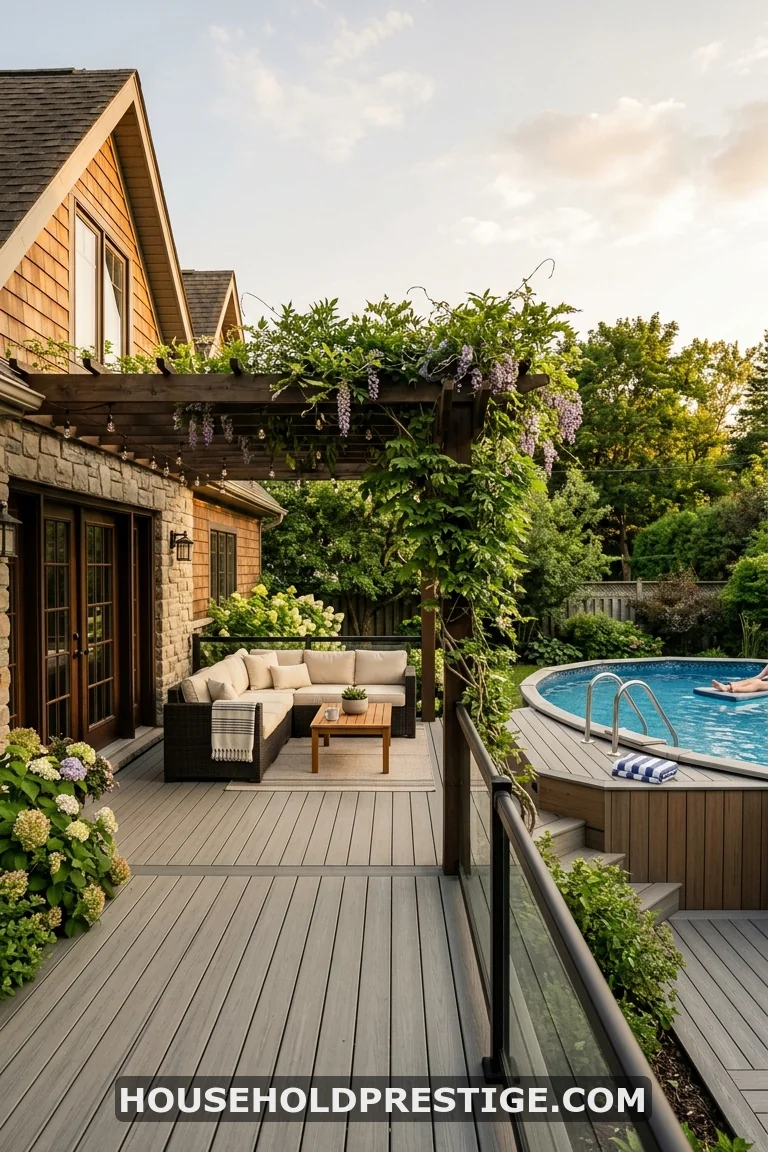
A pergola over the section nearest the house gives you shade right where you need it — close to the door, where you’re likely grilling or eating. The uncovered section near the pool stays open for sunbathing.
Size the pergola to cover about 60% of the deck area. A 10×12 foot pergola kit from a home center runs $1,200 to $3,500 depending on material (wood vs. aluminum vs. vinyl). Anchor the house-side posts to the deck frame and the outer posts to their own footings.
Climbing plants like jasmine or trumpet vine fill in over one growing season and cut sun exposure by another 40% to 60%. For instant shade, drape outdoor fabric panels from the crossbeams. IKEA’s DYNING shade canopies run about $15 each and hook right onto square pergola beams.
The key to this setup: make the pergola feel like a room extension, not an afterthought. Match the stain color to your house trim or deck boards. Keep the roofline low enough to feel cozy (8 feet at the lowest beam is plenty) but high enough to clear the tallest person in the house.
5. Narrow Catwalk Connector
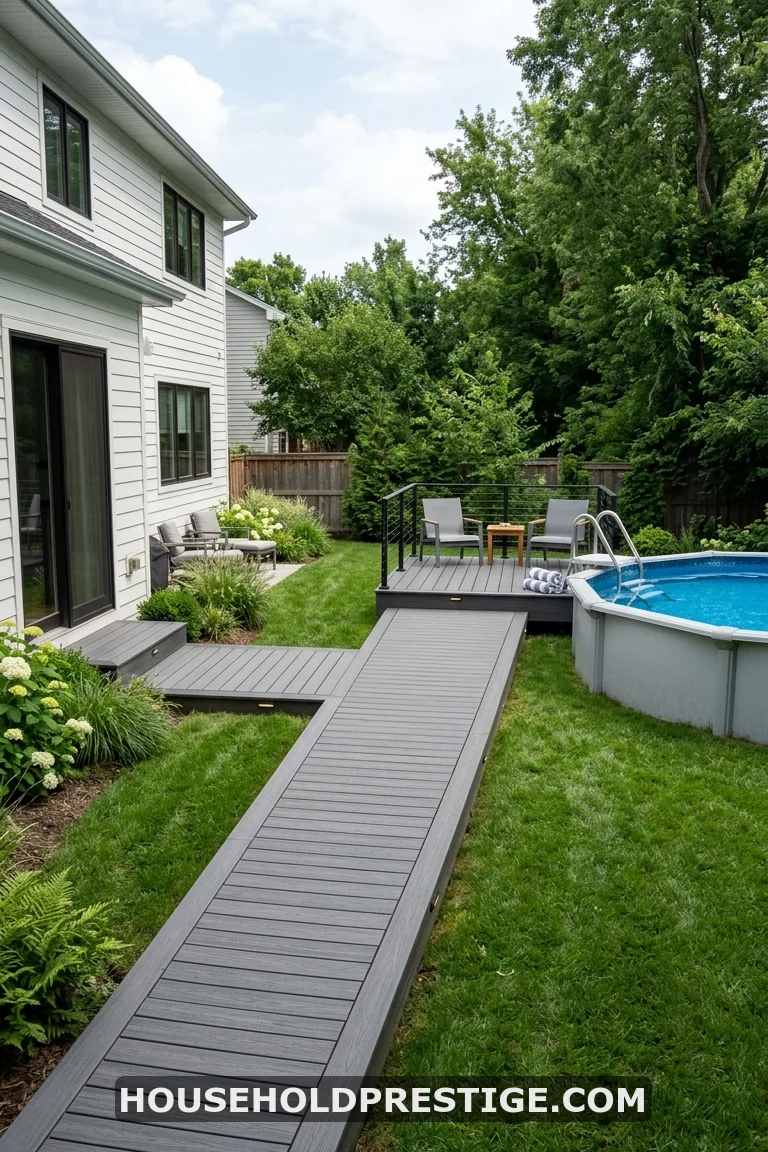
Three feet wide. That’s it. A catwalk-style deck connects the house to the pool without eating your whole yard. Add a 4×4 landing pad at the pool end for a towel hook and a pair of flip-flops. Materials for a 3×20 foot walkway: about $400 to $700 in pressure-treated lumber.
6. Privacy Screen Deck with Lattice Walls
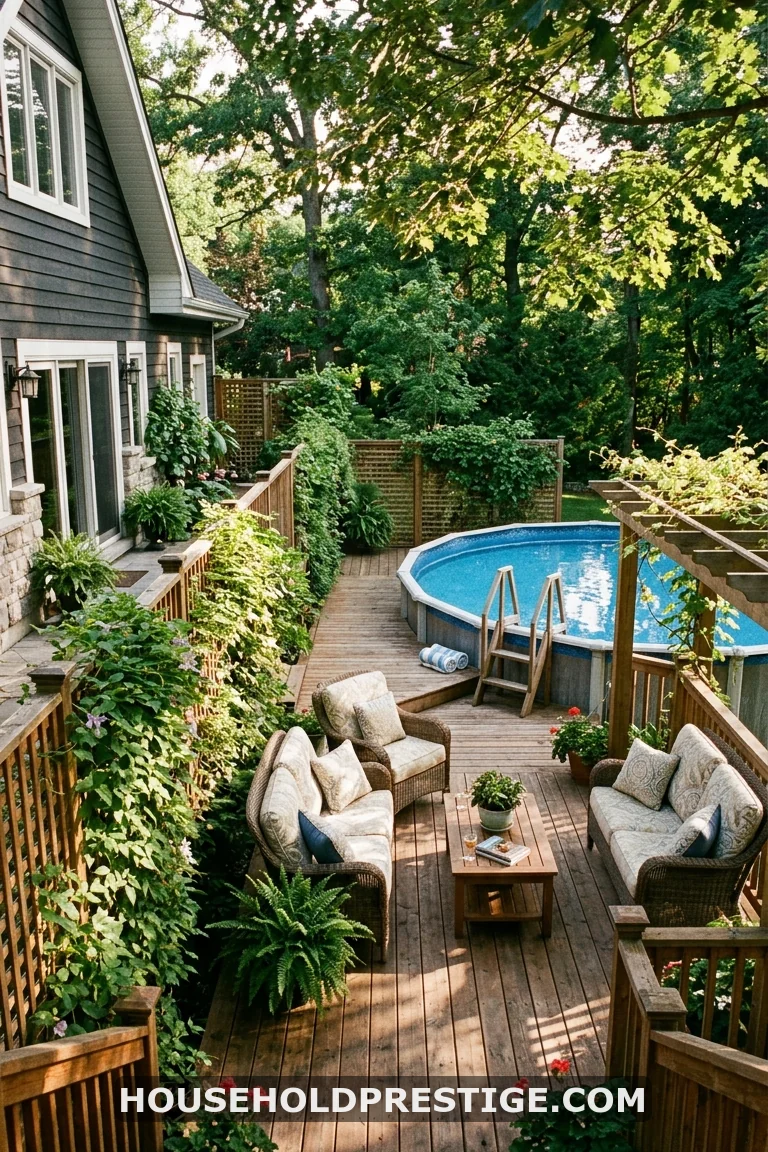
Neighbors can see everything when your deck sits 4 feet off the ground. Lattice panels fix that without making the space feel like a cage. Install 6-foot lattice sections along the sides facing neighboring properties. Leave the house side and pool side open.
Cedar lattice panels from a home center cost $30 to $60 per 4×8 sheet. Mount them to 4×4 posts sunk into the deck frame. For a cleaner look, cap the top edge with a 2×4 rail that doubles as a drink shelf.
Want more privacy without the lattice look? Bamboo reed fencing rolls out for about $1 per linear foot and zips onto existing railing posts. It lasts 3 to 5 years before needing replacement, which is long enough to decide if you want something permanent.
7. Semi-Recessed Pool with Flush House Deck
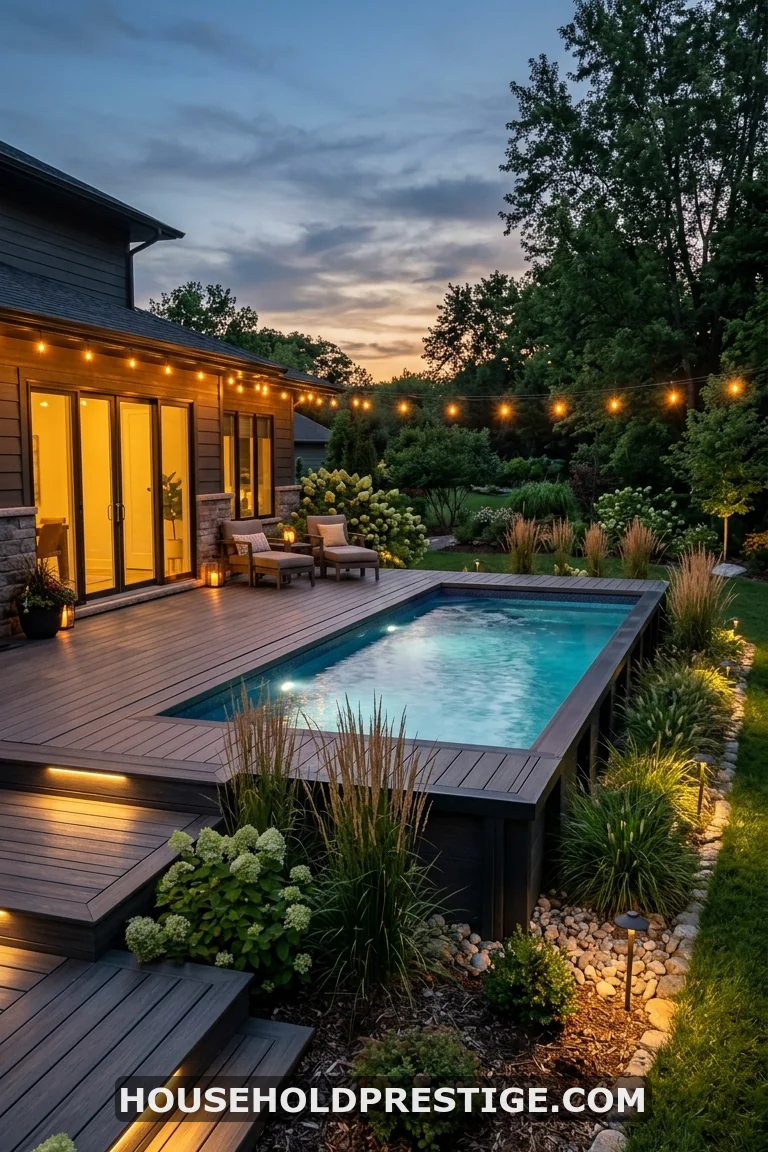
Bury the pool 18 to 24 inches into the ground. Build the deck at the same height as the pool’s top rail. The result: you walk out the door, cross the deck, and step directly into the water. No climbing a ladder. No feeling like you’re scaling a wall.
This setup requires excavation — either by hand (a brutal weekend) or with a small excavator rental ($250 to $400 per day). The pool manufacturer’s installation guide will specify the maximum burial depth. Most steel-wall above ground pools can be buried up to 24 inches without voiding the warranty. Resin-wall pools usually max out at 12 to 18 inches. Check your specific model before you dig.
Once the pool is partially buried, the deck height drops significantly. Instead of building up to 48–52 inches, you’re only building up to 24–30 inches. That means fewer footings, shorter posts, and a lower material cost. It also means the deck may not require a railing in some jurisdictions (decks under 30 inches above grade often get an exemption, but always verify with your local building department).
The connection to the house still requires a proper ledger board and flashing. Since the deck sits lower, you’ll likely need one or two steps down from the door threshold to the deck surface. Build wide, shallow steps (36 inches wide minimum, 7-inch rise) for a gradual transition that feels like a patio step, not a staircase.
Drainage matters more here than on any other design. Water needs to flow away from both the house foundation and the pool wall. Grade the surrounding soil to slope at least ¼ inch per foot away from both structures. A French drain along the pool perimeter handles the rest.
8. Myth vs. Reality: “You Can’t Attach a Pool Deck to Your House”
You’ll hear this on forums constantly. “Above ground pool decks must be freestanding.” “Never attach a deck to your house if it goes to a pool.” People repeat it like gospel.
Here’s what holds up under scrutiny: the pool itself should never bear structural load from the deck. That part is correct. Above ground pool walls are not load-bearing — lean a deck against one and it’ll buckle, bow, or collapse.
But attaching the house-side of the deck to your house? That’s standard residential construction. A properly installed ledger board — lagged or through-bolted into the rim joist, with self-adhesive membrane flashing behind it and metal drip-edge flashing over it — is how millions of decks in the country are built. The International Residential Code (IRC Section R507.2) covers exactly how to do this.
The real issue that trips people up is the pool-access code. When a deck provides a direct walking path from the house interior to the pool, most municipalities require a self-closing, self-latching gate between the two. The gate must open outward (away from the pool), the latch must be at least 54 inches above the deck surface, and the gap below the gate can’t exceed 4 inches. Some areas also require a pool alarm on the house door that opens onto the deck.
So you can absolutely attach your deck to the house. You just need to follow the flashing specs, the fastener schedule, and the pool-barrier code. None of that is particularly difficult — it just requires attention to detail. Call your local building department before you break ground. A 10-minute conversation saves months of headaches.
9. Matching Composite Deck and House Trim
Pick a composite deck color that matches your house trim. Trex’s “Clam Shell” pairs with gray siding. TimberTech’s “Pecan” works with warm brown trim. This one detail — color matching — makes the deck look like it was built with the house, not bolted on later.
10. Deck with Poolside Bar Counter
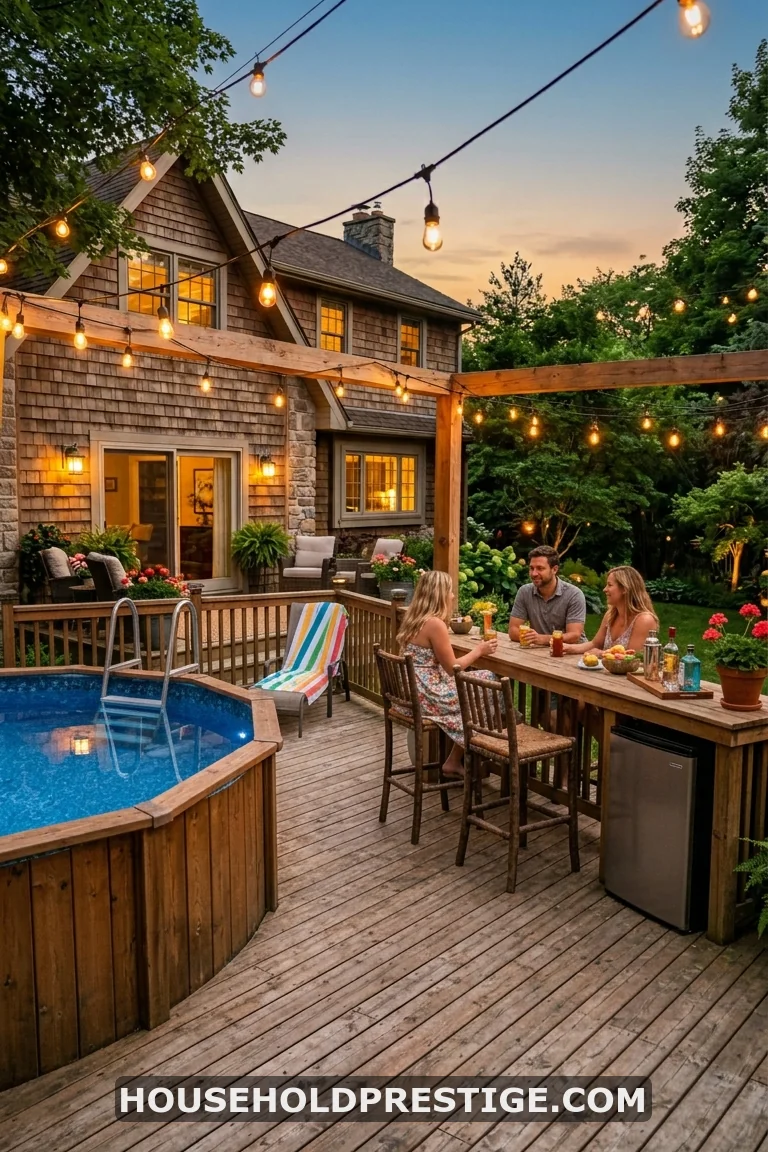
A 2-foot-deep bar counter runs along the pool-facing edge of the deck. It’s just a cantilevered 2×12 plank (or a composite board with a routed edge) supported by angle brackets every 3 feet.
Height matters. Set the counter at 42 inches — standard bar height — so standard bar stools work. The counter faces the pool, which means the people sitting there can watch the kids swim while holding a drink that isn’t on the ground waiting to get kicked over.
Underneath the counter, mount a small hooks board for towels. Next to the counter, a compact outdoor mini-fridge (Danby’s 1.6 cu ft unit runs about $130) keeps drinks cold without trips inside. Total add-on cost for the bar counter, stools, and fridge: $400 to $800.
11. Sloped-Yard Deck with Stepped Foundation
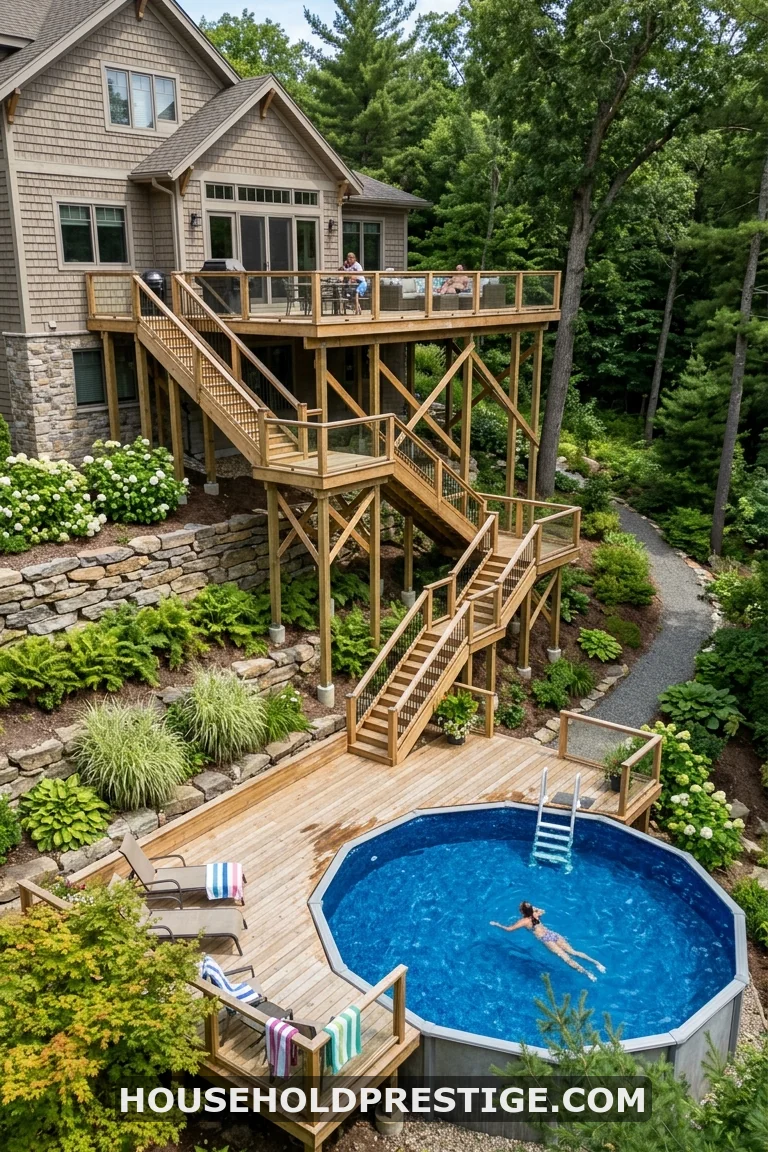
Slopes kill most above ground pool plans. The pool needs level ground, but the house sits at the high point. This design uses the slope instead of fighting it.
Build the deck at the house’s door height and let it cantilever or step down toward the pool. The support posts on the downhill side will be taller — sometimes 6 to 8 feet — which means deeper footings and beefier posts (6×6 minimum, not 4×4). On the uphill side near the house, the posts might only be 12 inches.
The pool goes on a leveled pad at the base of the slope. A retaining wall (concrete block, natural stone, or timber) holds back the hillside between the deck and the pool area. The retaining wall does double duty: it stops erosion and creates a visual anchor that makes the whole setup look intentional.
Cost is higher than a flat-yard build. Expect to add $2,000 to $5,000 for the retaining wall alone, depending on height and material. Professional grading for the pool pad adds another $500 to $1,500. But a sloped yard with a well-built tiered deck and retaining wall looks more expensive than it is. Guests will assume you spent twice what you did.
One critical note: on slopes steeper than 4:1 (a 1-foot drop for every 4 feet of run), consult a structural engineer for the deck design. The lateral forces on the posts increase significantly on steep grades, and standard span tables may not apply.
12. Hidden Storage Deck Boxes
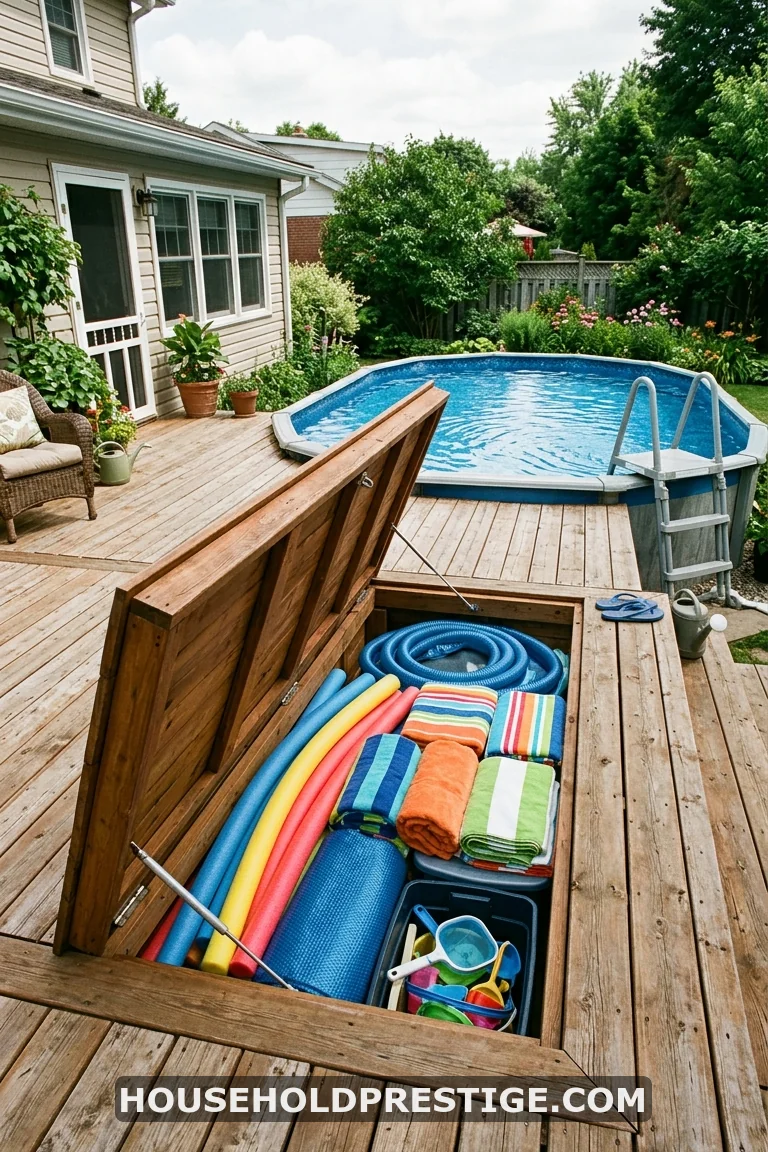
Hinge a 3×3 section of the deck boards to create a flip-up lid. Underneath, mount a waterproof bin for pool noodles, floats, and chemicals. Zero clutter on the deck surface. Total cost for hinges, a gas strut, and a storage bin: about $60.
13. Fire Pit Lounge Extension
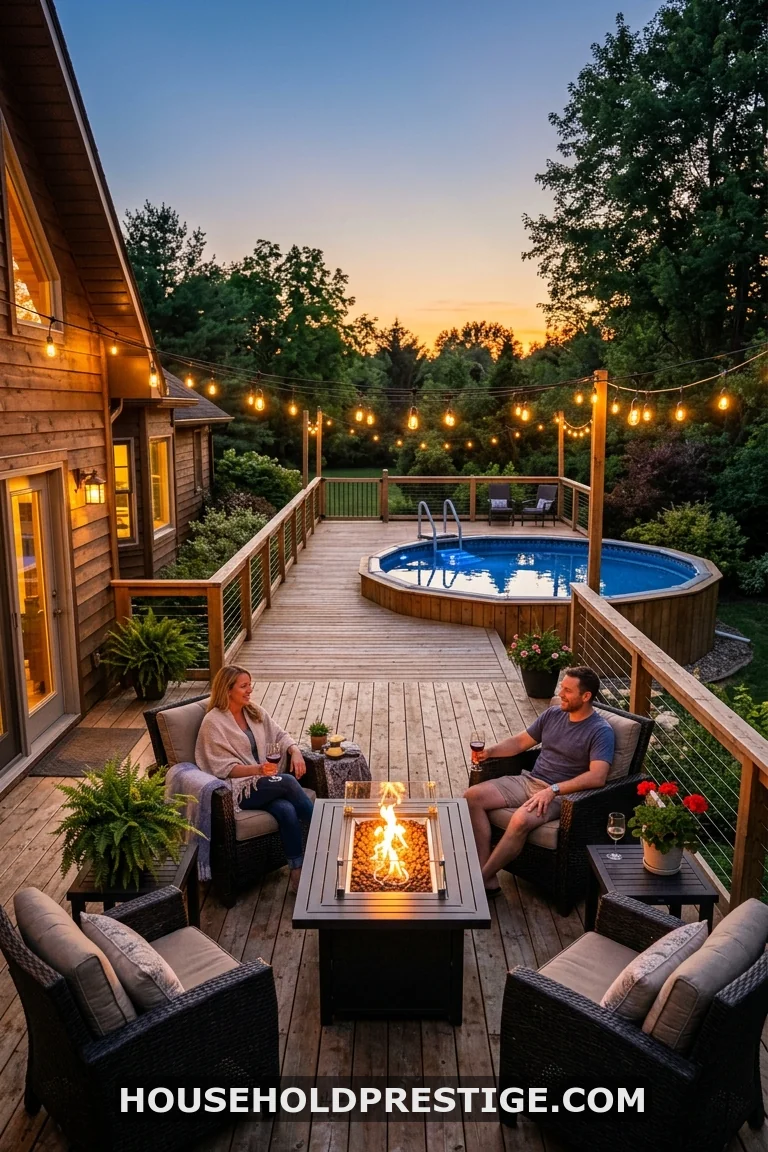
Extend the deck 6 feet past where it needs to end for pool access. That extra section becomes a fire pit lounge. A propane fire pit table ($200 to $600 from Wayfair or Amazon) sits on the deck surface without any permanent installation.
Keep the fire pit at least 10 feet from the pool wall and 10 feet from the house. Check your local fire code — some municipalities require a permit even for portable propane fire features on elevated decks. Composite decking can handle the radiant heat from a propane table, but place a fire-rated pad underneath ($30 to $50) for peace of mind.
This zone gets used from April through November. The pool alone is a June-through-September feature. The fire pit extends the season by two months on each end.
14. Two-Tone Deck with Picture-Frame Border
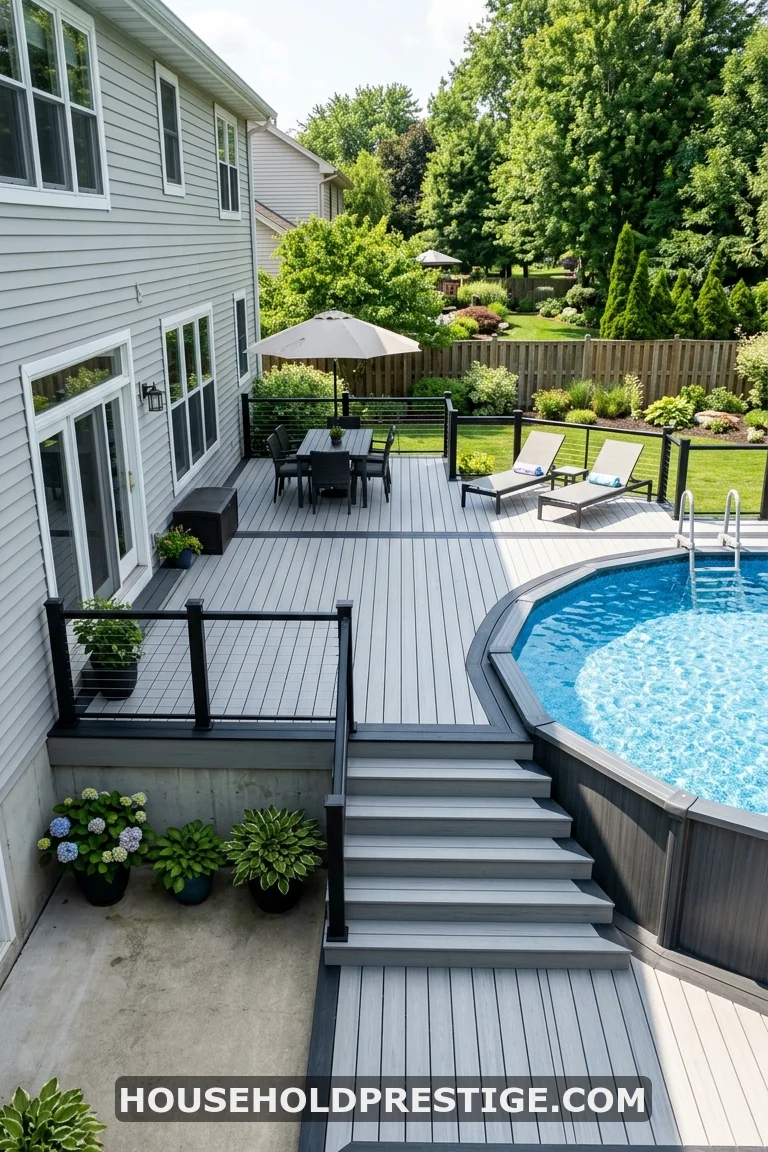
Run your main deck boards in one color. Frame the perimeter with a contrasting shade — dark border on a light field, or vice versa. The “picture frame” treatment costs one extra box of decking ($80 to $150) and makes a standard rectangle look custom.
15. Covered Breezeway with Outdoor Curtains
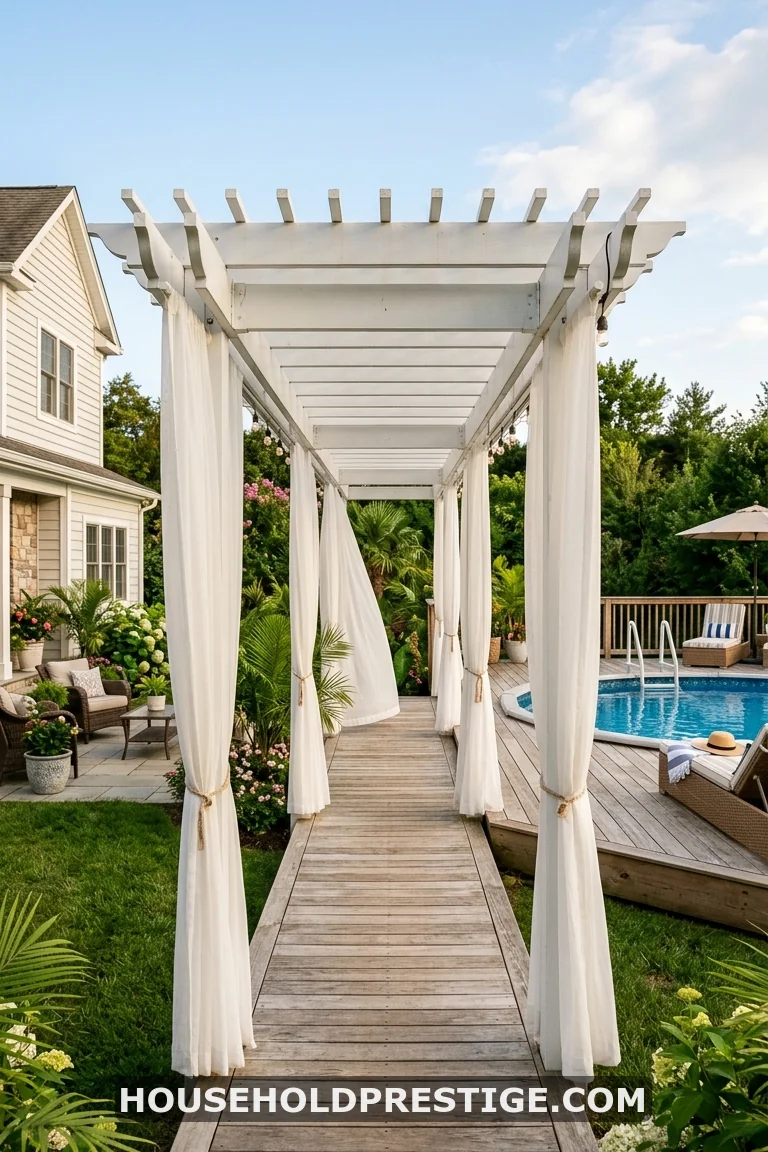
A simple roof structure (four posts, two beams, corrugated polycarbonate panels on top) creates a covered walkway from the house to the pool. It keeps you dry on rainy days and shaded on hot ones.
Hang outdoor curtains from curtain rods mounted under the beams. Sheer white panels from IKEA’s outdoor line run about $12 per panel. They billow in the breeze and make the space feel like a coastal resort. Tie them back with rope or jute for a nautical touch.
The polycarbonate roof panels (Suntuf brand, available at Home Depot) cost about $26 per 8-foot sheet and let light through while blocking rain and UV. A 4×16 foot breezeway needs about 8 sheets. Total structure cost with posts, beams, panels, and curtains: $600 to $1,200 DIY.
16. Integrated LED Deck Lighting
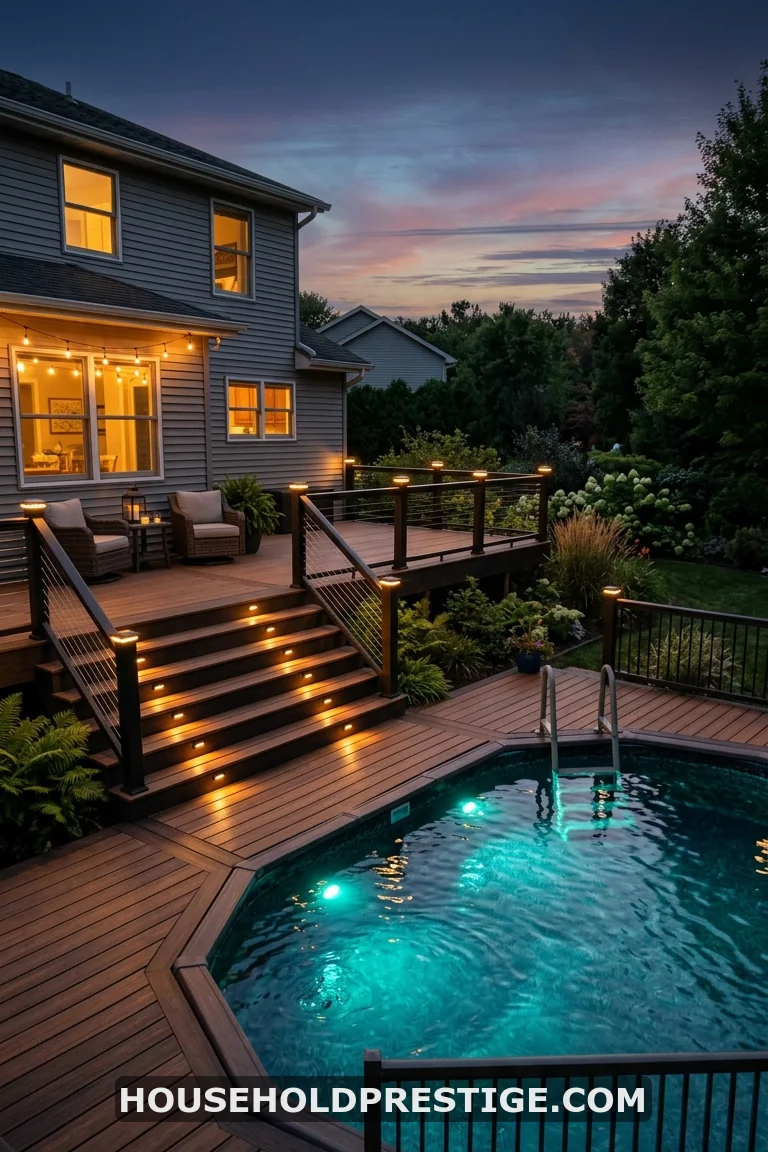
Lighting does more work per dollar than almost any other deck upgrade. Three layers make the difference between “deck with lights” and “wow.”
Layer 1: Step risers. Recessed LED stair lights ($8 to $15 each) install into the vertical face of each step. They light the walking path without shining in your eyes. You need one per 4 feet of step width.
Layer 2: Post caps. Solar-powered post cap lights ($15 to $30 per cap) sit on top of railing posts and glow all night with zero wiring. They create the ambient perimeter light that makes the deck feel defined after dark.
Layer 3: Pool-edge uplights. Waterproof LED strip lights ($20 to $40 for a 16-foot roll) mount under the deck edge facing the pool. The light bounces off the water and reflects back onto the deck surface. This single detail makes a $3,000 deck look like a $15,000 installation.
All three layers cost $150 to $300 total for a mid-sized deck. Most are low-voltage and connect to a single transformer plugged into an outdoor GFCI outlet.
17. Stock Tank Pool on a Minimalist House Deck
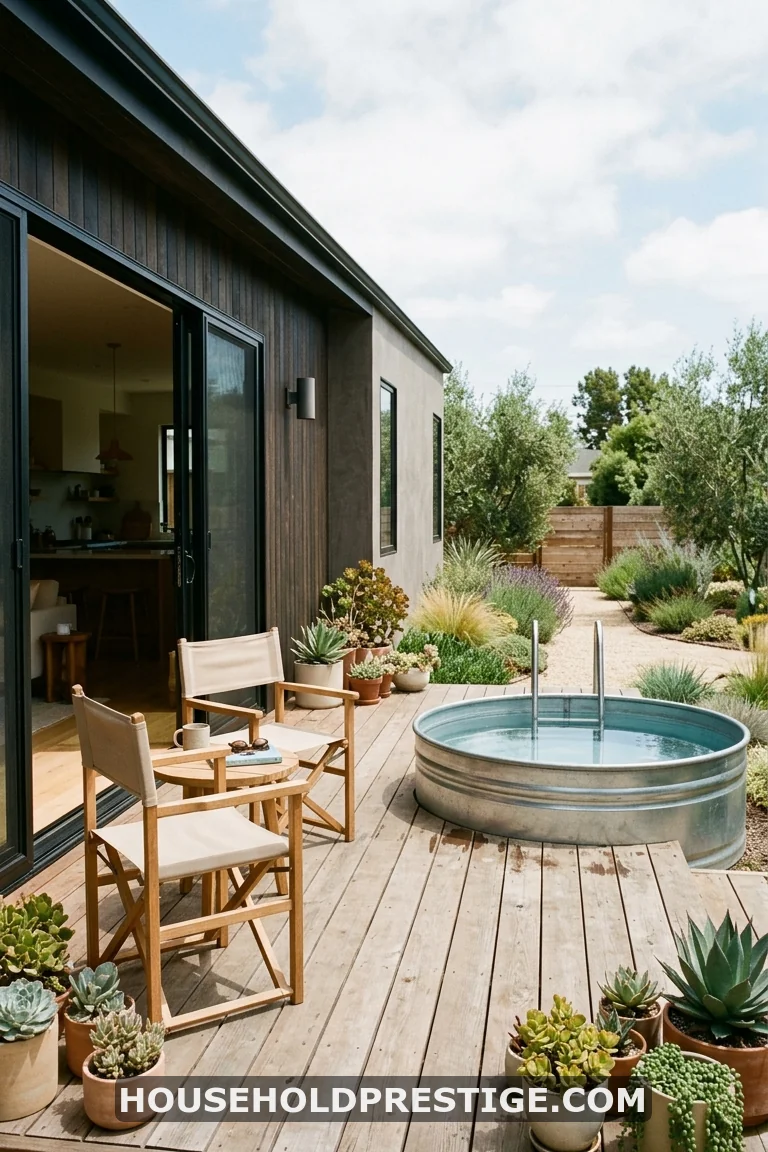
An 8-foot Tarter galvanized stock tank ($400 to $600) on a reinforced deck section gives you a plunge pool without any of the above ground pool infrastructure. The deck only needs to be 10×12 feet. Keep the design minimal: two chairs, a side table, done.
18. A Cautionary Tale: The Deck That Wrecked the Siding
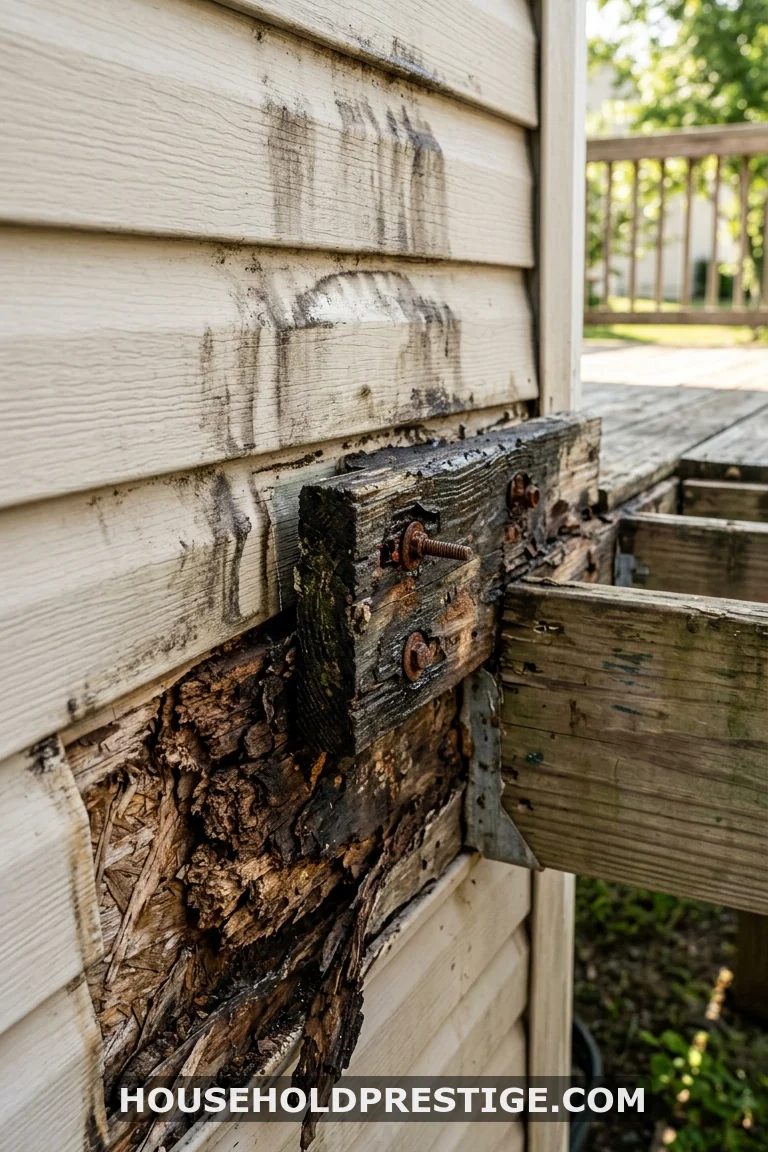
A friend of mine built a gorgeous deck from her back door to a 24-foot round pool. Cedar boards. Stainless steel screws. Professional-grade railing. It looked magazine-ready. She skipped one thing: proper ledger board flashing.
Two years later, she noticed a soft spot in the wall inside her laundry room — the room directly behind where the deck attached. A contractor opened it up and found black mold running 6 feet up the interior wall. Water had been funneling behind the ledger board, soaking the rim joist and the bottom plate of the wall framing. The rim joist was spongy. The subfloor was sagging.
Repair cost: $14,200. That included mold remediation, rim joist replacement, subfloor repair, new siding, and re-attaching the deck with proper flashing. The deck itself was fine. The house was not.
The fix that would have prevented all of it? A $45 roll of self-adhesive membrane (like Grace Vycor Plus) applied behind the ledger board before installation, plus a $12 piece of metal drip-edge flashing over the top. Total prevention cost: under $60. Total repair cost: $14,200. The math speaks for itself.
If you’re building a deck off your house — for a pool or anything else — get the flashing right. It’s the least glamorous part of the project and the most important one.
19. Full-Surround Deck with Gated Pool Entry
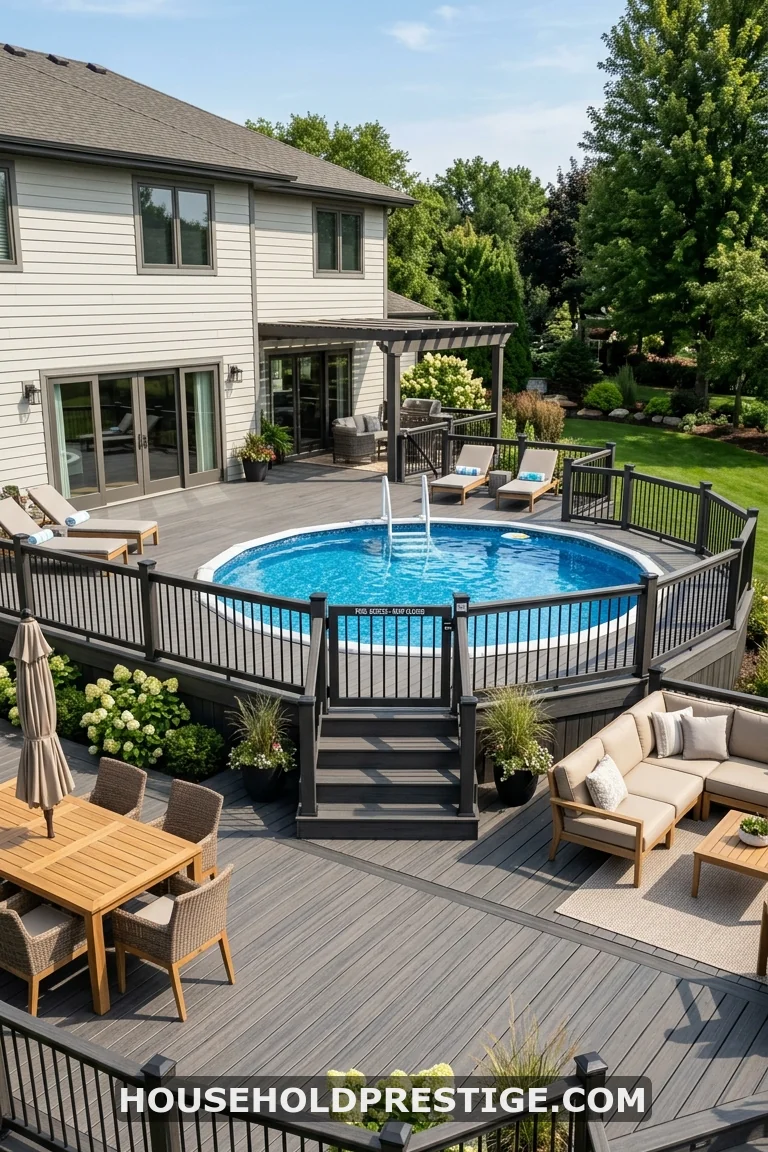
The deck starts at the house, wraps around the pool on all sides, and ends back at the house. It’s the most material-intensive option but creates the most usable space. You get 360-degree pool access, room for furniture on every side, and a setup that makes the pool look like it was built into the ground.
The wraparound design requires careful planning around the pool’s equipment. Leave a 3-foot access panel (removable deck section or hinged hatch) near the pump and filter location. You’ll need to reach the skimmer, the pump basket, and the return jets for maintenance. Builders who forget this end up ripping out deck boards every time they need to backwash the filter.
Code compliance is stricter with a full surround. Since the deck completely encircles the pool, the perimeter railing effectively becomes the pool fence. Balusters must be spaced 4 inches apart (maximum). The gate between the house and the pool area must self-close, self-latch, and open outward. Latch height: 54 inches from the deck surface. Some municipalities also require a door alarm on the house door that opens onto the deck.
Material quantity for a full surround on a 24-foot round pool: roughly 800 to 1,000 square feet of decking, plus railings on the full perimeter. Budget $6,000 to $12,000 in materials for composite, or $3,000 to $5,000 for pressure-treated lumber.
20. Floating Deck Island with Bridge Connector
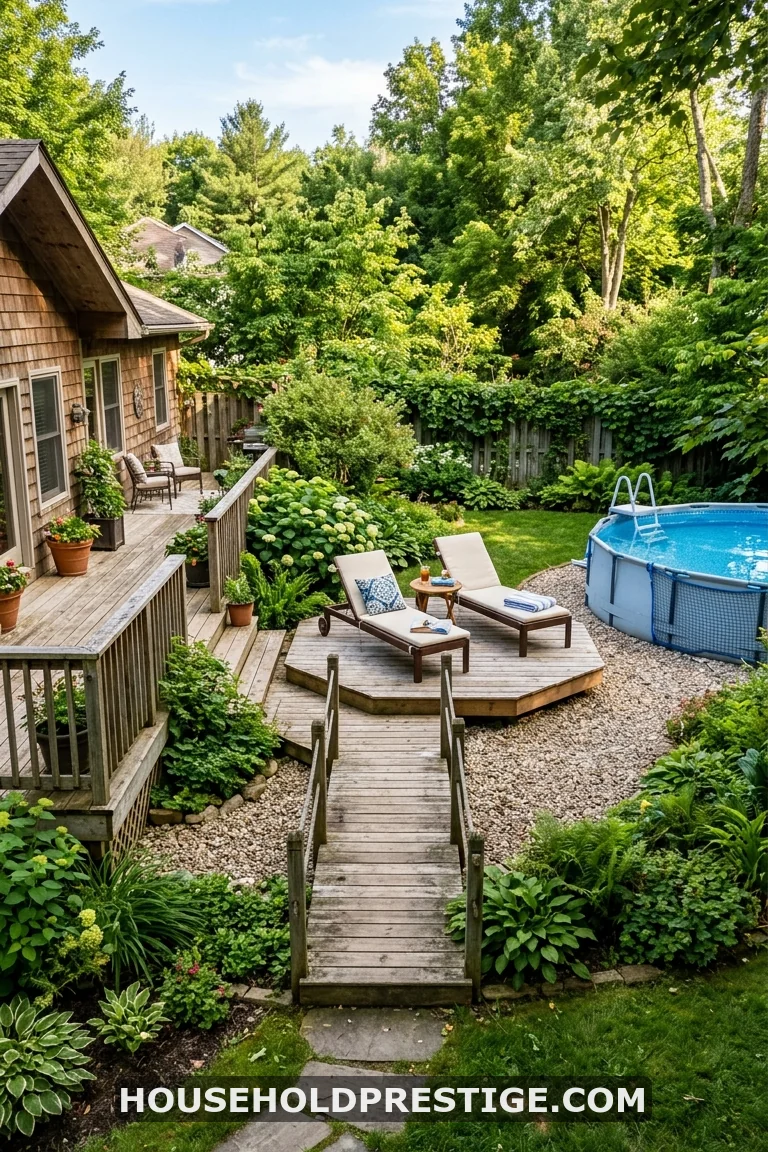
Build a small freestanding deck (8×8 or 10×10) next to the pool. Connect it to the house deck with a narrow bridge — literally a 3-foot-wide walkway with railings on both sides.
The “bridge” creates a sense of journey. You leave the house, cross the bridge, arrive at the pool island. It sounds dramatic, but the visual effect is real. The separation makes the pool area feel like a distinct destination, not just the far end of a big deck.
The island deck sits on concrete deck blocks ($7 each at Home Depot, no digging required) and doesn’t need footings if it stays under 30 inches above grade. The bridge connects the two structures with simple joist hangers. Total add-on cost beyond a standard house deck: $600 to $1,500 for the island and bridge.
21. Deck with Built-In Planter Walls and Bench Seating
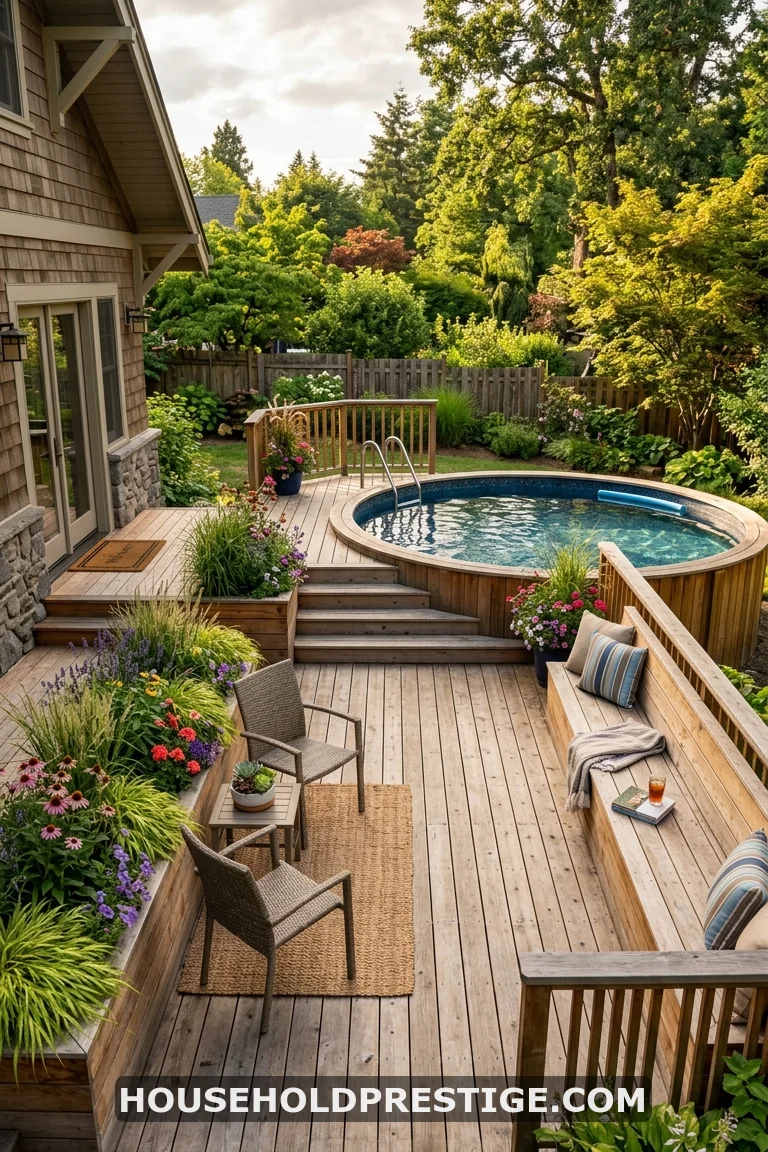
Planter walls serve three purposes: they add greenery, create soft boundaries, and block wind. Build them 18 inches wide and 24 inches tall along the deck edges that don’t face the pool. Fill with ornamental grasses (Karl Foerster feather reed grass grows tall and thin — $12 to $18 per gallon pot) for year-round structure.
On the opposite edge, a built-in bench runs parallel to the pool. Build it 18 inches deep and 18 inches high — standard bench dimensions. The seat doubles as a storage box if you hinge the top and line the interior with a moisture barrier.
The combination of planters on one side and bench seating on the other creates a corridor effect that funnels attention toward the pool. It’s a design trick borrowed from resort landscaping: frame the view, and the view gets better.
Material cost for 16 linear feet of planter boxes and 12 feet of bench seating: $300 to $600 in lumber and hardware. Plants add another $100 to $250, depending on how dense you go.
Frequently Asked Questions
Do I need a permit to build a deck off my house to an above-ground pool?
In most municipalities, yes. Any deck attached to a house requires a building permit because it involves a structural connection to the home (the ledger board). The permit process typically includes a site plan, a footing inspection, and a final inspection. Expect to pay $200 to $500 for the permit itself. The pool may also trigger separate fencing and barrier requirements under your local pool code. Call your building department before you buy materials — a 10-minute phone call can save you from fines or forced rebuilds.
Can I attach the deck directly to my above-ground pool?
No. Above-ground pool walls are not designed to bear structural loads from a deck. Attaching a deck to the pool can cause the wall to buckle, bow, or collapse. Instead, build the deck as a freestanding structure (supported by its own footings and posts) or attach it to your house via a ledger board. Leave a ¾-inch gap between the deck edge and the pool wall to allow for seasonal expansion and to prevent pressure on the pool structure.
What decking material is best for a pool deck connected to the house?
Composite decking (Trex, TimberTech, Fiberon) is the most popular choice for pool decks because it resists moisture, won’t splinter under bare feet, and doesn’t need annual sealing. It costs $8 to $14 per square foot for materials. Pressure-treated lumber is the budget option at $2 to $4 per square foot, but it requires annual sealing and can splinter over time. For the area directly adjacent to the house, composite or PVC decking is worth the investment since moisture damage at the house connection point is the most expensive repair you’d face.
How far should the deck be from the above-ground pool wall?
Maintain a minimum ¾-inch gap between the deck surface and the pool wall. This gap allows for expansion and contraction of both structures and prevents the deck from pushing against the pool. For the deck frame (joists and beams), keep a minimum clearance of 1 to 2 inches from the pool wall. The deck should never rest on, lean against, or attach to the pool in any way.
How much does it cost to build a deck from the house to an above-ground pool?
A basic 150-square-foot pressure-treated platform deck with a simple railing runs $1,500 to $3,000 in materials for a DIY build. A 400-square-foot multi-level composite deck with lighting, built-in seating, and professional installation ranges from $8,000 to $18,000. The biggest cost variables are the decking material (composite vs. wood), the deck height (taller decks need more post and footing material), and whether you DIY or hire a contractor. Professional labor typically adds $15 to $35 per square foot.