

You know that little shimmy you do before you climb the ladder that came with your above-ground pool? The one where you test it first, grip both sides, and sort of hold your breath? Yeah. Same. I did that for two whole summers before I finally snapped and started hunting for real above-ground pool steps ideas that looked good AND didn’t feel like a lawsuit waiting to happen.
The good news? There are options for every budget, every yard size, and every skill level — whether you want a full wood deck staircase or just a quick, cheap fix that buys you a season while you plan something bigger. Let’s get into it.
1. The Pallet Step Platform
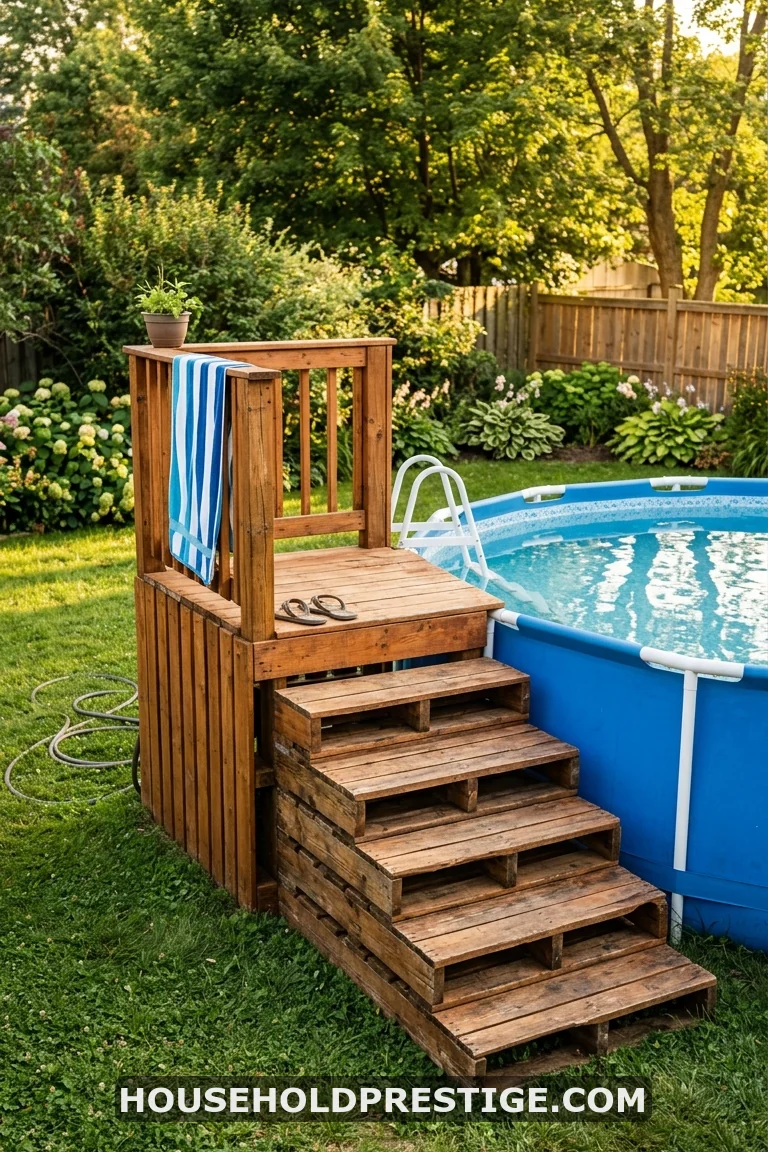
This is the budget move that still looks intentional. Find three or four standard 48″ × 40″ shipping pallets on Facebook Marketplace (most go free or $5 each), stack them into a staircase configuration, and reinforce with 2×4 cross-bracing underneath.
The key is the finish. Raw pallets look rough. Sand them down, apply two coats of outdoor wood stain — something like Cabot Australian Timber Oil in Honey Teak runs about $35 a quart and soaks right in — and the whole thing reads like a custom wood entry. Seal with a waterproof topcoat and add strips of 3M Safety-Walk non-slip tape (about $12 a roll) to each tread.
Total cost: $15–$60 depending on pallet source and stain. This works best for pools 48 inches or under. Anything taller needs a more structural solution — more on that below.
What most people skip: Leveling the base. Dig out a flat spot and lay pavers or compactable gravel underneath. A rocking pallet staircase defeats the whole purpose.
2. Wedding Cake In-Pool Steps
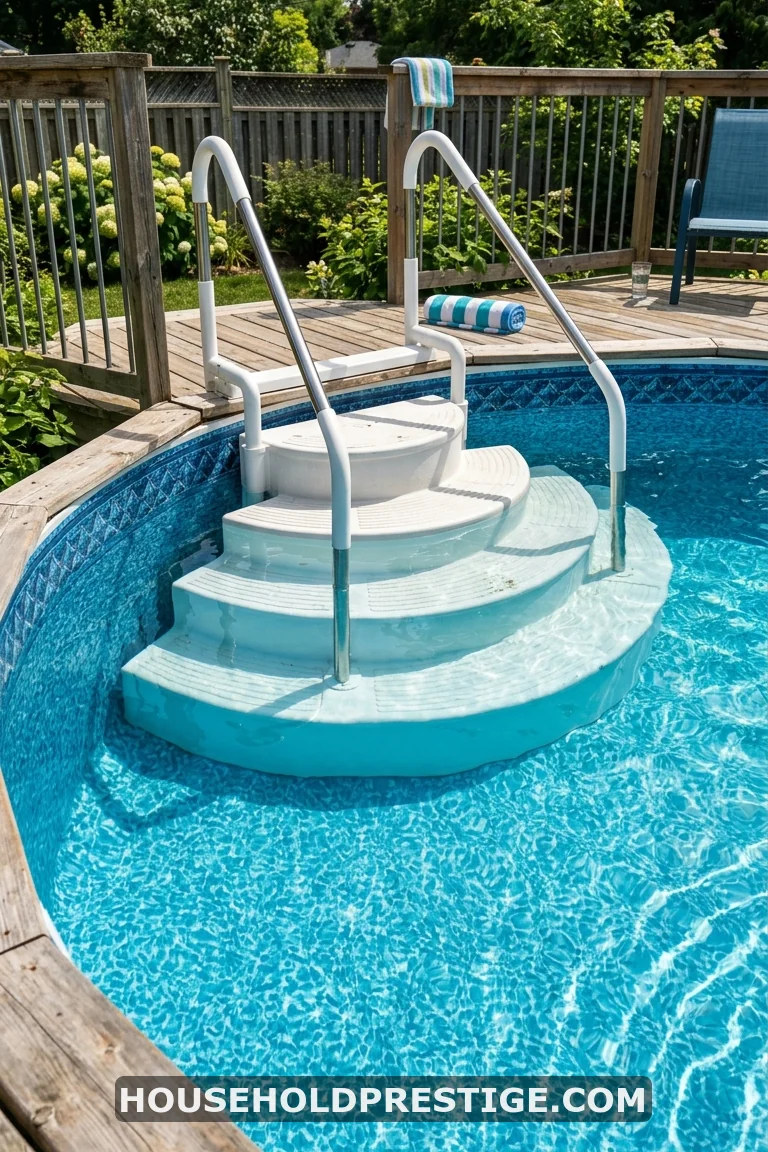
If you don’t have a deck and don’t want to build external stairs right now, in-pool steps are the fastest solution. These sit inside the pool itself, weighted down with sand bags, and they give you a safe, gradual entry that feels nothing like the side-mount ladder.
The Confer Plastics 7200 A-Frame is the most widely recommended model — it straddles both sides of the pool wall, weighs about 40 lbs empty, and holds up to 300 lbs. You fill the hollow sections with sand (about 100 lbs total) and it locks in place. Current price: $120–$160 on most retail sites.
For a wider, true “wedding cake” style with two interior steps, the Confer Plastics CCX-AG or Blue Wave 8000 series are solid choices in the $180–$250 range. These work best in pools 48–54 inches deep.
The one thing nobody mentions: Remove and store these every fall before closing the pool. Sand-filled steps left under a winter cover can damage the liner when ice forms around them. A 20-minute removal job in October saves a $300+ liner replacement in spring.
3. Build Your Own Wood Platform Staircase
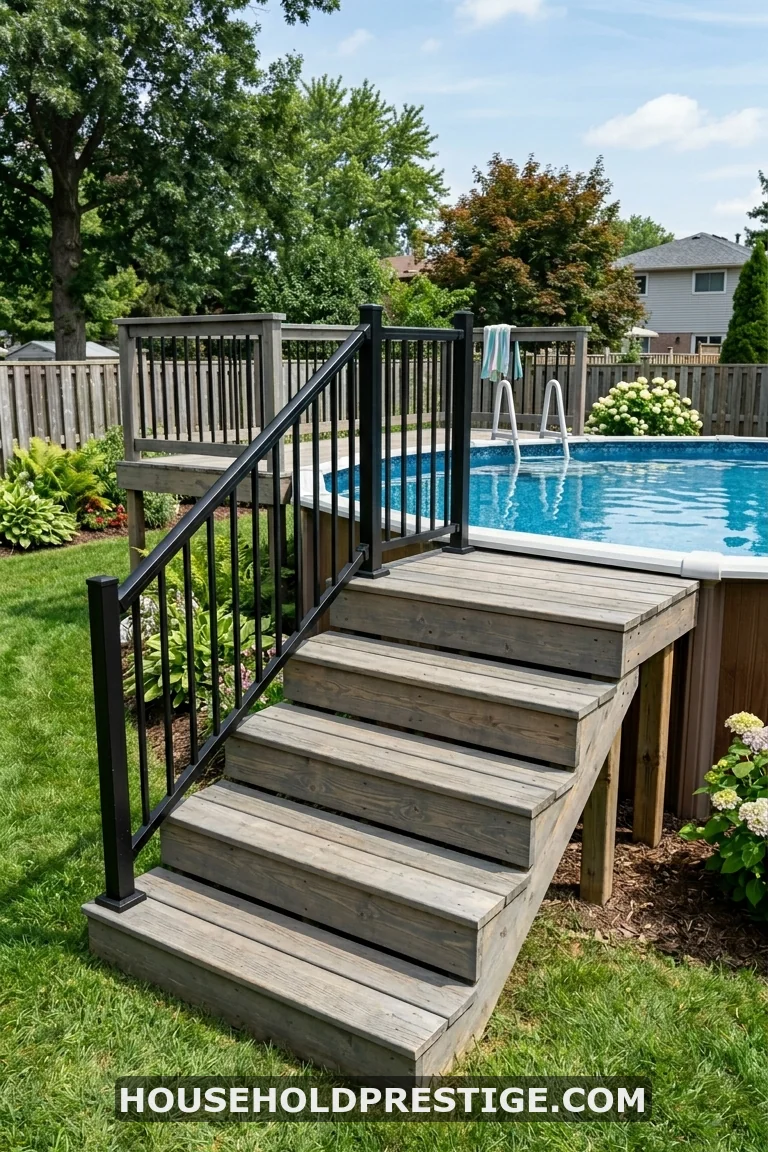
This is the move that changes how your pool looks from across the yard. A custom wood platform staircase replaces the side-mount ladder entirely, gives you a real entry point, and makes your pool look like it belongs there. It’s a weekend project — one long Saturday for the frame, a few hours Sunday to finish the treads and rails.
Here’s how to build it properly.
Why This Works
A freestanding staircase doesn’t attach to the pool wall at all. It leans against the top rail or rests against a stabilizer bar, so zero stress goes through the pool structure itself. This matters for pool longevity and warranty compliance.
The ideal spec for most above ground pools: 6 steps, each 40 inches wide, rising approximately 7 inches per step, with a landing platform at the top that sits flush with the pool deck rail. If your pool is 48 inches tall, that’s a staircase with a total rise of about 48 inches — meaning each step rises 8 inches, which is still within comfortable stair ergonomics.
Materials List and Costs
| Item | Quantity | Approximate Cost |
|---|---|---|
| 2×8 pressure-treated lumber (step treads) | 6 boards, 10 ft each | $90–$110 |
| 2×10 pressure-treated lumber (stringers) | 4 boards, 8 ft each | $80–$100 |
| 4×4 pressure-treated posts (frame legs) | 4 posts, 8 ft | $60–$75 |
| Galvanized deck screws (3″ and 1-5/8″) | 2 lbs each | $20 |
| Carriage bolts, nuts, washers | 20 pieces | $15 |
| Concrete deck blocks | 4 | $25 |
| 3M Safety-Walk non-slip tape (2″ wide) | 2 rolls | $24 |
| Exterior wood stain or sealant | 1 gallon | $35–$50 |
| Metal post cap connectors | 8 | $30 |
| Total | $379–$449 |
Optional: Add a single galvanized steel handrail kit on one side for another $60–$90. Worth every cent if you have kids or older relatives using the pool.
Step-by-Step Build Process
Step 1 — Plan and measure. Measure the distance from the ground to the top of your pool rail. That’s your total rise. Divide by 7–8 inches to get your step count (most pools land between 5 and 7 steps). Your width should be at least 36 inches, but 40 inches feels substantially more comfortable and allows two people to use the stairs at the same time.
Step 2 — Cut the stringers. Stringers are the angled side boards that support each tread. Use a framing square set to your rise and run measurements and mark each notch. Cut with a circular saw. You’ll cut two identical stringers — triple-check they match before moving on. A mismatch means uneven steps.
Step 3 — Build the base frame. Set four concrete deck blocks on level ground in a rectangular configuration matching your stair width and depth. Place 4×4 posts upright on each block and connect them with 2×4 horizontal rails top and bottom. Check level in all directions. This frame carries the entire load.
Step 4 — Attach the stringers. Bolt the two stringers to the top of the frame on both sides using carriage bolts. This is a two-person job — one person holds, one person drills.
Step 5 — Install the treads. Cut 2×8 boards to your width (40 inches), sand the edges smooth, and screw each tread to the notched stringer positions with 3-inch deck screws. Leave a 1/4-inch gap between tread boards for drainage.
Step 6 — Build the platform landing. At the top of the staircase, frame out a small platform (at minimum 24×30 inches) that rests flush against your pool wall. Add decking boards and secure with deck screws.
Step 7 — Finish and seal. Sand all surfaces, wipe clean, and apply two coats of exterior stain or sealant. Let dry 24 hours between coats, 48 hours before use.
Step 8 — Add anti-slip tape. Run 3M Safety-Walk tape the full width of each tread, especially on the front edge. Wet pool steps are dangerous without it.
Common Mistakes to Avoid
- Skipping the concrete blocks. Pressure-treated lumber sitting directly on soil will rot in 2–3 seasons. The $25 for deck blocks is non-negotiable.
- Using standard lumber instead of pressure-treated. Regular pine goes gray and soft within one summer of wet pool contact. Always specify “PT” at the lumber yard.
- Skipping the carriage bolts. Screws alone won’t hold a stringer under load. Bolt everything structural.
- Making the platform too small. A 12-inch square landing at the top is terrifying to stand on. Minimum 24×24 inches; 30×30 is better.
Pro Move
Install the platform landing slightly lower than the pool rail so it tucks under. This removes the gap people tend to step over awkwardly and makes the whole entry feel seamless.
4. The Outdoor Carpet Cover-Up
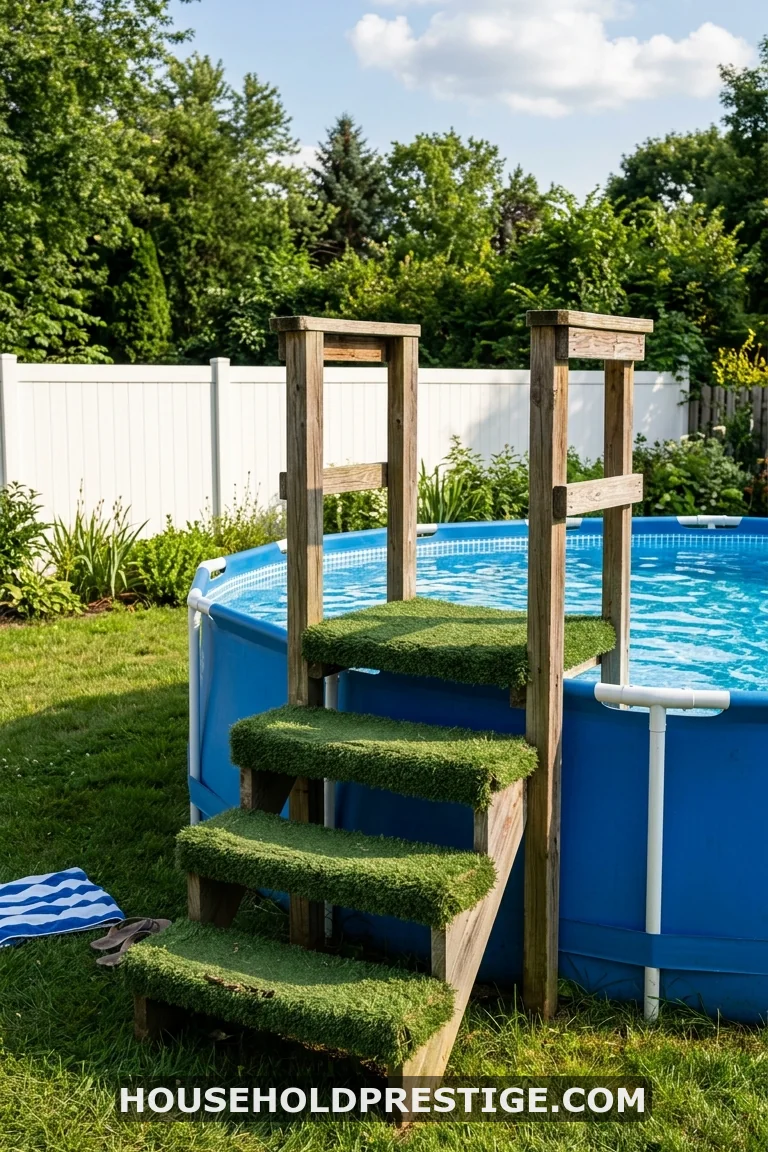
Buy a $15 roll of outdoor carpet remnant, cut it to fit your existing steps, and staple gun the whole thing down. Trim edges with an aluminum carpet strip. Instant non-slip grip, instant color, instant upgrade. Your basic step ladder goes from an eyesore to something that looks considered. Total time: 25 minutes. Total cost: under $25.
5. Partial Deck Entry with Steps Off the House
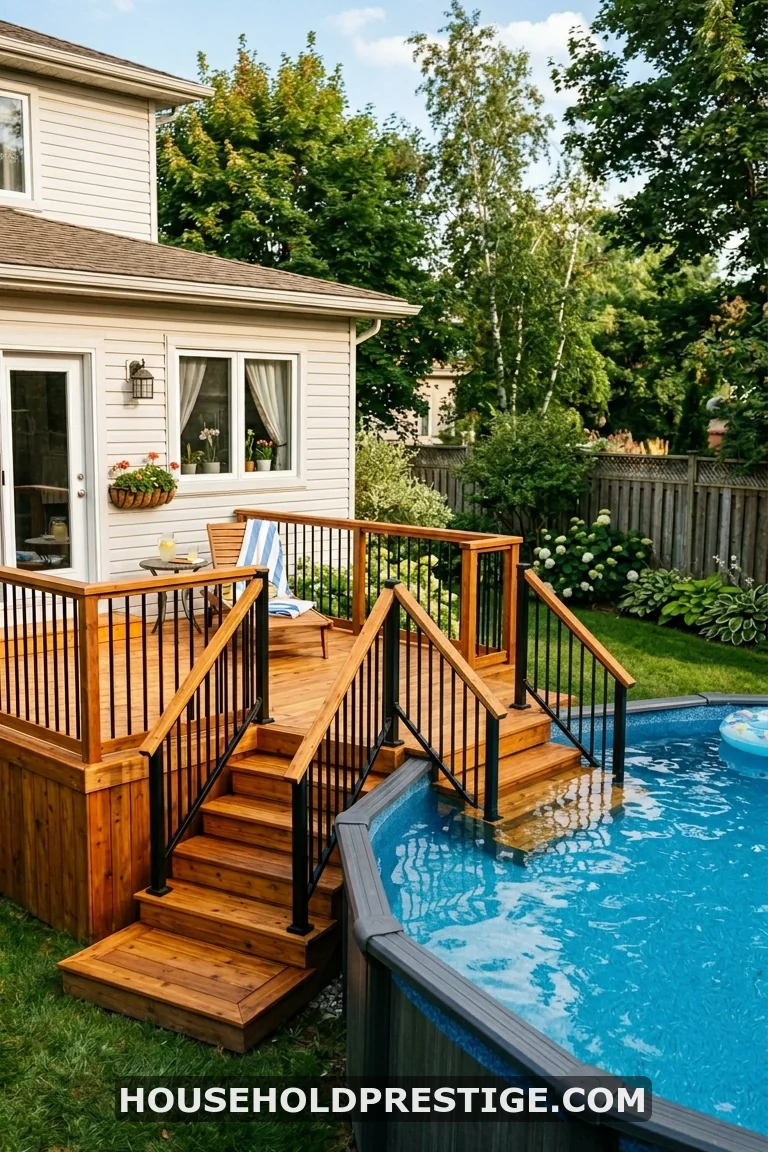
If your pool sits close to the house, this is the most polished setup you can build without going full wraparound. A partial deck — basically a bridge platform connecting your back door or patio to the pool entry — makes the whole backyard feel intentional.
The structure is a standard low-level deck frame (2×8 joists on 4×4 posts set on concrete footings) with one section raised to match pool height. Steps integrate into the side of the deck so you’re stepping down to grade level, not climbing a separate structure to reach the pool.
Most partial deck + step setups for a 15-foot pool run $600–$1,500 in materials using pressure-treated lumber, or $1,200–$2,200 with Trex Enhance composite boards. Composite costs more upfront but doesn’t need staining every year — over a 10-year window, costs often equalize.
This is also the setup that photographs the best. If Pinterest is part of the strategy here, this is your shot.
6. Steps with Built-In Safety Gate
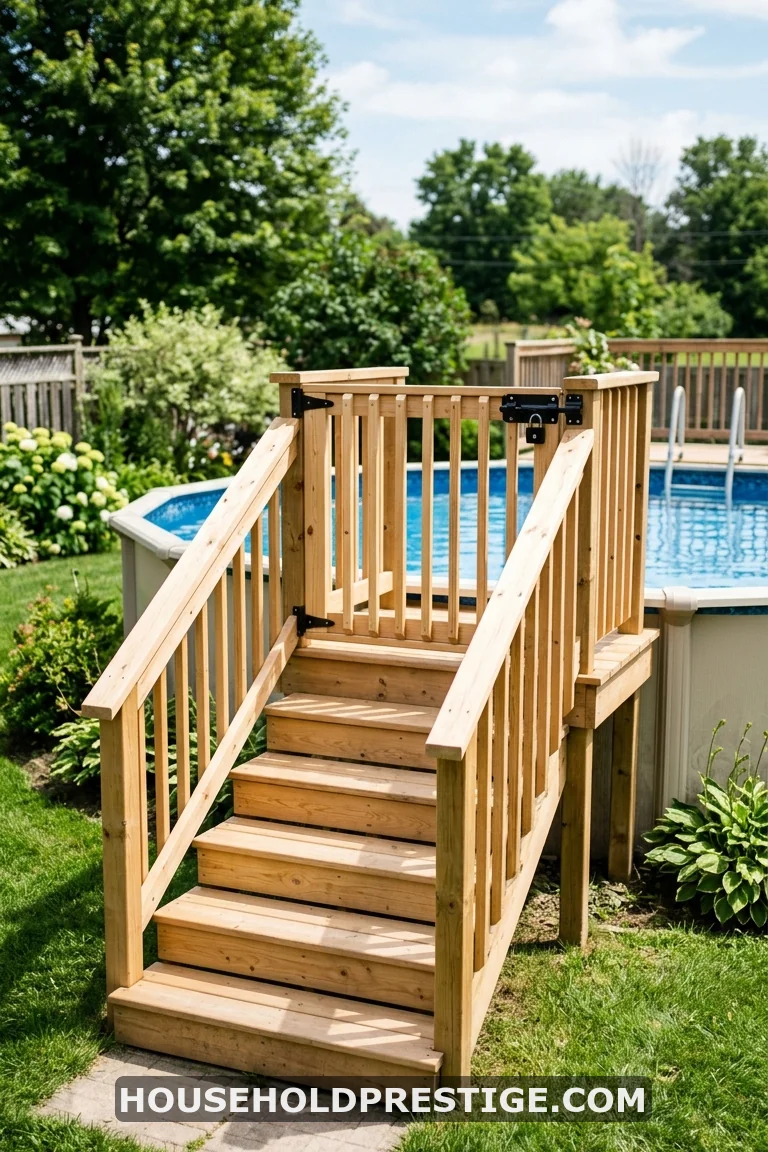
Standard pool steps don’t come with any barrier at the top. That’s a real problem if you have small children or pets. A simple self-closing, self-latching gate at the landing point changes the entire safety equation.
The D&D Technologies SAFETECH Latch ($35–$55) is pool-code compliant in most states and installs on any wood or metal post with two screws. Pair it with two 4×4 posts bolted to your stair frame — one on each side of the opening — and you’ve got a proper gate frame. Use cedar picket boards or metal hinge gates for the gate panels themselves.
For the latch: install it at adult hand height on the pool side, with the opening mechanism facing inward. This makes it child-proof — small hands can’t reach the release from the outside — while adults can always open it from within.
Budget: $80–$180 for a basic two-post gate setup attached to existing stairs.
7. Full Wrap-Around Deck with Steps
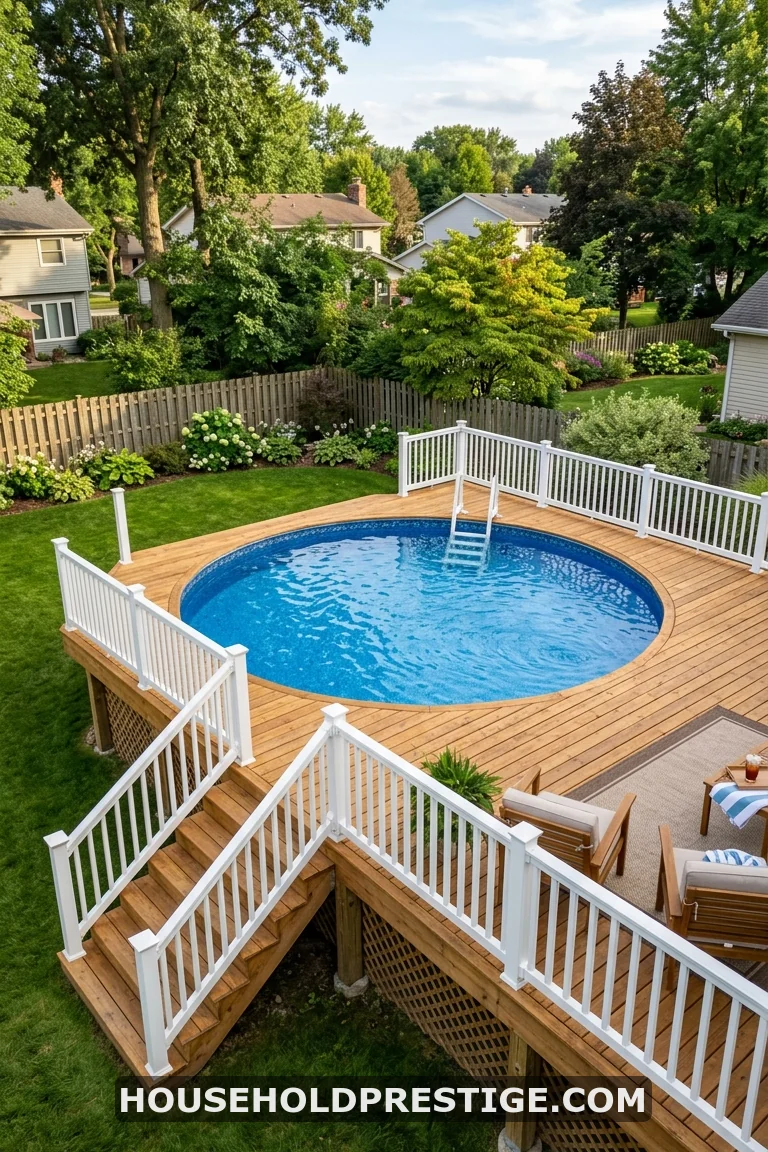
The biggest commitment. Also the one that makes your above ground pool look like it was always meant to be there.
A full wrap-around deck encloses the pool perimeter entirely at pool height, with a staircase on one or two sides leading back to grade level. This eliminates the “ladder” problem completely — you’re walking onto the deck, stepping over the pool rail, and sliding in. The staircase becomes a deck feature rather than a pool feature.
At the high end with Trex composite decking and aluminum railings, full wraparound decks for an 18-foot round pool run $3,000–$8,000 in materials — more with professional labor. On a budget with pressure-treated lumber and basic rails, you can build this yourself for $1,200–$2,500, depending on your pool size and deck configuration.
The build complexity is real — this is a multi-weekend project with footing holes, permit requirements in some municipalities, and serious structural planning. But nothing else in this list gives you the same transformation.
8. Concrete Block and Lumber Combo Steps
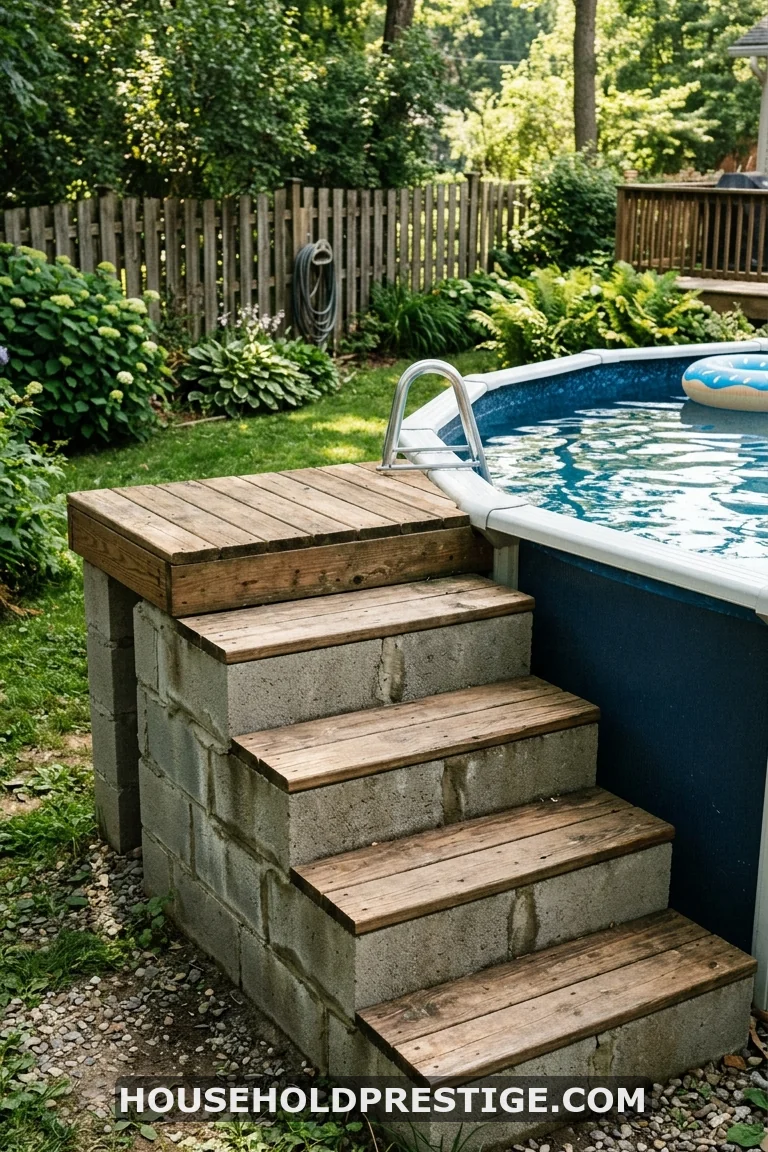
Concrete blocks as risers, wood boards as treads. It sounds rough but when you use uniform 8-inch standard CMU blocks stacked to the right height, then cap each level with a wide pressure-treated 2×8 tread, the finished look is pretty sharp.
The trick is mortar. Dry-stacked blocks shift. Mix a small batch of type-S mortar and bed each block layer. Once cured (48 hours), the structure is solid enough that a 250-lb adult won’t budge it.
Cost: concrete blocks run about $2.50–$4 each; a standard 4-step entry uses 12–16 blocks. Add treads, mortar, and hardware: total build runs $80–$160. Hard to beat for permanence at that price point.
9. The White Paint Fix
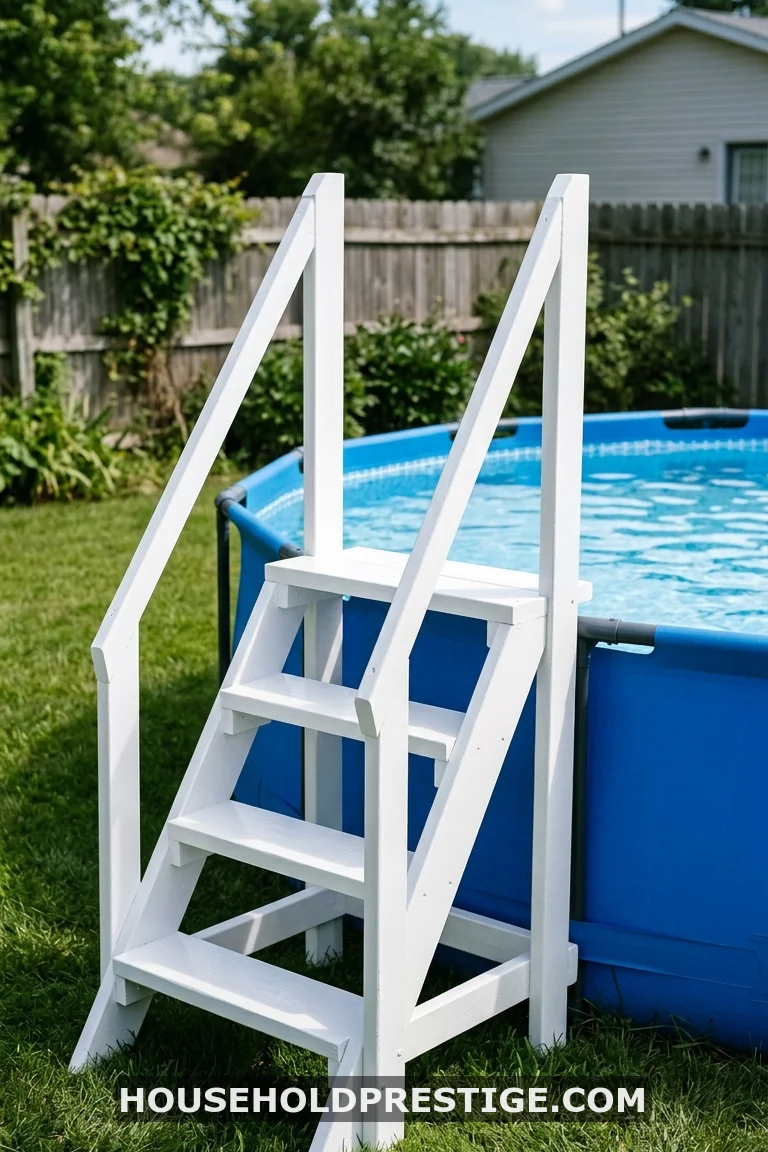
Sand your existing ladder steps smooth. Prime with exterior primer. Paint with solid white exterior paint (Sherwin-Williams Emerald Exterior in Ultra White is bulletproof for this application). Two coats. Add 3M Safety-Walk tape across each tread. Done. The entire ladder transforms from something embarrassing into something that looks clean and deliberate. Cost: $30. Time: one afternoon.
10. Side-Access Wood Ladder Steps
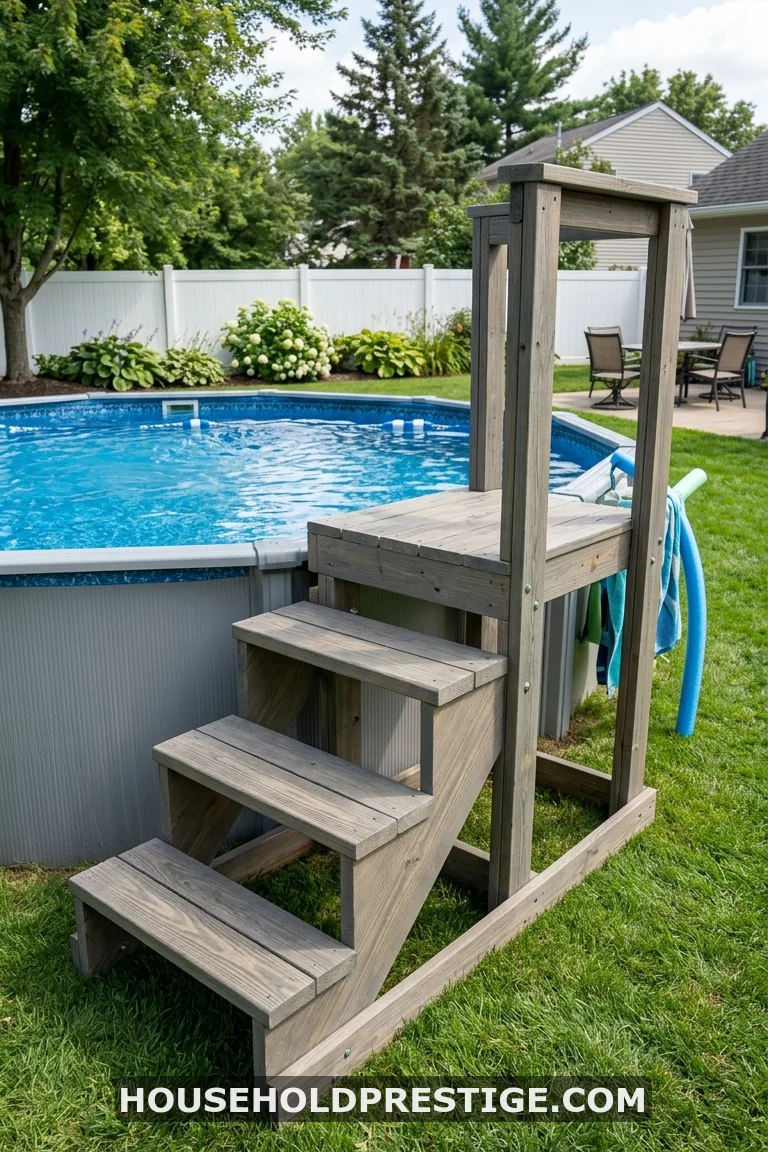
Instead of steps that go over the pool wall, side-access steps approach from the side and lead to a small landing that sits at pool height. You step up, step over the rail, and in you go — much smoother than a vertical ladder, less material than a full staircase.
This style works especially well for oval or rectangular above-ground pools where one end has more access space. Frame out three side-mounted steps in a traditional stringer configuration, add a 24×24 landing at the top, and secure it to the pool rail with a stabilizer bar.
Material cost for a 3-step side-access staircase: $150–$250.
11. Steps with Landscaping Around the Base
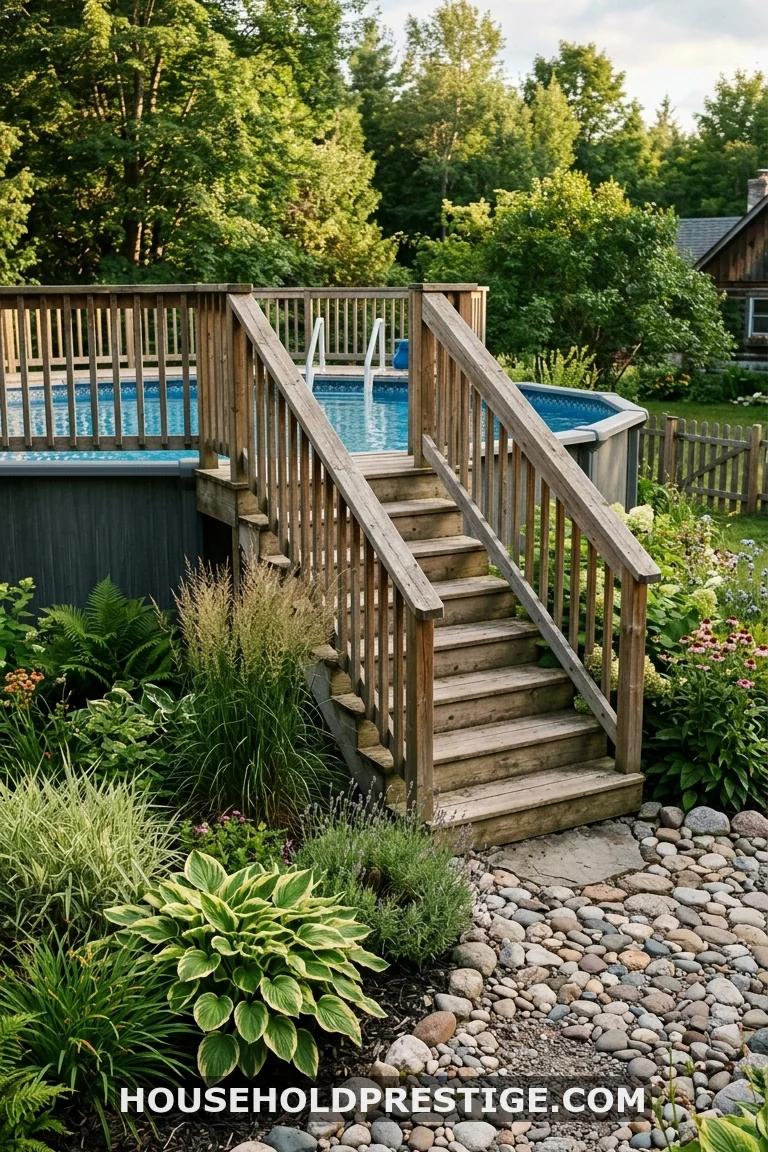
Most above ground pool steps have an awkward gap between the base of the staircase and the ground — raw soil or patchy grass that looks neglected from across the yard.
Fill it deliberately. Lay a 3-inch bed of river rock around the base perimeter. Plant low-maintenance ornamental grasses like ‘Karl Foerster’ or dwarf hostas on either side of the steps. Add two solar lantern stakes at the base corners.
Total landscaping spend: $40–$100. The visual effect is worth three times that. The steps go from a standalone structure to something that looks like it grew there.
12. I Almost Used Concrete Steps — Here’s What Stopped Me
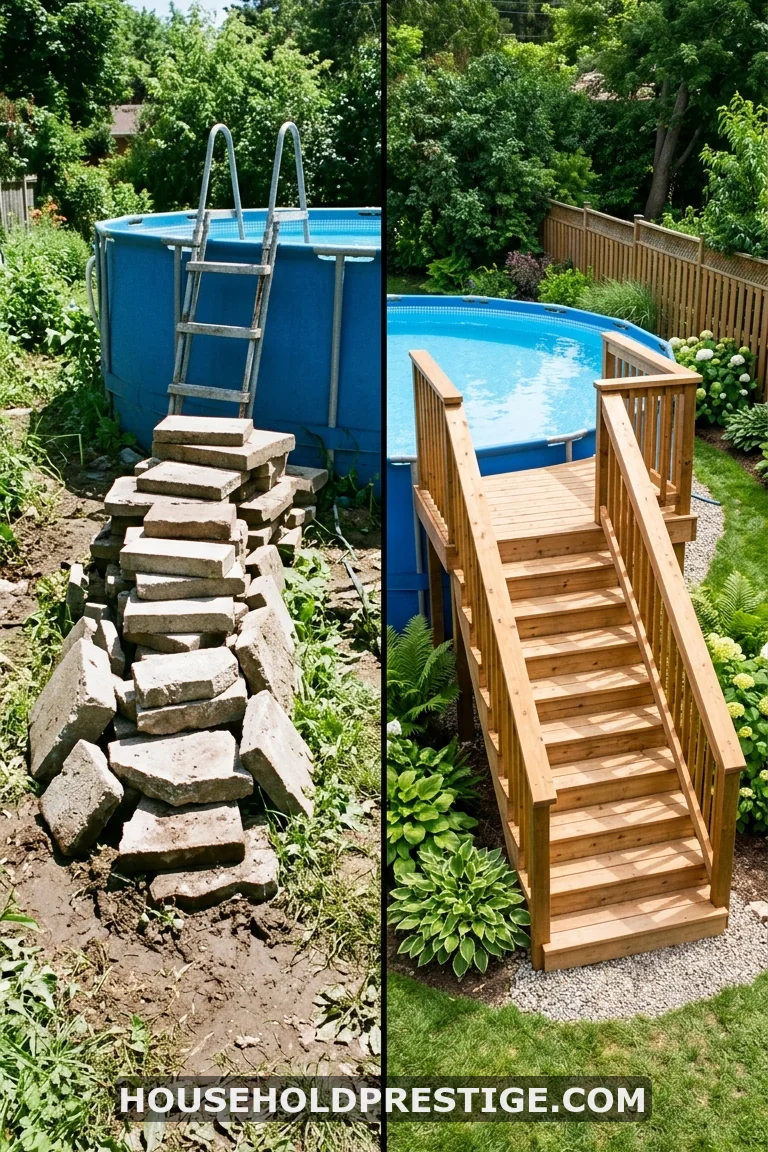
When I first started researching above ground pool steps ideas, the concrete garden stepping stone trick kept showing up in forum threads. Stack three or four flat concrete pavers in a stair configuration, lean them against the pool — done.
I nearly did it. Here’s what the forums didn’t tell me.
What most people think: Concrete stepping stones are heavy, so they’re stable.
Reality: Concrete pavers are not designed for vertical stacking. They’re cast for horizontal compressive load, not lateral shear. Stack them three high with 200 lbs of a wet, excited child landing on the top step, and the whole column shifts sideways. In a best case, someone trips. In a worse case, a sharp concrete corner meets a shin or a knee.
The second problem: contact with the pool wall. Raw concrete is abrasive. Against a painted or vinyl pool exterior — the kind on most above ground pools — repeated contact scratches through the finish, exposes the metal, and opens the door for rust within two seasons.
The third problem: no anti-slip surface. Flat concrete pavers get slick when wet. Pool steps are, by definition, always wet.
The better $40 version: Three concrete deck blocks set side by side on level ground, topped with a single wide pressure-treated 2×10 board per step level, secured with construction adhesive and screws. Same budget, properly structural.
The lesson: improvised concrete stacking looks resourceful on a phone screen. In real life, it’s a liability with no upside.
13. Steps with Solar Lighting
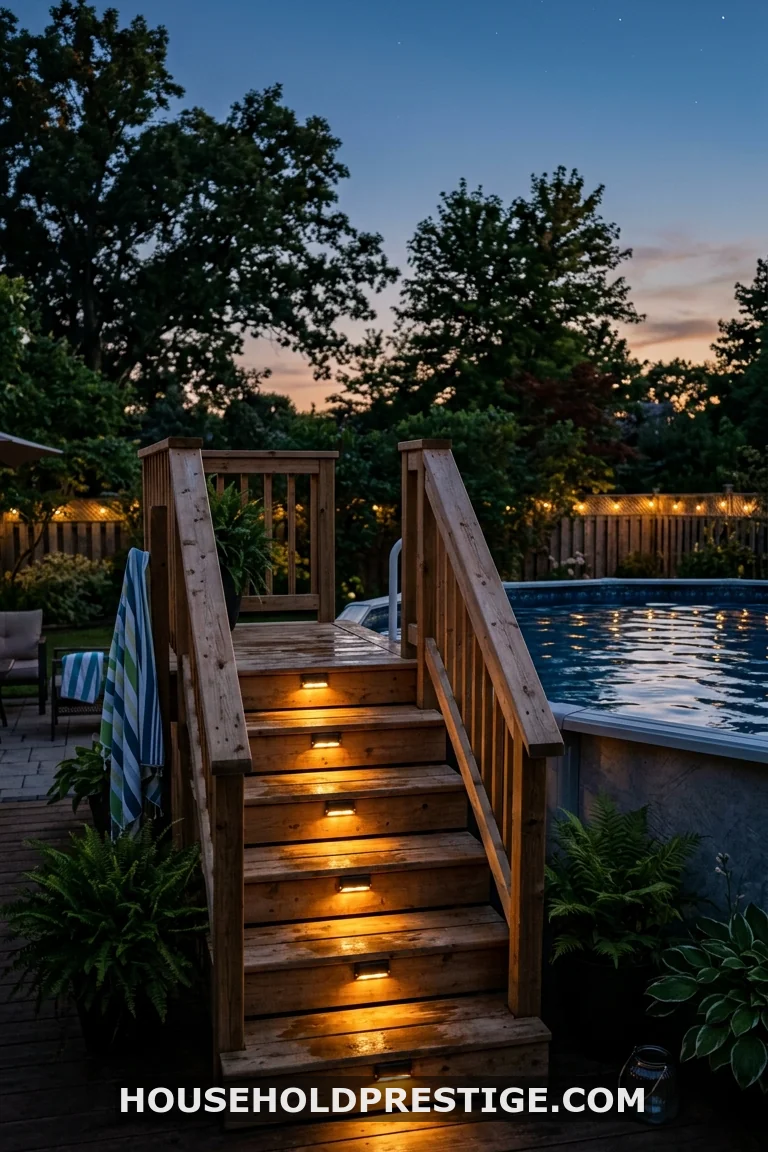
Clip-on solar step lights are one of the cheapest upgrades you can add to any existing stair configuration. The Maggift 12-pack solar stair lights ($30–$40 on most retail sites) clip to the front riser of each step and charge all day, then auto-activate at dusk.
Beyond aesthetics, this is a real safety upgrade. Anyone who’s ever stumbled down pool steps in the dark knows how fast that goes wrong. Lit risers eliminate the guesswork.
Mount one per step on the front edge of each riser, facing outward. For wider stairs (40+ inches), consider one on each side of the riser for even light distribution.
14. The A-Frame Ladder Upgrade
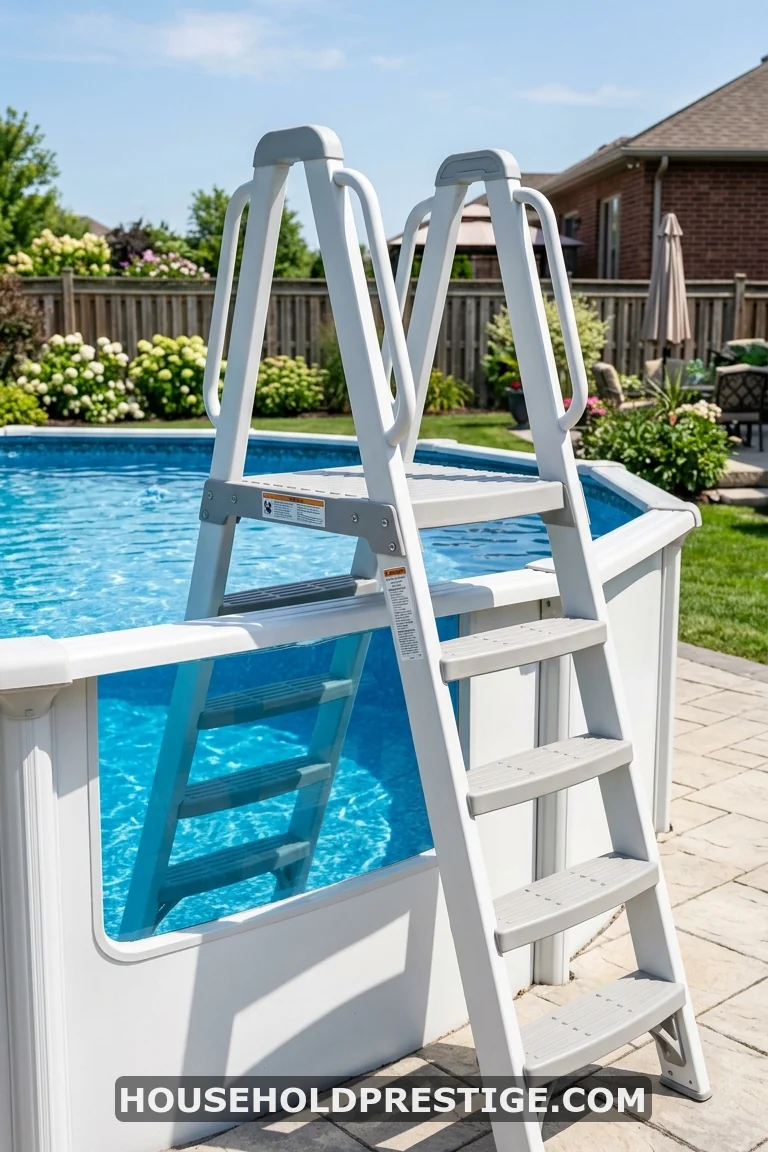
Your current ladder is wobbly because it’s cheap, not because A-frames are inherently bad. The Confer Plastics 7100X ($80–$110) locks to the pool wall with a positive latch, holds 300 lbs, and removes the exterior steps entirely when you want to secure the pool. It’s not a permanent fix — but if you’re mid-planning a real staircase, this buys you a season without terror.
15. Composite Decking Platform Steps
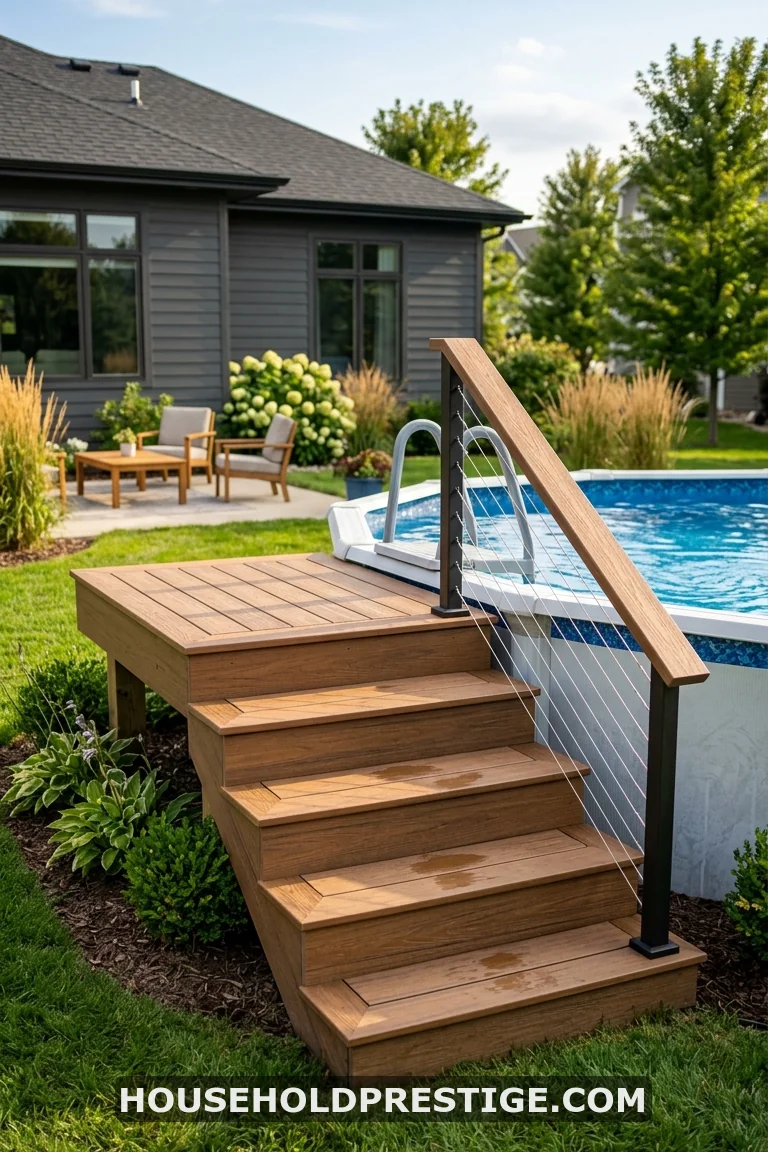
Pressure-treated wood is the budget choice. Composite decking is the choice you make once and never think about again.
Trex Enhance Naturals in Rocky Harbor (a warm gray-brown) is the most commonly used composite for above ground pool stairs in colder climates because of its resistance to freeze-thaw cycles. It doesn’t need staining, doesn’t splinter, and won’t gray out. Per linear foot, expect to spend $3–$5 more than pressure-treated lumber. For a 4-step staircase with a landing, the composite premium adds about $150–$250 to your total build cost.
The step construction process is the same as a wood build — composite boards need the same stringer framing. The difference is you use hidden fasteners instead of screws, which gives the treads a cleaner finished look.
Worth it if you’re building something meant to last 15–20 years. Not worth it if you’re renting or expect to move the pool.
16. Steps with Double Safety Gate
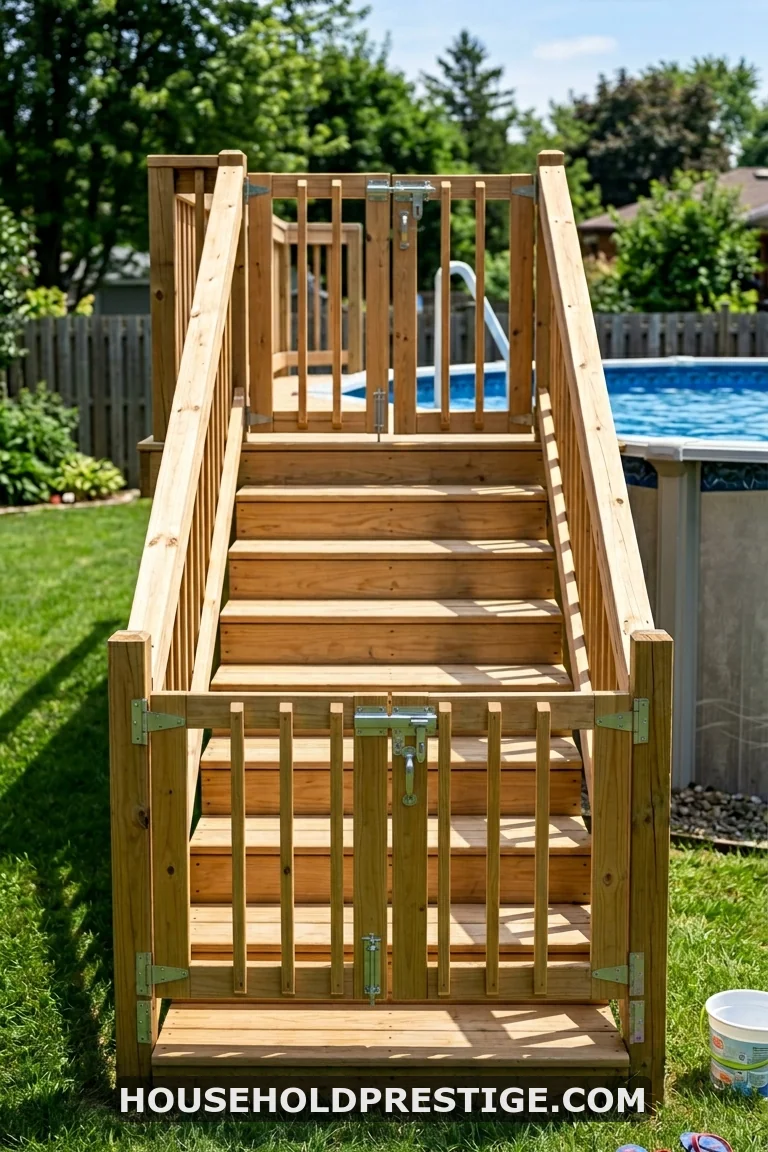
One gate at the top of the stairs is standard. Two gates — one at the bottom of the staircase, one at the top landing — creates a true double-barrier system that exceeds most local pool fencing code requirements.
For households with toddlers or a pool safety inspection requirement, this is the move. The bottom gate prevents kids from even starting the climb; the top gate is the last stop. Use the same D&D Technologies SAFETECH latch on both (pool code in most states requires at least one gate to be self-closing and self-latching), set both so they open from the adult side only.
Total hardware addition: $80–$120 beyond the staircase itself.
17. Steps with Built-In Storage
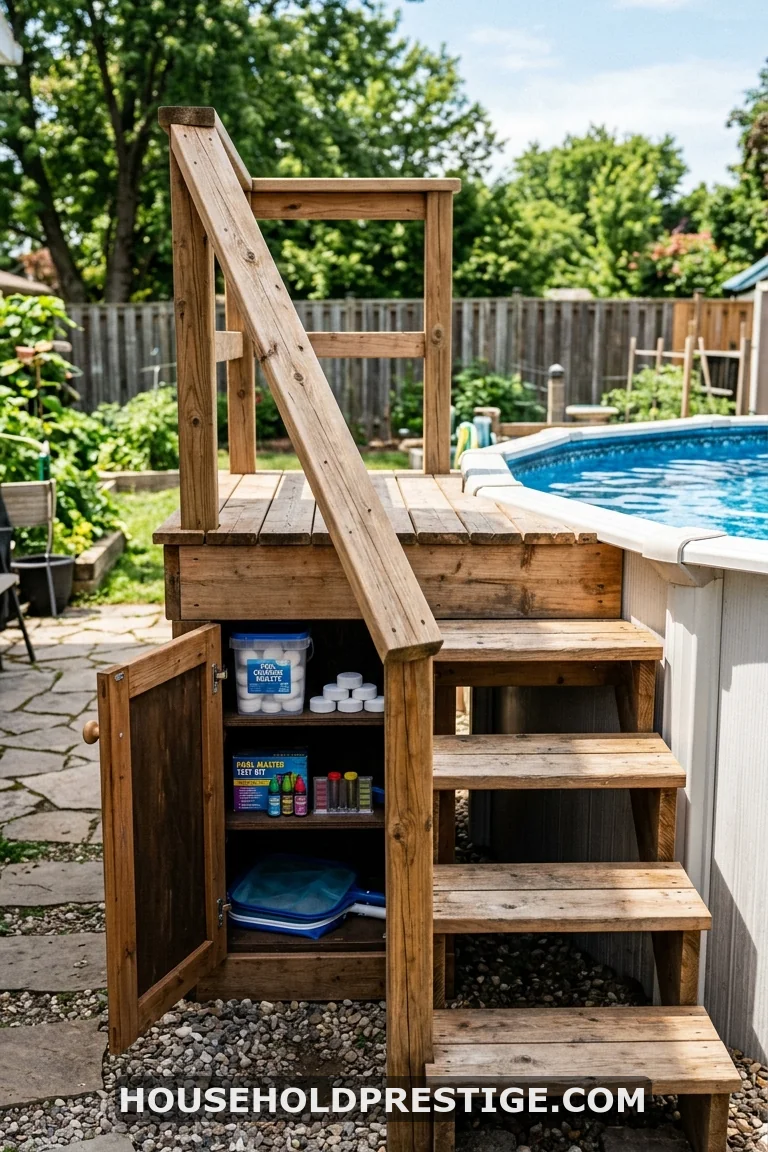
The platform landing at the top of most pool staircases is just dead space sitting on a framed box. Build that box with a hinged front panel and you’ve got 6–8 cubic feet of weatherproof storage.
Use this space for pool chemical storage, the skimmer net, a spare test kit, and a dedicated pool towel bin. Hinge the panel with exterior-grade hinges and add a simple hasp latch. Line the interior with 1/4-inch pressure-treated plywood.
This adds $30–$60 in materials to a staircase build and eliminates the perpetual scattered-pool-stuff problem. Kids know exactly where the floats go. You know exactly where the chlorine is. No more hunting.
18. Steps with an Attached Bar and Entertaining Area
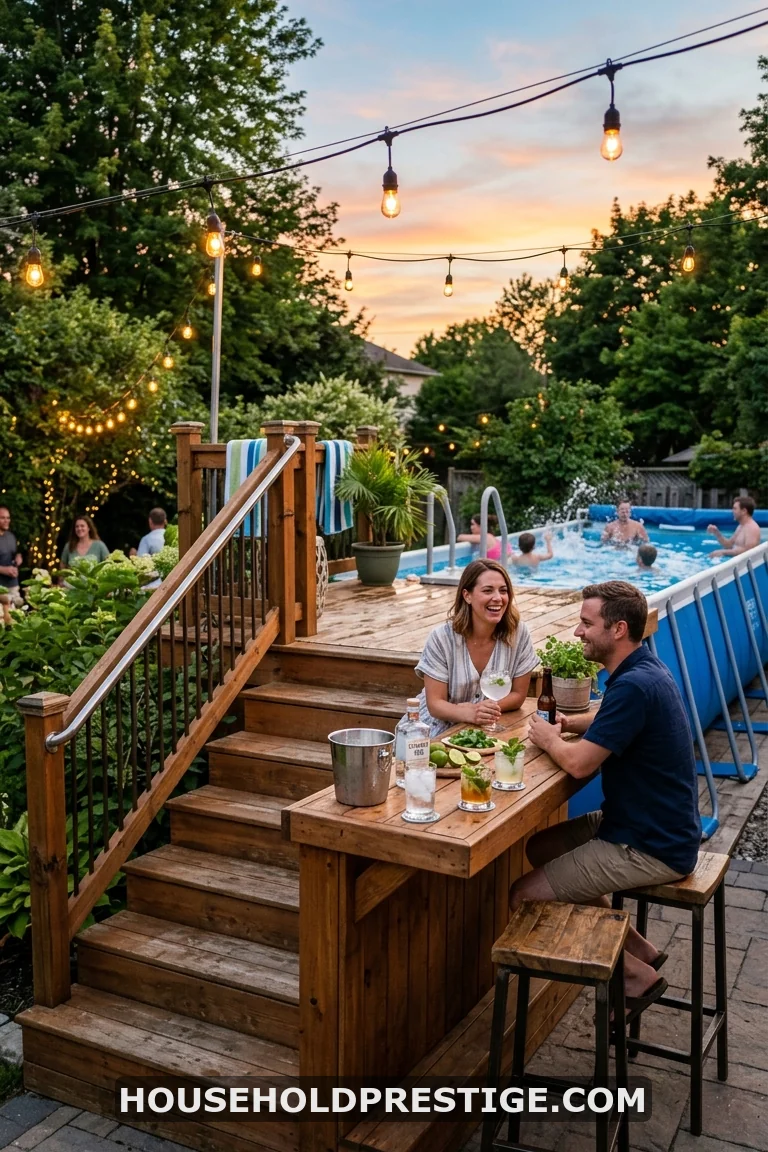
Take the partial deck concept and extend one side of the landing platform by 4–6 feet. Cap it with a 36-inch high ledger board as a bar counter. Add two bar stools on the outside. Suddenly your pool entry is also your pool bar.
This is the setup that earns the “your backyard is incredible” comment from every person who visits in July. It doesn’t cost dramatically more than a standard deck entry — you’re adding approximately $200–$400 in lumber and hardware — but the lifestyle payoff is completely disproportionate.
Finish the bar counter in a different stain than the stair treads (try a darker walnut tone against a lighter cedar deck) for a two-tone look that reads as designed rather than DIY.
19. The PVC Step System
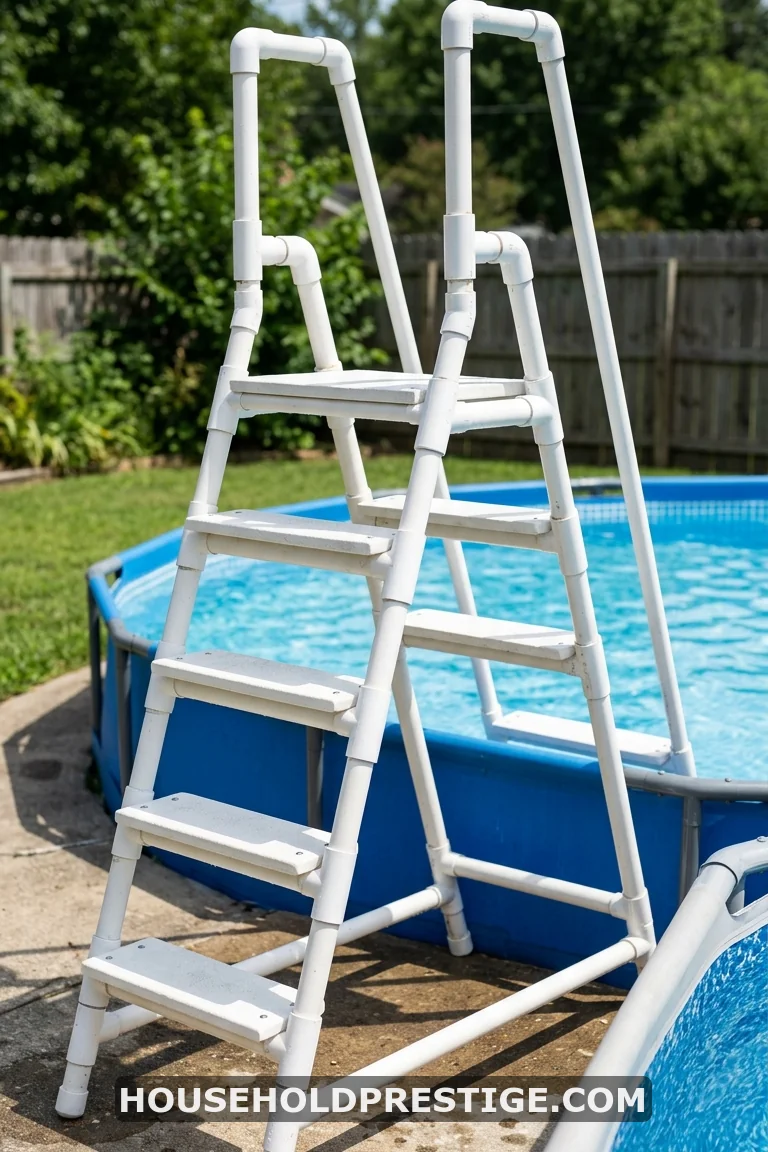
PVC pipe isn’t the most common choice for above-ground pool steps, but it’s legitimately practical for soft-side or Intex pools where you can’t anchor a wood frame to the pool wall. Use 1.5-inch schedule-40 PVC pipe with T-fittings and elbow joints to build a simple A-frame ladder shape. Cut PVC boards to size for the step treads and secure with PVC cement.
A 3-step PVC ladder runs about $45–$70 in materials and handles up to 200 lbs when built correctly. It won’t win a design award. But if you have a soft-side Intex pool and need a safe, portable, budget entry solution that won’t scratch or dent the pool walls, this is your answer.
Putting It All Together
There’s no one-size above ground pool steps idea that works for everyone. If you have a toddler, the double-gate staircase is a non-negotiable. If you’re renting, in-pool wedding cake steps are the most flexible option. If you’ve had your pool for five years and you’re tired of looking at a wobbly ladder every time you glance out the back window, the wood platform staircase build is the weekend project that changes the way your whole yard feels.
Start with what you need most right now — safety, budget, or looks — and build from there. Most of these ideas stack onto each other: you start with the outdoor carpet fix, build the wood staircase next summer, add the gate and the bar extension the summer after. The pool you want is usually just a few weekends away.
Frequently Asked Questions
What is the safest way to enter an above-ground pool? A fixed wood platform staircase with non-slip treads and a self-latching gate is the safest external entry. For in-pool safety, a proper wedding cake step system like the Confer Plastics 7200 distributes weight across a wide base and eliminates the balance issues of a vertical side ladder. Any step system should have 3M Safety-Walk non-slip tape or textured grip surfaces on every tread.
Can you build above-ground pool steps without a deck? Yes — and most people do. A freestanding staircase sits on concrete deck blocks and leans against the pool rail with a stabilizer bar. It requires no deck and no permanent footings. In-pool step systems are another option and require no external structure at all.
How much do above-ground pool steps cost? Costs range from $15 for a DIY pallet step platform to $250+ for a quality in-pool wedding cake step system (like the Confer Plastics CCX-AG) to $400–$500 for a full DIY wood platform staircase. Professional installation of a full deck entry starts around $1,500–$3,000, depending on size and materials.
Do above-ground pool steps need to be removed for winter? In-pool step systems — anything inside the pool — should be removed before winterizing. The weight and contact can damage the liner as water freezes. External wood staircases and platform steps can typically stay in place, though covering them protects the wood through freeze-thaw cycles.
What lumber should I use for above-ground pool steps? Always use pressure-treated (PT) lumber for any pool staircase — specifically rated for ground contact (labeled “.40 retention” or “UC4B”). Regular pine will gray, soften, and splinter within one season of pool contact. Composite decking (like Trex Enhance) is the premium alternative that never needs staining and holds up for 15–25 years.