

You picked the countertops, chose the baskets, maybe sprung for the high-efficiency detergent. These laundry room wallpaper ideas are the move you haven’t made yet — and possibly the one that changes the room more than anything else you’ve done to it.
The laundry room trap is real. It’s the room you use six or more hours a week, and yet it never makes it onto the mood board. You painted it pale gray and called it done. Wallpaper does what paint can’t. It adds depth, pattern, and enough personality to make the task feel less like a task.
These 15 picks work for every budget and every wall type — full-room installations or a single accent wall behind the machines. I’ve included a complete installation deep-dive for the style with the highest Pinterest saves, a cautionary tale that’ll save your walls and your deposit, and the moisture-resistance guidance most inspiration articles skip entirely.
1. Moody Botanical Statement Wall
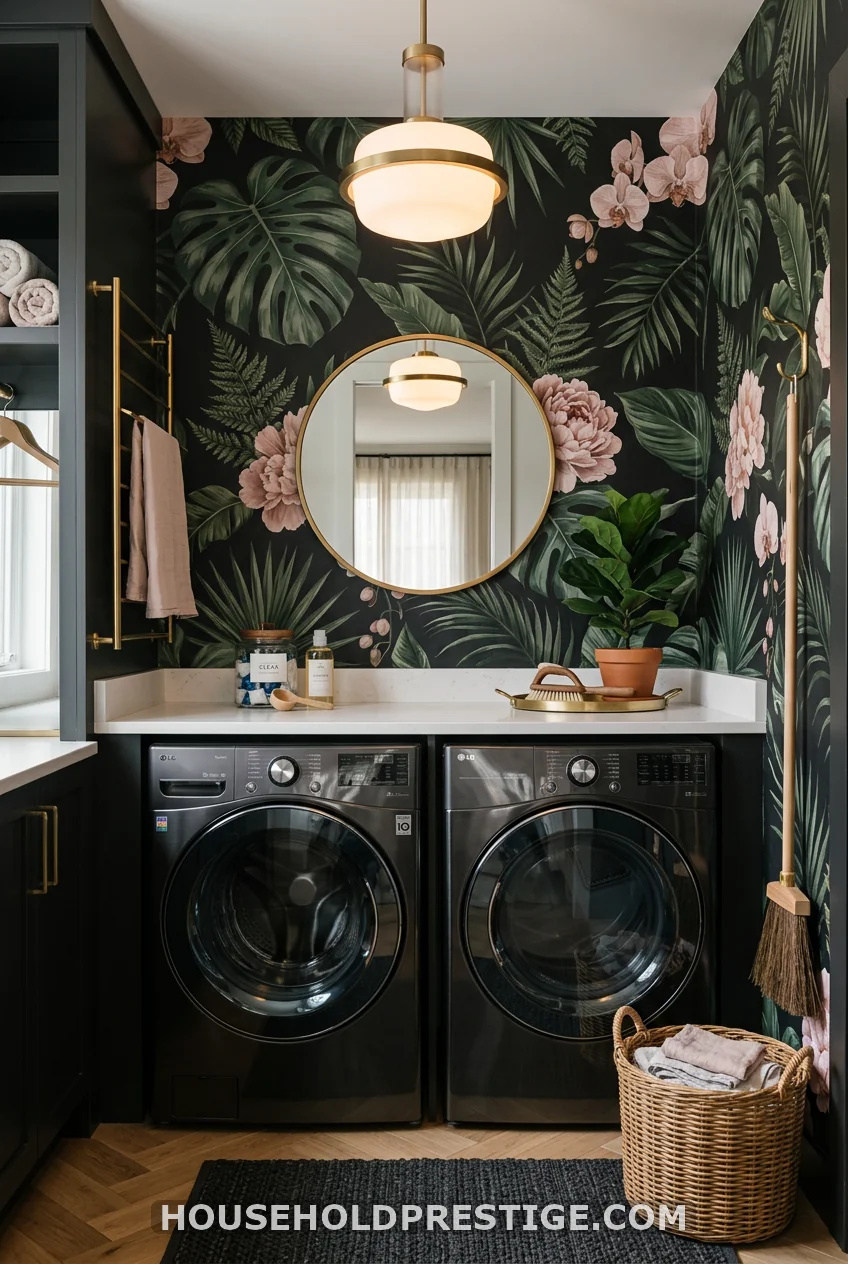
This is the look that stops the Pinterest scroll. Not by accident.
Dark botanical wallpaper — oversized leaves, vintage-style florals, deep charcoal or forest green or navy base — is the single most-saved laundry room wallpaper style on the platform. There’s logic to it. The laundry room already has plenty of hard, bright surfaces. Chrome machines. White countertops. Tile floors. A dark, textured botanical wall doesn’t darken the space; it grounds it. It gives the room a soul it didn’t have before.
But there’s more to this look than picking a print you love. Getting it right means choosing the right wallpaper type, hanging it correctly around appliances, and avoiding the mistakes that send homeowners back to square one three months later.
Why Dark Botanical Works Here
The machines are the visual anchors already. You’re not decorating around them — you’re framing them. A dramatic wall pattern behind the washer and dryer makes the whole setup look intentional, like a styled interior rather than a utility closet that outgrew its name.
The dark background absorbs the starkness of white appliances instead of competing with them. It also hides what plain walls expose: scuffs, drip marks, the general entropy of a room that works hard. Win on every level.
Choosing the Right Wallpaper Type
Not all botanical wallpaper survives a laundry room. The dryer vents heat. The washing machine sometimes leaks. Humidity spikes every time you run a hot-water cycle. You need one of the following:
- Vinyl-coated traditional wallpaper — minimum 150 gsm, labeled “scrubbable” on the packaging
- Peel-and-stick vinyl — at least 4 mil thick for durability in humid conditions
- Unpasted vinyl — hung with heavy-duty adhesive like Roman Pro-838
Avoid paper-backed, natural grasscloth, and fabric-backed wallpaper anywhere near steam. They absorb moisture, bubble within weeks, and in worst cases develop mold behind the backing. More on this in item #6.
Dimensions and Pattern Repeat
Before ordering, account for pattern repeat. Botanical prints typically have a 24–27 inch vertical repeat, which means you lose up to two feet per strip matching the design. If your wall is eight feet tall and your repeat is 24 inches, you’re cutting and wasting close to a full roll.
Standard calculation:
– Wall height (typically 8–9 ft) + pattern repeat = usable strip length needed per strip
– Wall width ÷ wallpaper roll width (usually 20.5 in.) = number of strips
– Number of strips × usable strip length ÷ roll coverage = rolls needed
– Add one extra roll as a buffer. Always. Reordering from a different dye lot is a headache.
For a standard accent wall behind a side-by-side washer/dryer unit — roughly 60–72 inches wide × 8 feet tall = 40–48 sq ft — plan for 3–4 rolls of a 27 sq ft/roll product.
Step-by-Step Installation
- Prep the wall. Wipe it down with a damp cloth and let it dry for 24 full hours. Patch holes with spackle, sand smooth. Apply one coat of wallpaper primer — it seals the surface, improves bond strength, and makes future removal far easier.
- Move the appliances out first if possible. Hang wallpaper before sliding the machines back in. You will not regret this. Trying to hang wallpaper with a dryer six inches from the wall is genuinely miserable.
- Mark a plumb line at the center of your wall using a level. Start from center, not from the corner. Corners are rarely plumb and your pattern will drift within two or three strips if you align to one.
- Cut strips based on your height-plus-repeat calculation. Number the back of each strip in pencil in hanging order before you start.
- Activate paste. For pre-pasted wallpaper: submerge each strip in a water tray for 30 seconds, fold loosely paste-to-paste, and “book” it for 3–5 minutes before hanging. For unpasted: apply adhesive to the wall in sections using a paint roller.
- Hang from your plumb line outward, one strip at a time. Smooth from center toward edges with a plastic smoother or dry wallpaper brush to release air bubbles. Do not use a wet sponge — it warps vinyl temporarily and causes seam gaps on drying.
- Trim ceiling and baseboard edges with a sharp utility knife against a metal straight edge. Replace the blade every two to three strips. Dull blades tear vinyl instead of cutting it.
- Seal every seam. Run a seam roller firmly along each joint 15–20 minutes after hanging. Open seams in a humid room are where moisture creeps in over time.
Leave a 1–2 inch gap between the back of the machines and the wallpaper at the floor level. The dryer exhausts heat from the back; a tight fit against the wall traps it and degrades the adhesive.
Cost by Brand
| Brand | Style | Price Per Roll | Coverage |
|---|---|---|---|
| Tempaper | Dark Botanical (peel-and-stick) | ~$55 | 28 sq ft |
| NuWallpaper | Tropical Night Collection | ~$40 | 27 sq ft |
| York/Rifle Paper Co. | Canopy Peel & Stick | ~$85 | 27 sq ft |
| Brewster | Advantage Botanical | ~$35 | 27 sq ft |
| Spoonflower | Custom print (vinyl option) | ~$45 | 25 sq ft |
Total cost for a 40–48 sq ft accent wall: $140–$350, depending on brand. Tempaper and NuWallpaper are the sweet spot for laundry rooms — thick enough to handle humidity and forgiving enough to remove without a full wall repair.
Common Mistakes to Avoid
- Ordering by square footage without accounting for pattern repeat. You will run short. This is the most expensive mistake in wallpaper projects.
- Using paper-backed wallpaper in the steam zone. Guaranteed bubbling within three months.
- Skipping primer. The unprepared paint surface absorbs adhesive, weakens the bond, and makes removal destructive.
- Starting from the corner instead of a plumb center line. The first strip sets every strip after it. Get it wrong once, you’re rehanging from strip three onward.
- Over-soaking pre-pasted paper. Thirty seconds in the water tray is enough. Longer causes the paper to stretch, and stretched paper means seams that won’t line up after drying.
2. Sunny Lemon Print
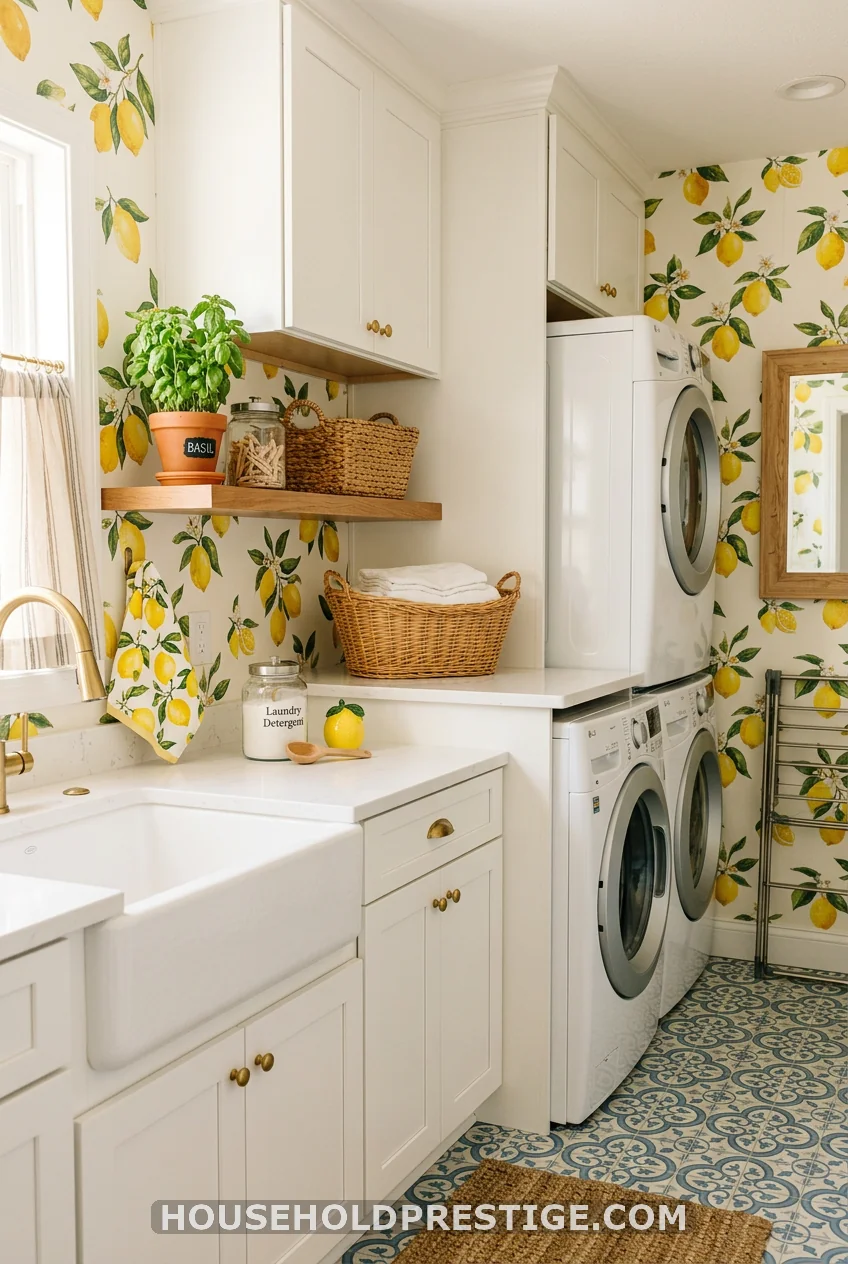
Nobody walks into a room with lemon wallpaper and feels stressed.
That’s not an accident. The lemon print has been a kitchen and pantry staple for decades, and it migrates naturally to the laundry room because the logic is identical: clean, organized, vaguely Mediterranean. Go for a white or cream background with loose, watercolor-style lemons rather than illustrated ones — the painterly quality reads softer in a room with hard appliance surfaces. Pair with white upper cabinets and warm wood countertops.
Spoonflower’s Citrus Garden print in vinyl (~$45/roll) and Tempaper’s Lemon Grove collection (~$52/roll) are both reliable picks. A standard laundry room uses 4–5 rolls for full walls, or 2 rolls for an accent wall. Pull the yellow into your hardware finish — brushed gold cabinet pulls cost $3–8 each and tie the look together without a full cabinet repaint.
3. Vertical Stripe for Instant Height
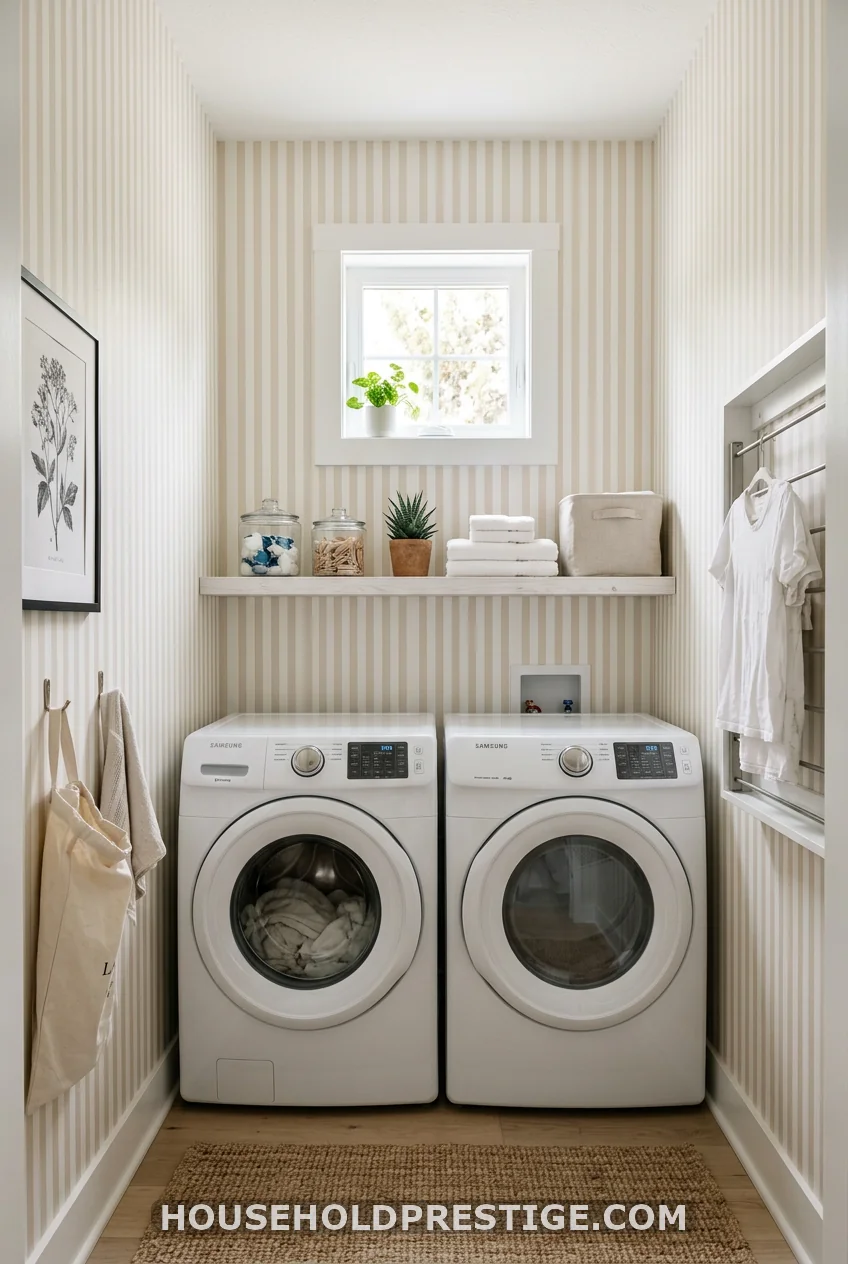
Run vertical stripes and your 7-foot ceiling reads as 9. Same wall, completely different room.
Narrow stripes in two soft tones — off-white and cream, or pale gray and white — work in laundry rooms that feel more like hallways than rooms. The eye tracks the lines upward instead of across the cramped wall span. Choose a stripe no wider than one inch for subtle visual lift. Go wider and it reads as bold rather than tall.
4. Peel-and-Stick Strategy for Renters
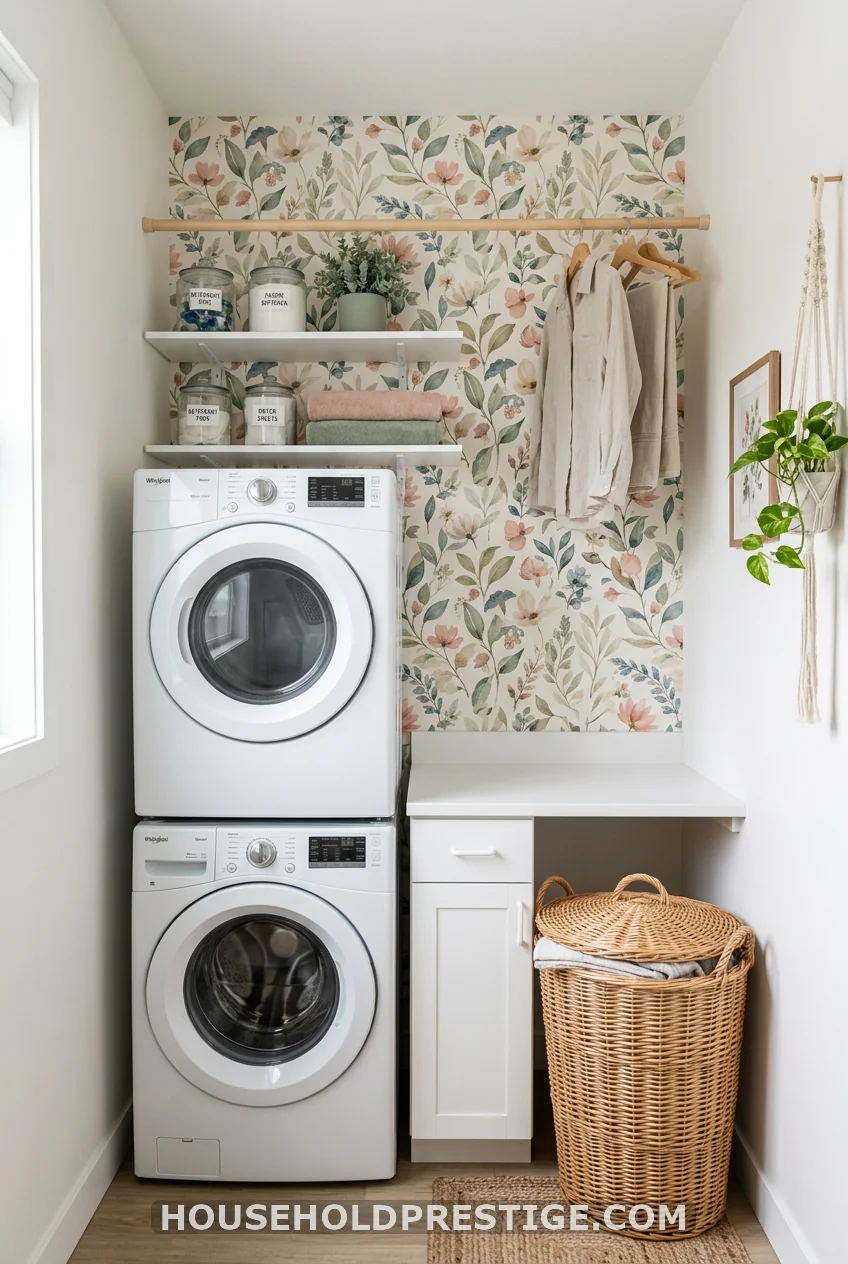
If you rent, you’ve probably already talked yourself out of wallpaper. Let me undo that.
Modern peel-and-stick vinyl at 4 mil or thicker has genuinely changed the renter calculus — but prep is everything. Wipe the wall with isopropyl alcohol and let it fully dry before applying. Do not install over matte paint; the aggressive adhesive can lift the paint off when you remove the wallpaper at move-out. Test a small inconspicuous section first if you’re unsure of your paint type, or ask your landlord directly.
The brands that consistently perform in rental conditions: Tempaper Signature (~$55/roll), Chasing Paper (~$48/roll), and RoomMates Peel & Stick (~$30/roll) for a budget-conscious option. When removing, peel at a 45-degree angle slowly while holding the wall surface taut with your other hand to distribute tension. Remove in warm weather if possible — cold temperatures make vinyl brittle and more likely to tear rather than peel cleanly.
One accent wall behind the machines is enough. You’ll use 2–3 rolls, spend $60–150, and leave with your deposit intact.
5. Faux Grasscloth Texture: The Scullery Aesthetic
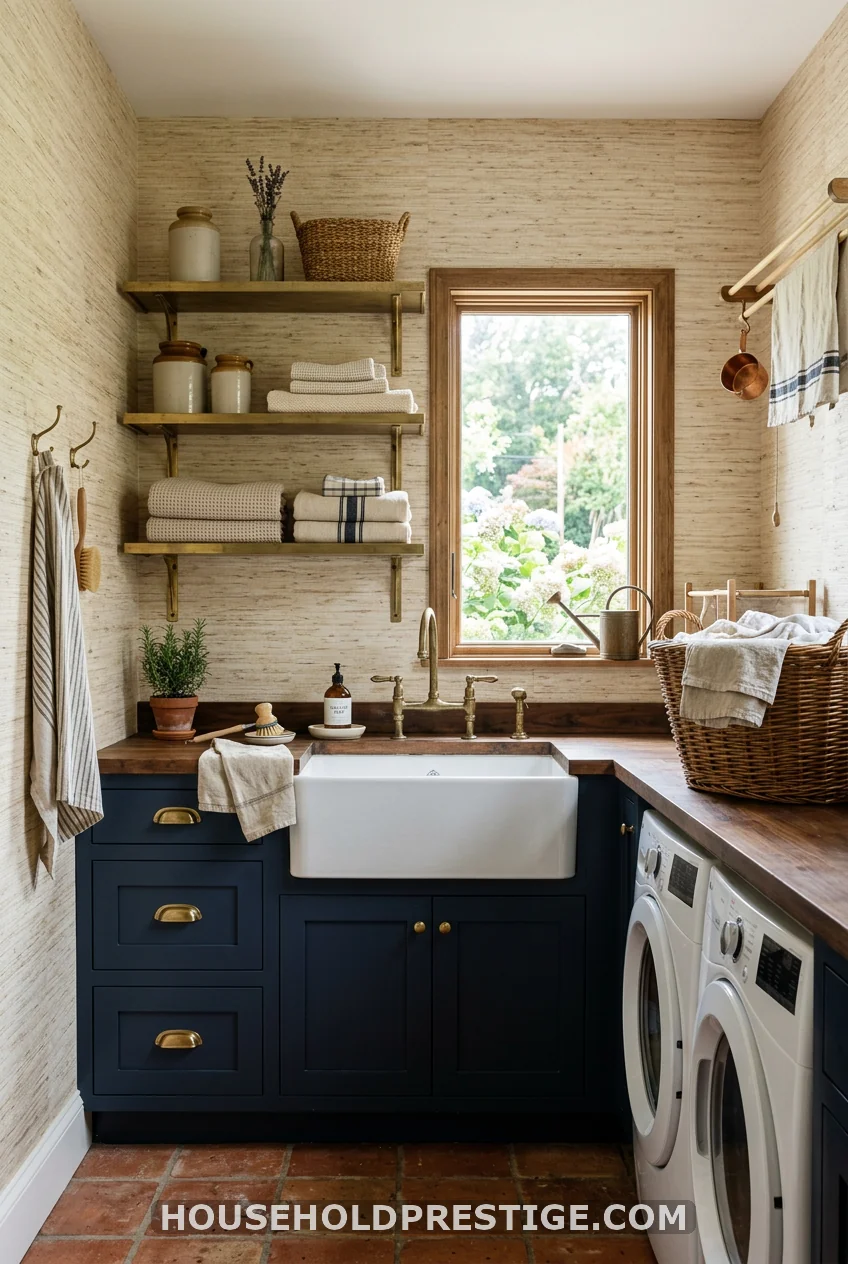
The “scullery” aesthetic has quietly taken over interior design, and the laundry room is ground zero for it.
If the term is new to you, a scullery is the back kitchen from a traditional English country house — the working room where laundry was done, produce sorted, and dishes scrubbed. The aesthetic is earthy, built-in, practical, and beautiful all at once. Faux grasscloth wallpaper — woven-look vinyl that mimics natural grasscloth without the moisture sensitivity — captures that energy perfectly without the upkeep.
The critical distinction: real grasscloth is a natural fiber wallpaper. Do not use it in a laundry room. It absorbs moisture, stains, and degrades in humid conditions within a year. Faux grasscloth (vinyl-coated imitation) gives you the same visual warmth and texture. EazzyWalls’ Faux Grasscloth collection (~$38/roll) and Brewster’s Natural Texture series (~$32/roll) are the practical picks. Pair with dark navy or sage lower cabinets and unlacquered brass hardware for the full scullery effect.
6. The Cautionary Tale: What the Wrong Wallpaper Taught Me
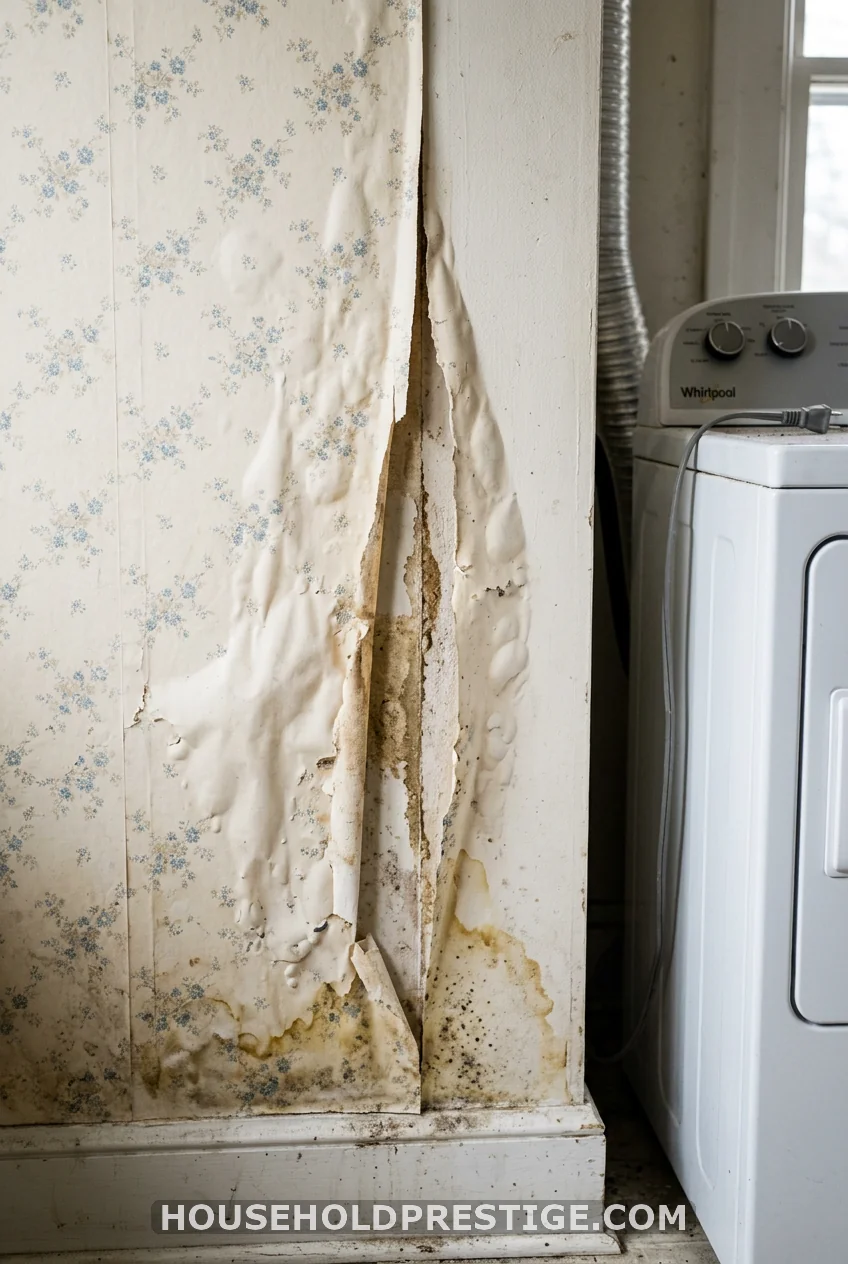
Let me save you a summer of regret.
Three years ago, I found the most gorgeous wallpaper at an estate sale — blue-and-white French toile, linen-backed, incredibly charming. I hung it on a Saturday, styled the room for photos on Sunday, and by Tuesday, something was already wrong.
The seams near the dryer exhaust were lifting. By the end of that month, visible bubbling had spread across the lower half of the wall. By month three, I smelled it before I saw it — a faint mustiness behind the paper closest to the machine stack. I pulled the paper and found gray bloom on the wall backing. The early stages of mold.
Linen-backed paper. Natural fiber. In a room where a dryer exhausts hot, humid air multiple times a day.
The materials that do not belong in a laundry room:
– Paper-backed wallpaper
– Fabric-backed wallpaper
– Natural grasscloth or seagrass wallcoverings
– Bamboo-based wallpapers
– Any product labeled “non-washable.”
If the product description doesn’t mention moisture resistance, vinyl facing, or scrubbable surface — it belongs in a bedroom, not a laundry room.
The materials that work: Vinyl-coated traditional wallpaper (scrubbable grade), peel-and-stick vinyl (4 mil minimum), fiberglass-reinforced vinyl. All three are rated for bathrooms, which means they handle laundry room humidity without complaint.
Check the label. Every single time. A $40 roll of proper vinyl wallpaper will outlast a $120 roll of gorgeous-but-wrong specialty paper by years.
7. Watercolor Floral in Soft Neutrals
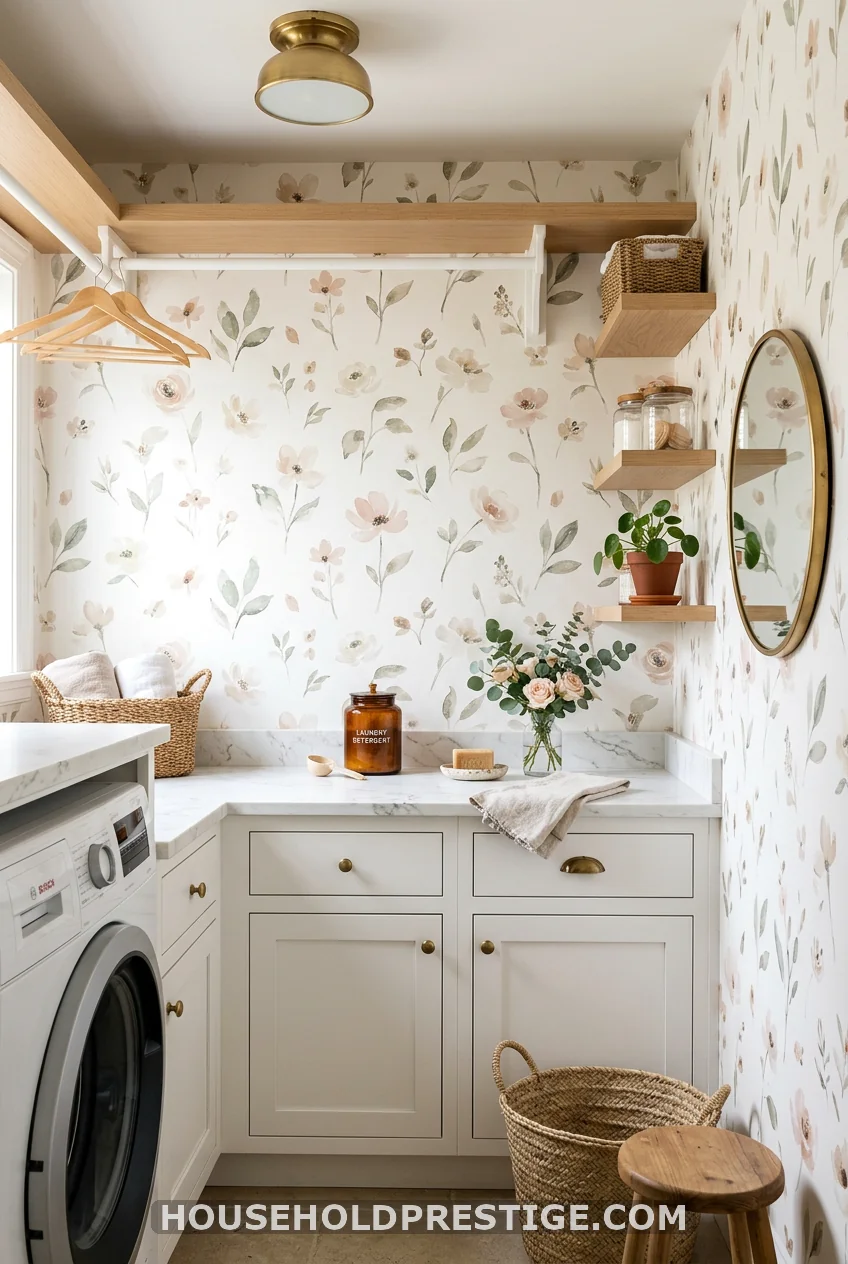
Some laundry rooms need a loud statement wall. Others just need to feel considered.
Watercolor florals are for the second kind of room — where the goal is calm rather than drama. The loose, painterly quality of the pattern reads softer than a structured print. It’s the difference between a shout and a suggestion. Look for patterns with a cream or warm-white background and blush, dusty rose, or muted sage flowers. Avoid stark white backgrounds in laundry rooms with no windows — they can tip into clinical rather than clean.
Spoonflower has a deep catalog of watercolor botanical prints starting around $30/roll in their standard vinyl option. For a fully finished look, pair with unlacquered brass cabinet pulls and a simple white ceramic utility sink. The softness of the wallpaper does all the heavy lifting.
8. Wallpaper the Ceiling
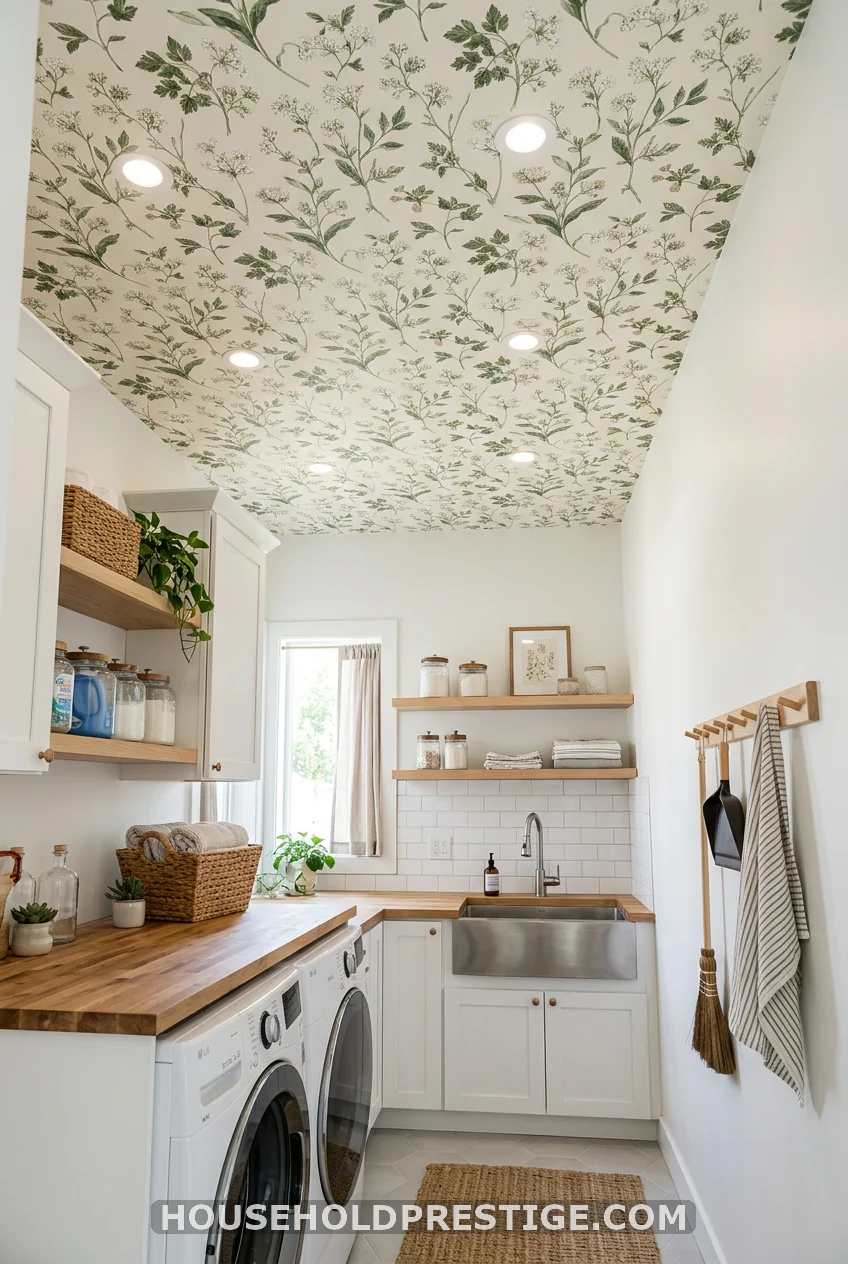
Every wall in the laundry room is competing with a washer, dryer, cabinet, or shelf. The ceiling is free real estate.
One roll of a delicate floral or simple geometric print on the ceiling pulls your gaze upward and makes the room feel taller, not busier. Keep the walls neutral to balance it. This is the single highest-impact, lowest-disruption move in the laundry room — the appliances don’t move, the installation is one surface, and guests will ask about it every time.
9. Cape Cod Coastal Print
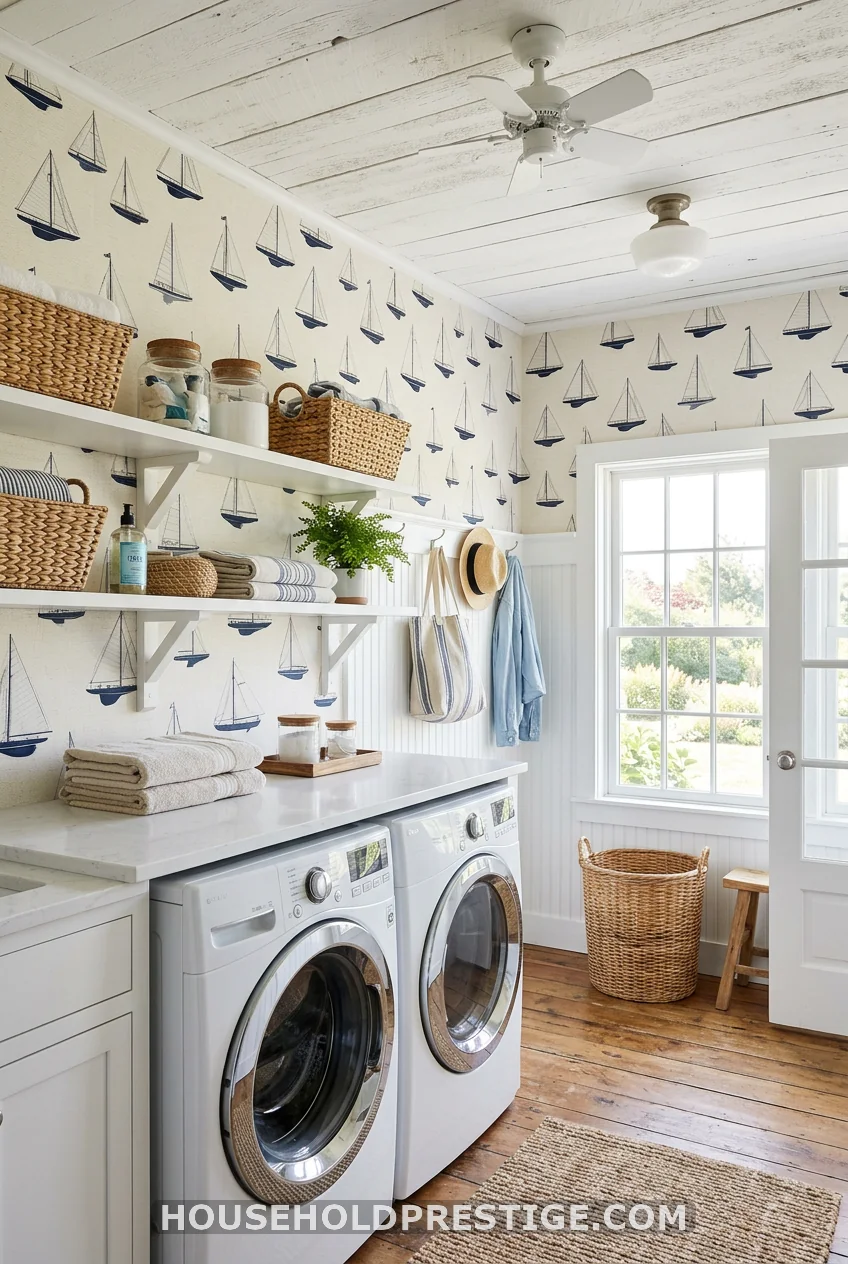
If your laundry room sits adjacent to the back door, treat it as part of the mudroom aesthetic.
Cape Cod-style prints — sailboats, navy-and-white cabana stripes, anchor motifs, or lobster prints — work particularly well in laundry rooms that handle beach bags, wet swimwear, and sandy floors. The pattern reads as “we know what this room does, and we’re having fun with it.” Pair with wicker storage baskets, a white utility sink, and shiplap or beadboard on lower walls for a full coastal effect.
Mitchell Black’s Sailboats Blue print (~$42/roll) and York’s Blue Heron stripe (~$38/roll) are both well-reviewed for humid-adjacent spaces. Use the vinyl-coated version only — many coastal prints come in natural paper variants that will not survive regular steam exposure.
10. Vintage Toile
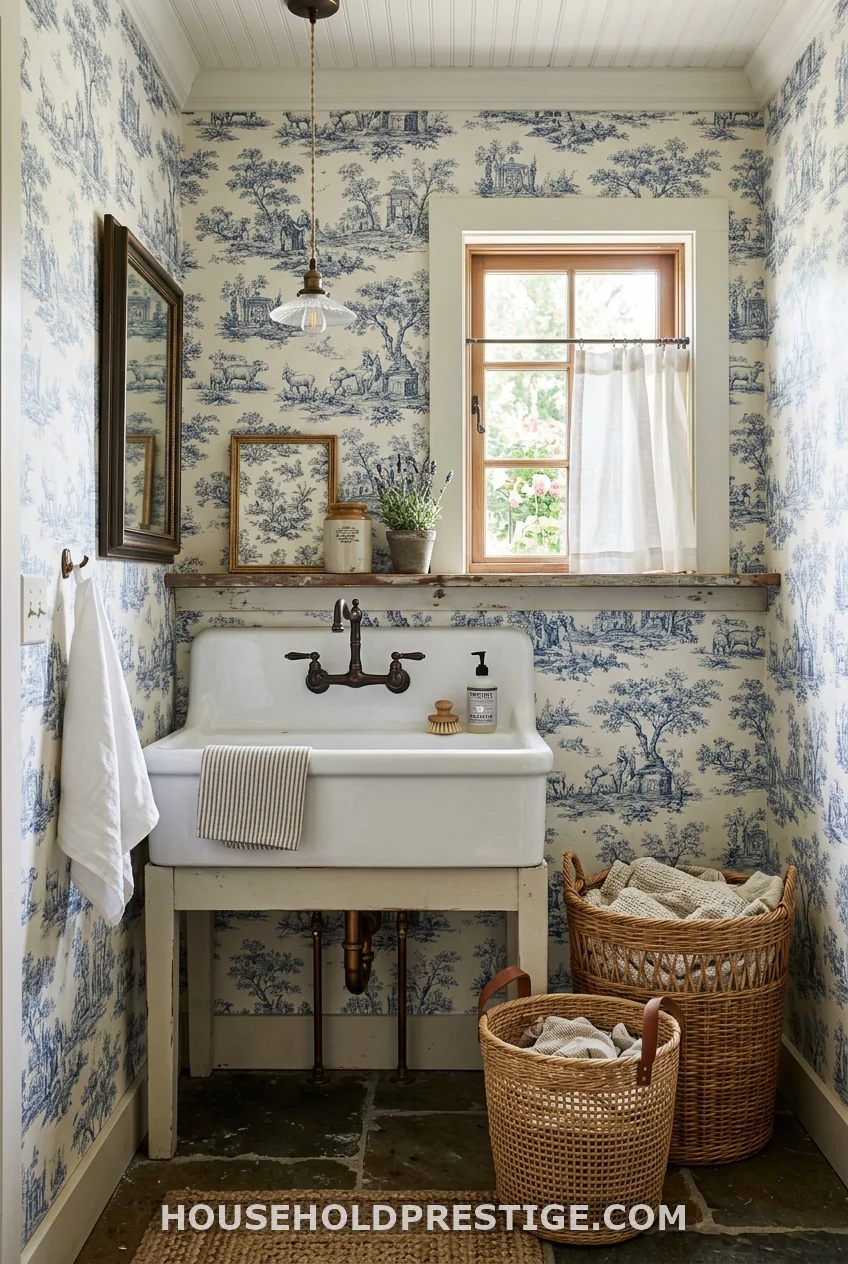
Blue-and-white French toile on a laundry room wall is an interior design cheat code. It says “I have opinions about rooms that work hard” without saying a word. Pair with oil-rubbed bronze hardware, a farmhouse sink, and woven baskets. Done. No further decisions required.
11. Abstract Geometric Tile-Effect
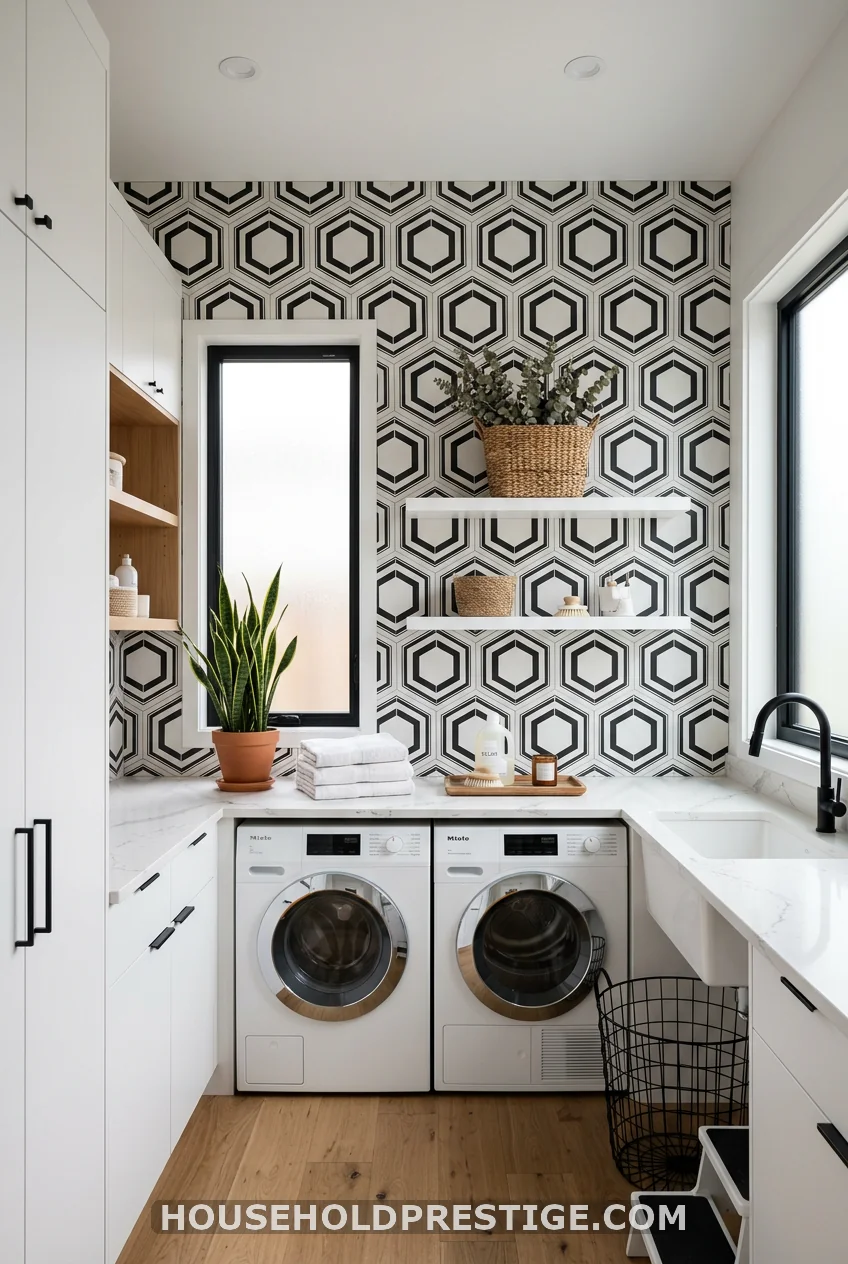
Tile-effect wallpaper does something conventional pattern prints can’t: it makes a room read as finished in a way that feels structural rather than decorative.
A geometric tile-effect print in black and white can make a builder-grade laundry room look like a considered interior. Scale matters — choose a pattern where each “tile” unit is at least 4–6 inches for a laundry room; smaller repeats get busy on a wall that’s already visually occupied. Pair with white flat-front cabinets, chrome hardware, and a concrete-effect countertop for a clean modern result.
This look also photographs well if you’re staging a home for sale. Buyers read “tile” as “renovated.” The cost difference is significant: tile-effect wallpaper at $35–50 per roll versus actual ceramic tile at $4–8 per square foot installed.
12. Soft Fern, Modern Minimal
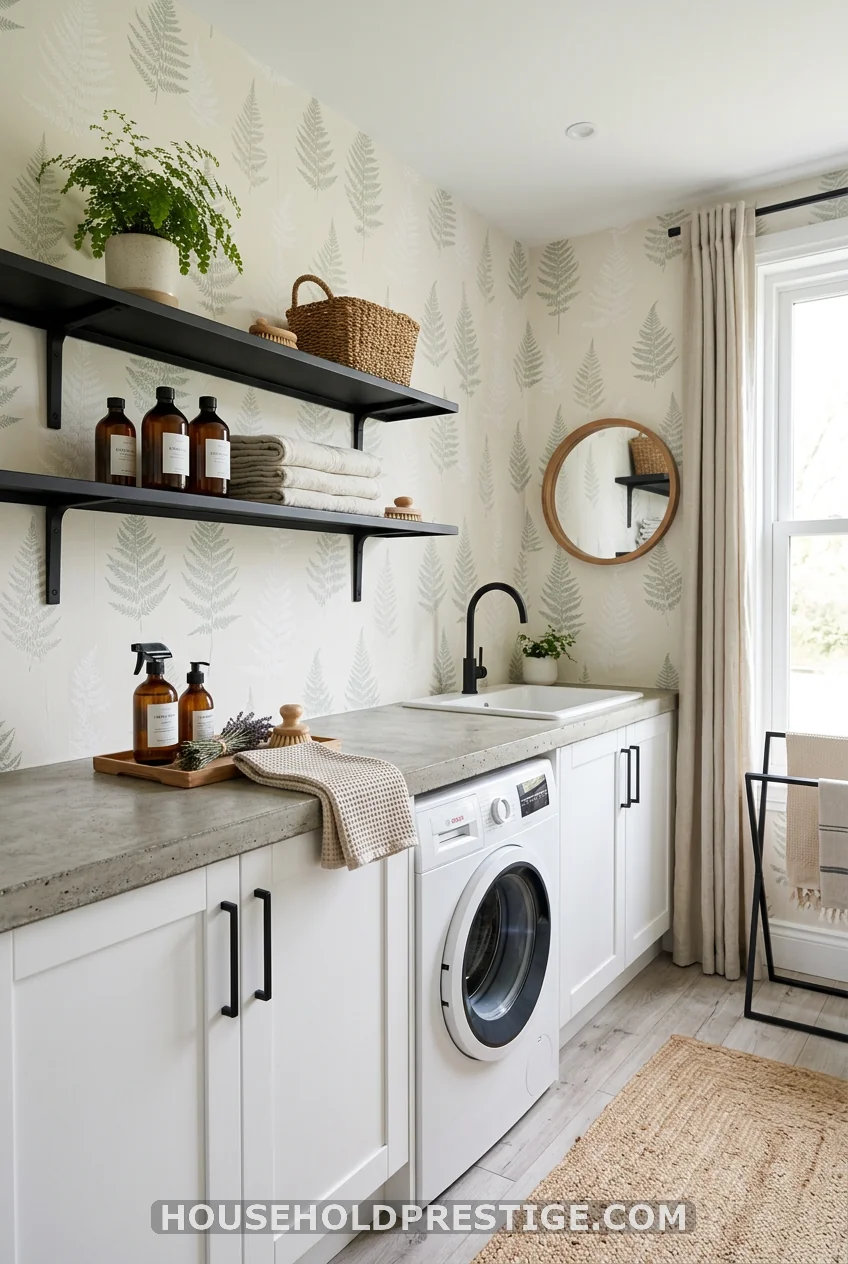
Not every laundry room needs to make a statement. Some just need to feel like they were thought about.
A soft fern print on a white or cream background does exactly that. It’s recognizably a design choice without demanding attention. The green tone brings freshness that a plain white wall never quite achieves, and it works with nearly every cabinet color — white, black, navy, sage, or natural wood. Tempaper’s Fern collection (~$48/roll) and Hygge & West’s botanical offerings (~$58/roll) are both vinyl-coated and easy to clean — the two requirements that matter most in this room.
13. Regal Botanical: The Peacock Print
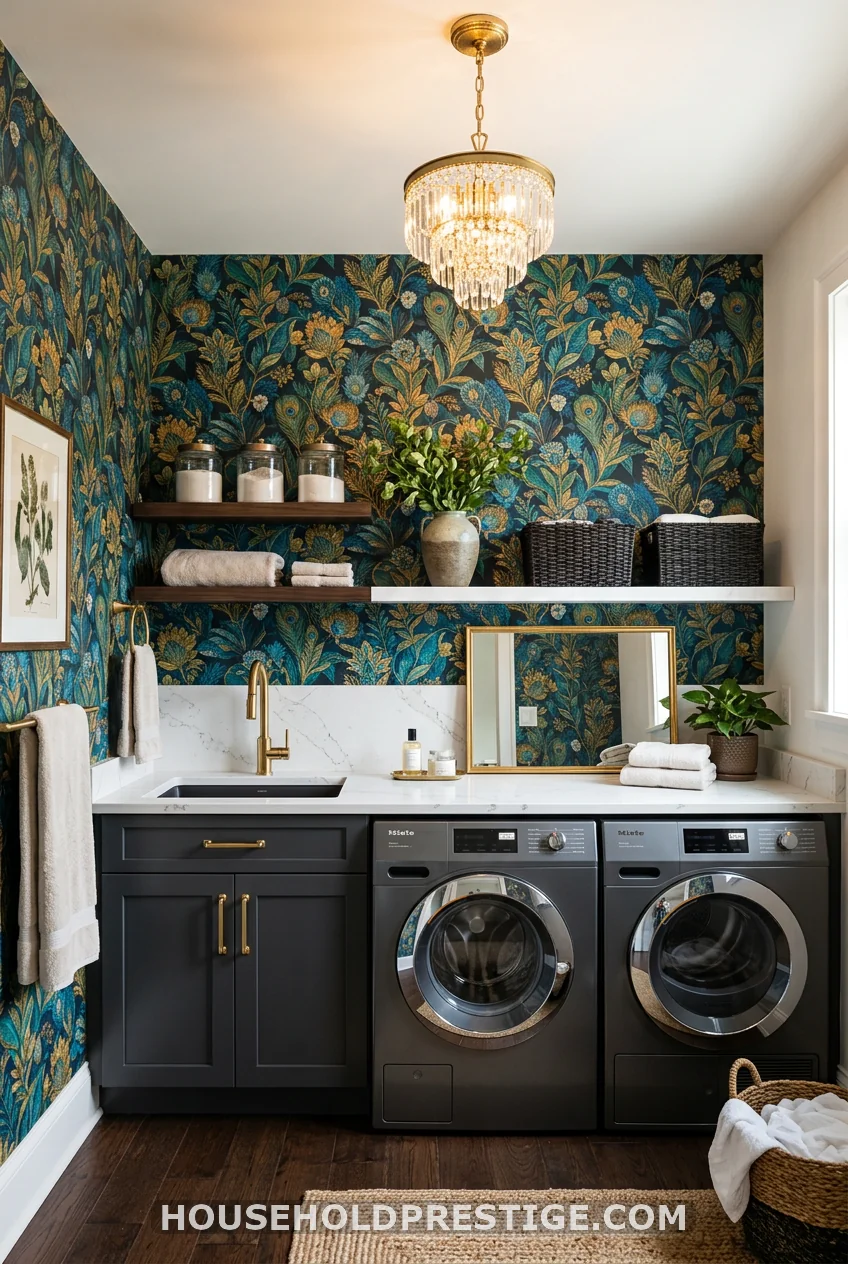
This is the laundry room that stops visitors and makes them reconsider their own choices.
The peacock botanical print — jewel-toned blues, teals, and golds in an ornate Victorian-inspired floral pattern — works in the laundry room for the same reason it works in powder rooms: go big in the small space. The richness of the pattern absorbs the machinery around it and makes the whole room read as cohesive rather than cluttered.
For the fully realized version: deep navy or charcoal lower cabinets, polished brass or unlacquered gold hardware, a white or cream countertop, and a small decorative pendant light. The wallpaper should run floor to ceiling. Partial wall treatments undersell it completely.
Wallblush’s Peaceful Botanical (~$95/roll) is the most-pinned version and is worth the price for print quality. Hygge & West’s Deco collection (~$72/roll) offers a slightly restrained take at a lower cost. Budget for 4–5 rolls for a full accent wall, and apply a clear matte sealant spray ($12–18) over the finished installation to protect against cleaning product splashes.
14. Oversized Tropical Leaf
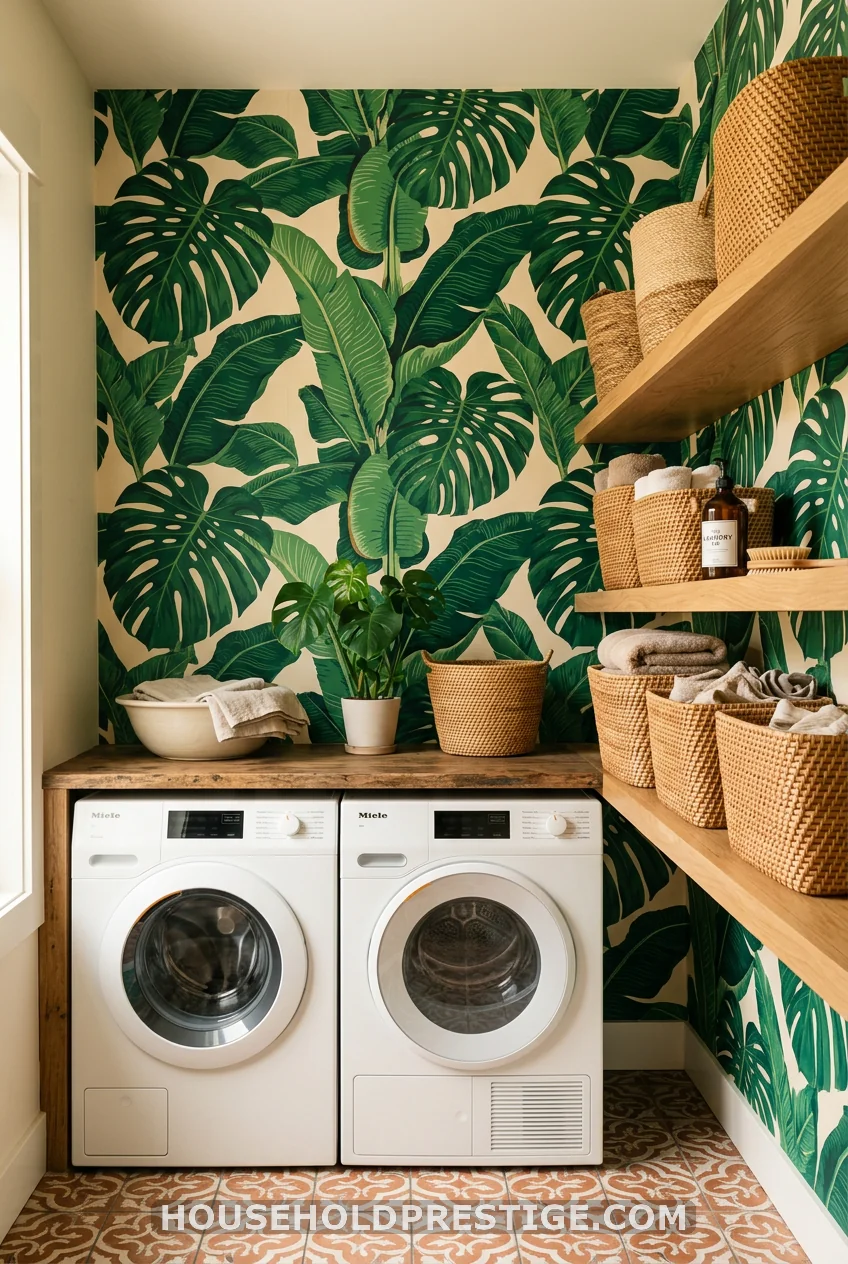
Go large or don’t bother.
Tropical leaf wallpaper works when the print scale matches the scale of the machinery. Small tropical prints disappear next to a full-size washer/dryer stack. Oversized monstera leaves, banana-leaf prints, or bird-of-paradise fronds hold their visual weight. Choose a cream or warm-white background if your room has no window — deep green on cream reads as fresh; deep green on a stark white background can tip cold.
Spoonflower’s Tropical Paradise print (~$45/roll, vinyl option) and Tempaper’s La Palma collection (~$55/roll) are both reliable. Pull one color from the wallpaper — the deep green — into your cabinet color or a single hardware finish to make the design feel intentional rather than decorative.
15. Whimsical Novelty Print
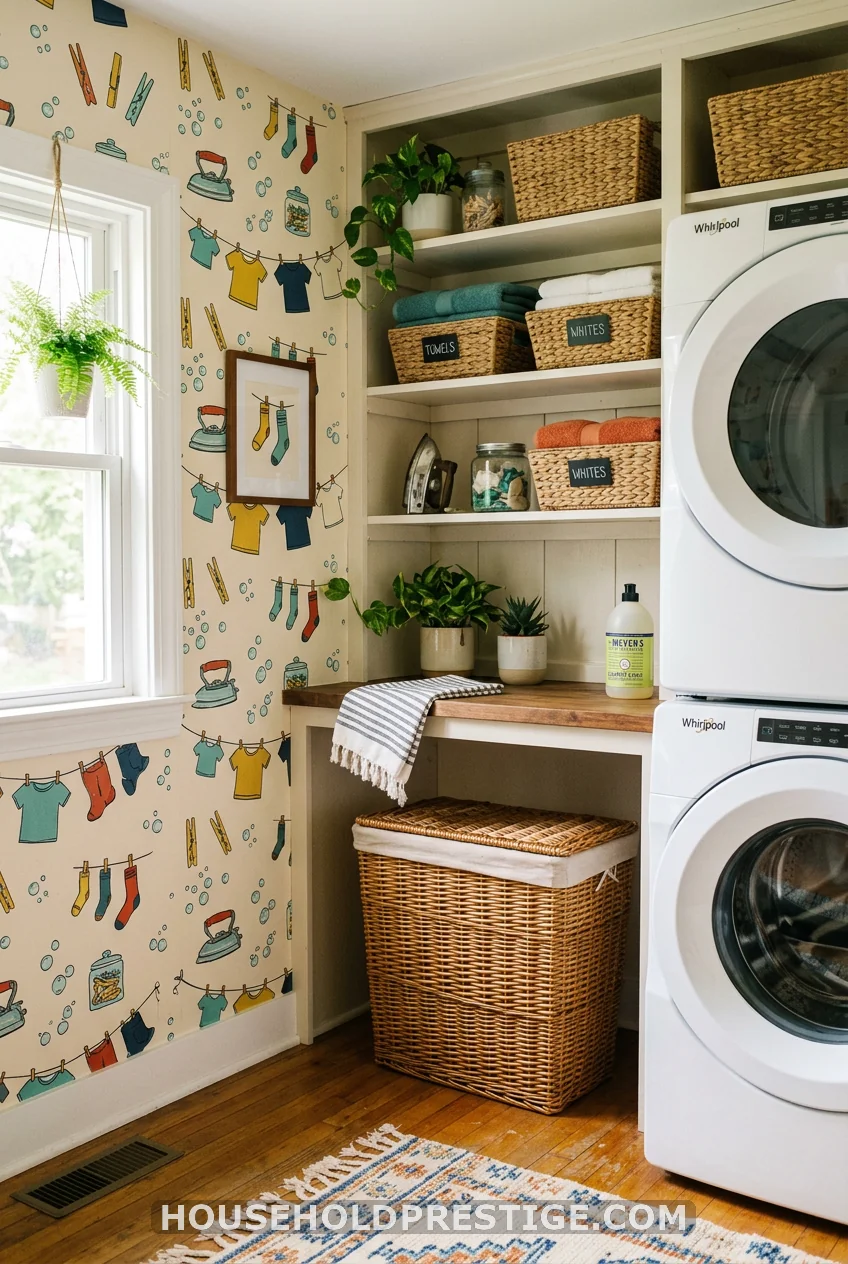
Some rooms deserve a sense of humor about what they’re for.
Novelty prints — laundry-themed illustrations, vintage detergent label patterns, illustrated clotheslines, soap bubble motifs — are underused in the one room they were practically designed for. A laundry-themed print in the laundry room is the kind of choice that reads as intentional and self-aware rather than cute. Keep it in a vintage-illustration style (mid-century commercial art aesthetic) rather than cartoon for a result that ages well. Pair with a warm background color — cream, butter yellow, or terracotta — and simple painted wood shelving to let the print lead.
Conclusion
Wallpaper is the fastest single change you can make to a room that’s been coasting on “functional.” The laundry room doesn’t need a renovation — it needs a wall that earns some attention.
Pick the style that fits where you are. Moody botanical if you’re committing fully. Peel-and-stick floral if you’re renting. Vertical stripe if the room is more hallway than room. Novelty print if you’d rather smile every time you run a load. The aesthetic choices are wide open. The only firm rule is materials: vinyl-rated wallpaper in the laundry room, always.
FAQ
What type of wallpaper is best for a laundry room?
Vinyl-coated or vinyl-faced wallpaper rated “scrubbable” or “washable” is the right choice. The laundry room generates heat and humidity from the dryer and washing machine, so paper-backed, fabric-backed, or natural fiber wallpapers will bubble, peel, or develop moisture problems within months. Peel-and-stick vinyl at 4 mil or thicker is the best option for renters or anyone who wants a removable solution.
Can I use peel-and-stick wallpaper in a laundry room?
Yes, with the right product and proper wall prep. You need a vinyl peel-and-stick rated for humid environments — Tempaper, Chasing Paper, and NuWallpaper all make suitable options. Prep the wall by wiping it with isopropyl alcohol first and letting it dry fully. Avoid applying over matte paint, which can lift off when you remove the paper. A single accent wall behind the machines is the most practical and best-looking approach.
Should I wallpaper the whole laundry room or just one wall?
An accent wall behind the washer and dryer delivers about 80% of the visual impact for a fraction of the material cost and installation effort. Full-room wallpaper works well in larger laundry rooms with high ceilings or when the goal is a truly immersive aesthetic. For most standard laundry rooms under 80 square feet, one statement wall is both the practical and better-looking choice.
What wallpaper pattern makes a small laundry room look bigger?
Vertical stripes create the illusion of height, making low ceilings read taller. Light-colored prints on a white or cream background reflect ambient light and keep the space from feeling enclosed. Avoid very small-scale all-over prints in tiny rooms — they can read as busy rather than interesting. One oversized botanical motif on an accent wall reads as open and airy rather than compressed.
How do I protect laundry room wallpaper from steam and moisture?
Choose vinyl-coated wallpaper and seal all seams with a seam roller immediately after hanging. Leave a 1–2 inch gap between the machines and the wall at floor level to allow heat ventilation from the dryer. If your laundry room lacks ventilation, run a small exhaust fan during and after laundry cycles. For extra protection, apply a clear matte sealant spray — available at hardware stores for $12–18 — over the finished wallpaper installation as a topcoat.