

You scroll past another resort photo — turquoise water, smooth concrete deck, some kind of waterfall — and think, that’s not my backyard. But it could be closer than you think. Fiberglass pools have genuinely changed the game for regular homeowners, not just resort developers. They go in faster, they cost less to maintain, and the design options have gotten so good it’s almost unfair.
This post breaks down 19 fiberglass pool ideas across every style, size, and budget. Whether you’re working with a postage-stamp yard or half an acre, there’s something here that will work for you. By the end, you’ll know exactly what to ask for — and what to skip.
1. Zero-Entry Beach Pool
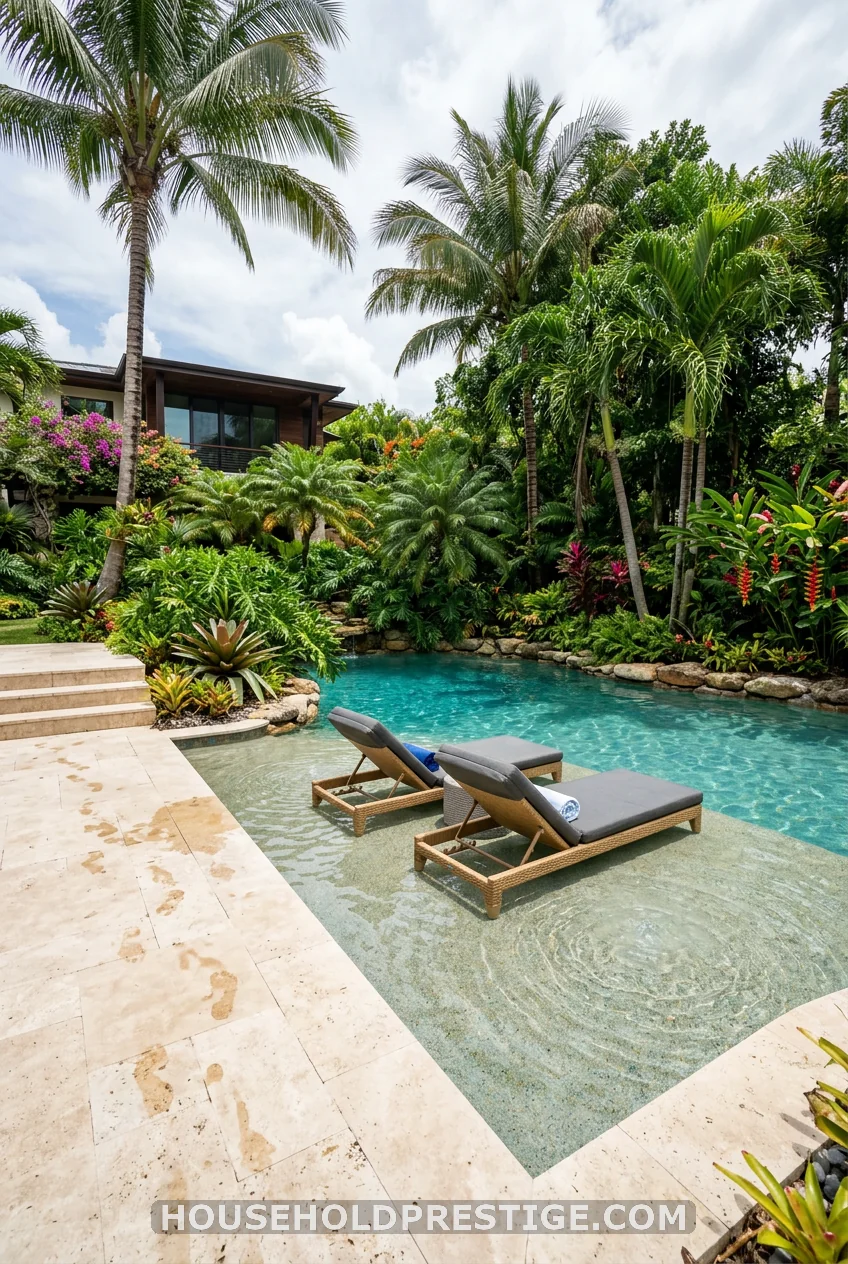
Picture walking into a pool the way you’d walk into the ocean. No ladder. No steps. Just a gentle slope from the deck straight into the water. That’s the zero-entry (also called beach entry) pool, and it’s the most-saved pool design on Pinterest for a reason.
Thursday Pools holds the US patent on fiberglass beach entry designs, which tells you how new this concept is in the fiberglass world. Their Grace and Sandal models are the main options — Grace is a classic rectangle, Sandal is freeform. Both slope from zero inches at the deck edge to about 18 inches deep before transitioning into the main swim area.
The practical benefits are real. Little kids can wade without parental panic. Dogs can get in and out without scratching a vinyl liner. Older adults who struggle with steps genuinely love it. And for anyone who just wants to cool their feet without committing to a full swim, it’s perfect.
Plan on roughly $1,800 per linear foot installed. It’s not the cheapest option, but the Pinterest traction it generates for your listing when you eventually sell? Priceless.
2. Tanning Ledge With Ledge Loungers
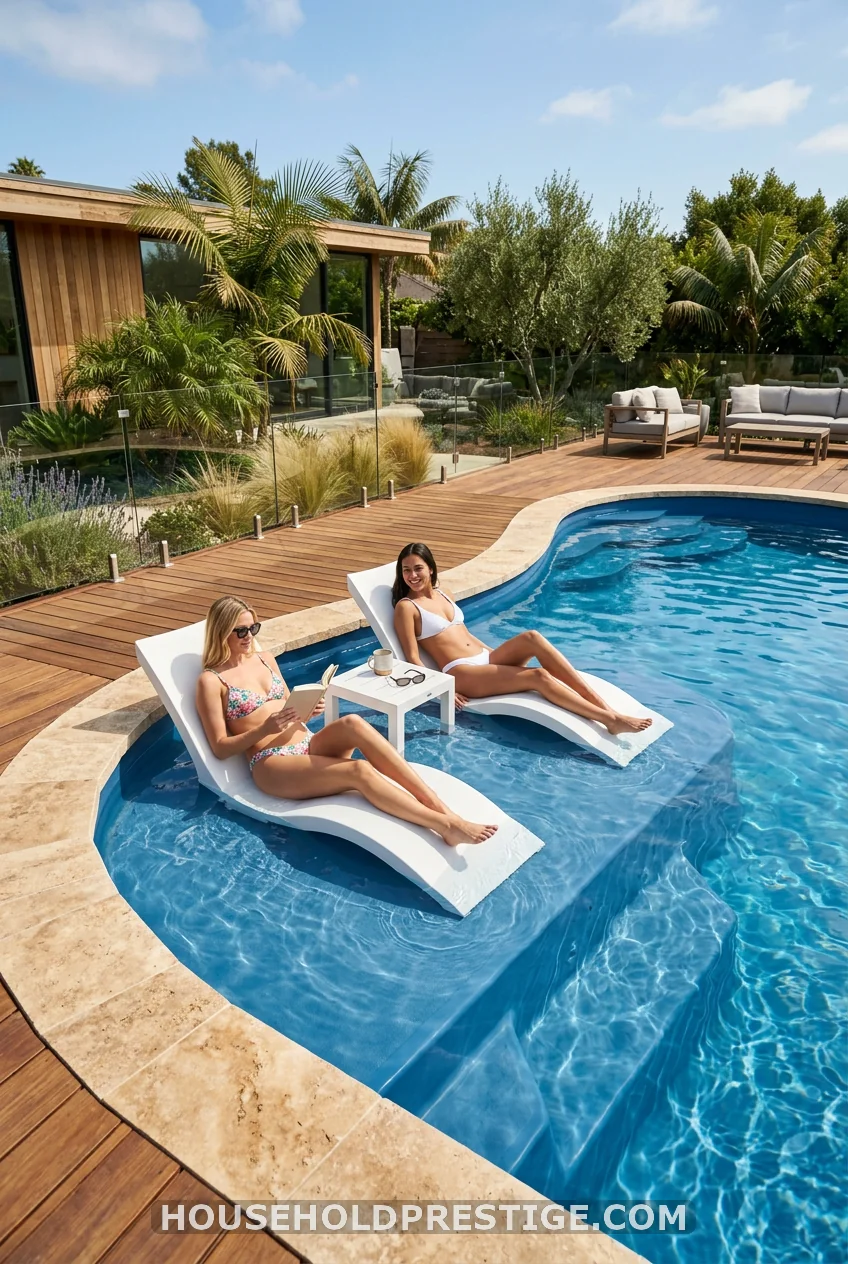
Built-in tanning ledges are the most requested fiberglass feature right now. A 12-inch deep platform at the shallow end holds 6–8 inches of water — enough to keep you cool, shallow enough to sunbathe. Two Ledge Lounger Original chairs ($700–900 each) turn that ledge into a resort spot. The ledge doesn’t add cost when it’s molded into the shell, which is the whole advantage of fiberglass over concrete.
3. Plunge Pool for a Small Backyard
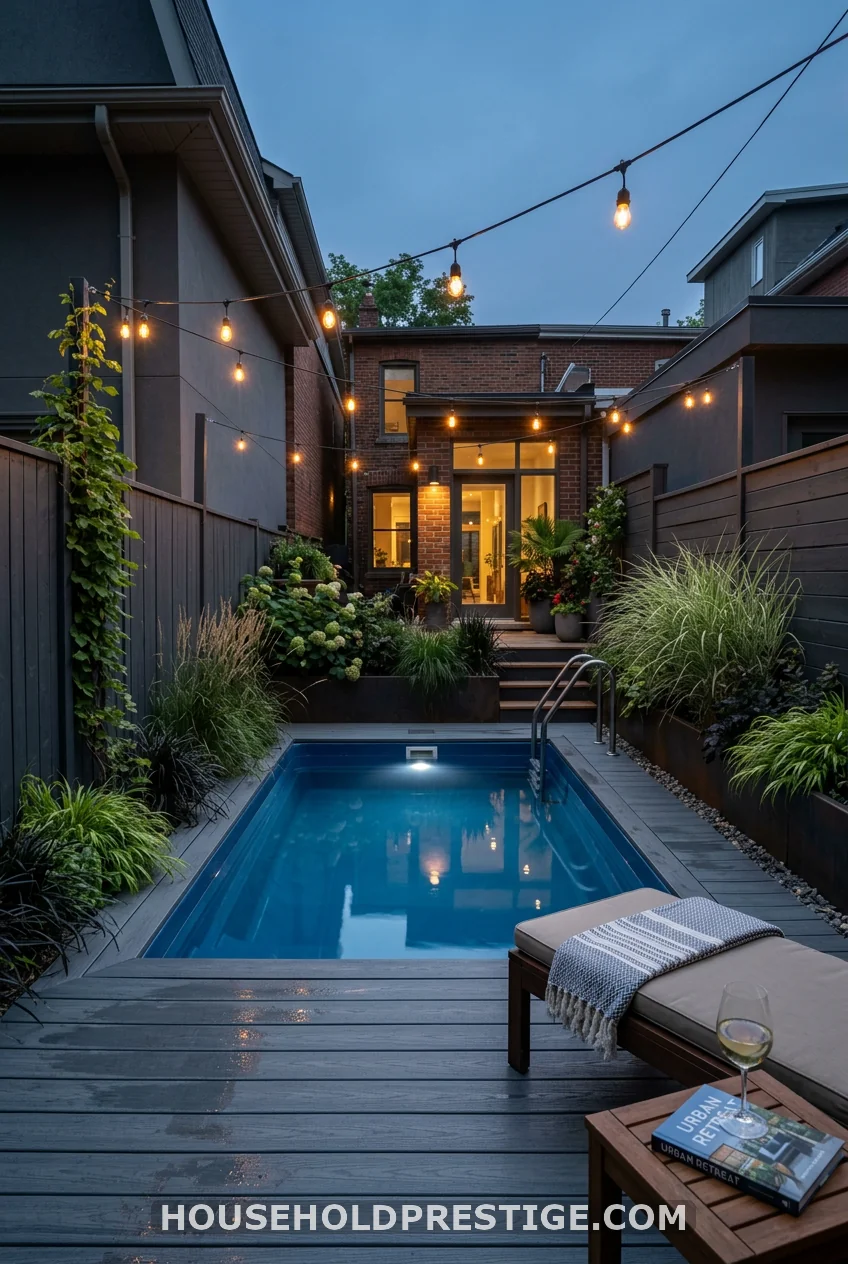
Small yard? A fiberglass plunge pool — typically 8×16 to 10×20 feet — fits where traditional pools can’t. Shells start around $12,000–$16,000 for small models, with full installation landing between $35,000–$55,000. Monthly maintenance runs $80–100, about a third less than a full-size pool.
4. Saltwater Fiberglass Pool — The Complete Setup
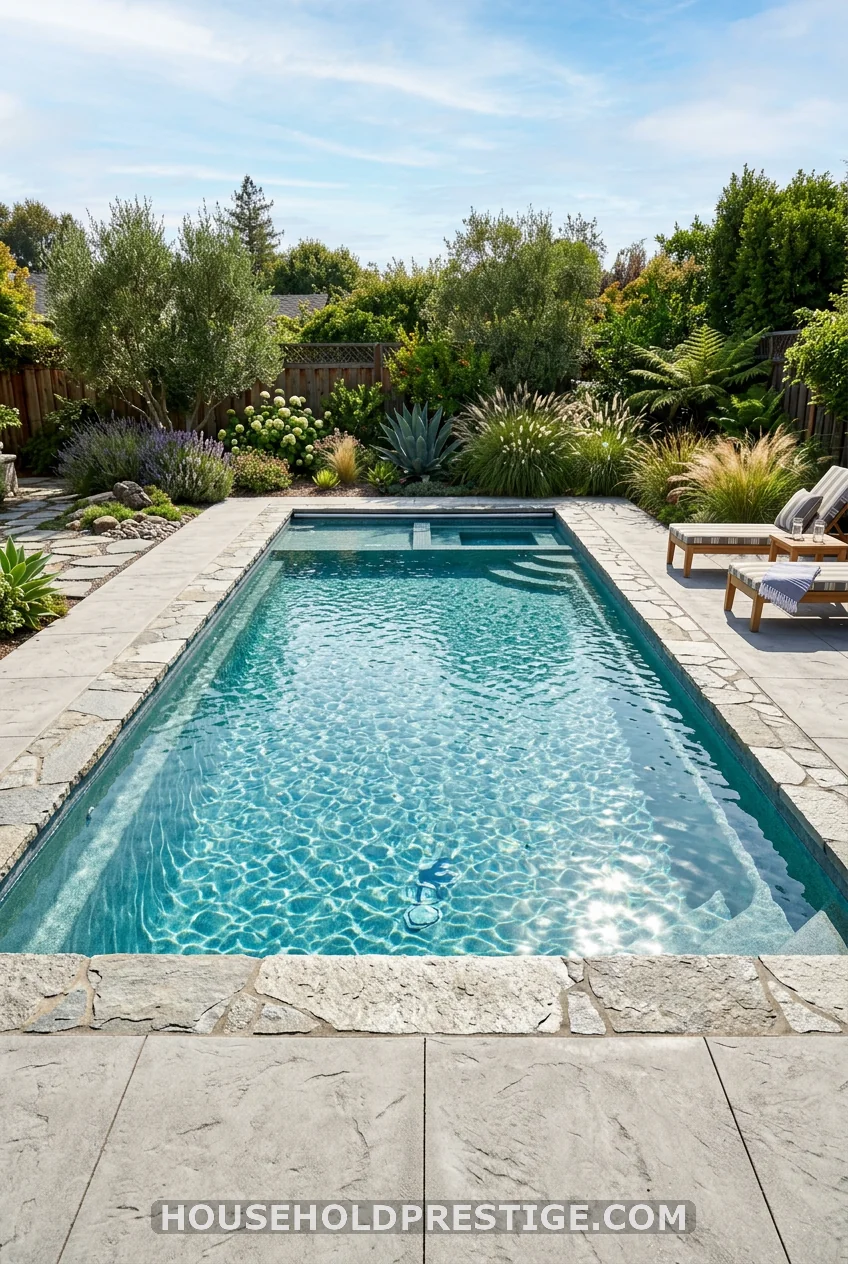
This is the one worth doing right, so I’m going all in on the details.
Saltwater pools get talked about like they’re exotic. They’re not. A saltwater system is just a chlorine generator — it converts dissolved salt into chlorine continuously, which means you’re not manually adding chlorine tablets or shock as often. The salt level in a well-maintained saltwater pool is about 3,200 ppm. The ocean, for comparison, is 35,000 ppm. You won’t taste salt. You won’t feel sticky. Your eyes won’t burn.
Fiberglass is the ideal surface for a saltwater system. Here’s why: concrete pools with a salt system need their plaster or pebble finish resurfaced every 10–15 years because salt is mildly corrosive. Fiberglass is non-porous and chemically inert, so the salt does nothing to the surface. Vinyl liner pools are theoretically fine with salt, but the liner seams and vinyl itself can degrade over time with repeated salt exposure.
Why It Works for Fiberglass
The gelcoat surface on a fiberglass pool doesn’t absorb water or salt. That means no algae pores for bacteria to hide in, no calcium buildup eating into a plaster surface, and zero resurfacing costs over a 30–50 year pool lifespan. The smooth finish also means you use fewer chemicals overall — about 50–70% less chlorine-related product than a comparable concrete pool.
What You’ll Need
Here’s the exact equipment list for a standard saltwater conversion on a fiberglass pool:
- Salt chlorine generator (SCG): Hayward AquaRite ($700–900), Pentair IntelliChlor ($800–1,100), or Jandy TruClear ($600–800). These mount inline with your plumbing and auto-generate chlorine from salt.
- Salt: Pool-grade NaCl, 99%+ purity. Budget $100–$180 for initial fill (40–50 lb bags at $10–15 each). You only top up the salt level once or twice a season.
- pH monitor: Salt systems tend to push pH high (above 7.6). A digital monitor like the Apera Instruments PC60 ($70) or a basic ORP controller for automated pH dosing ($300–600 if you want fully automated).
- Acid feeder (optional but helpful): A peristaltic dosing pump like the Blue-White Industries F-300 ($200–350) that adds muriatic acid automatically when pH climbs.
- Stabilizer (cyanuric acid): Keep CYA at 70–80 ppm for outdoor saltwater pools to prevent UV from burning off your chlorine too fast. A 10 lb bag runs $15–20.
Step-by-Step Saltwater Conversion
- Test your current water chemistry. You want: pH 7.4–7.6, alkalinity 80–120 ppm, calcium hardness 200–400 ppm, CYA 70–80 ppm. Balance these first, or your SCG will work harder than it should.
- Add pool-grade salt. Use the manufacturer’s calculator (Hayward has one online) to find exactly how many pounds to add for your pool volume. Broadcast salt across the deep end with the pump running. Don’t pile it near the skimmer.
- Run the pump 24 hours to fully dissolve the salt before starting the generator.
- Install and wire the SCG. This involves cutting into your return line to mount the cell, and wiring the control unit to a GFCI outlet. If you’re not confident with electrical work, budget $200–400 for an electrician.
- Set the generator output. Start at 50% output and test free chlorine after 24 hours. Target: 1–3 ppm free chlorine. Adjust output up or down based on results.
- Test weekly for the first month. Salt pools need less frequent chemical adjustment once dialed in, but the first few weeks require attention.
Materials & Costs Summary
| Item | Cost Range |
|---|---|
| Salt chlorine generator | $600–$1,100 |
| Initial salt load | $100–$180 |
| CYA stabilizer | $20–$40 |
| pH dosing setup (optional) | $200–$600 |
| Electrician (if needed) | $200–$400 |
| Total addition cost | $1,120–$2,320 |
Annual maintenance savings vs. traditional chlorine: $300–$600/year in chemical costs. Most saltwater systems pay for themselves in 3–4 years.
Common Mistakes to Avoid
- Letting salt levels drop below 2,700 ppm. The SCG will shut off to protect itself, and you won’t know until your pool turns green. Test salt monthly.
- Skipping a stabilizer. UV destroys chlorine fast without CYA, especially in sunny climates. If your fiberglass pool is in the sun all day, keep CYA at 70–80 ppm.
- Choosing a cell that’s undersized for your pool. A Hayward AquaRite is rated for pools up to 40,000 gallons in a 12-hour pump cycle. If your pool is 20,000 gallons but you only run the pump 6 hours a day, you’ll need to run it longer or get a higher-output cell.
- Ignoring pH. Saltwater pools are notorious for drifting to high pH (7.8–8.2). High pH makes your chlorine less effective and can cloud the water. Check pH twice a week until you know your pool’s drift rate.
Brand Recommendations
Hayward and Pentair are the two most trusted names. Hayward’s AquaRite is the most widely installed residential SCG in the US and has the deepest service network. Pentair’s IntelliChlor integrates beautifully with their IntelliConnect automation systems if you want remote control via smartphone. For budget installs, the Intex KRYSTAL Clear is adequate for pools under 15,000 gallons.
5. Freeform Pool With Tropical Landscaping
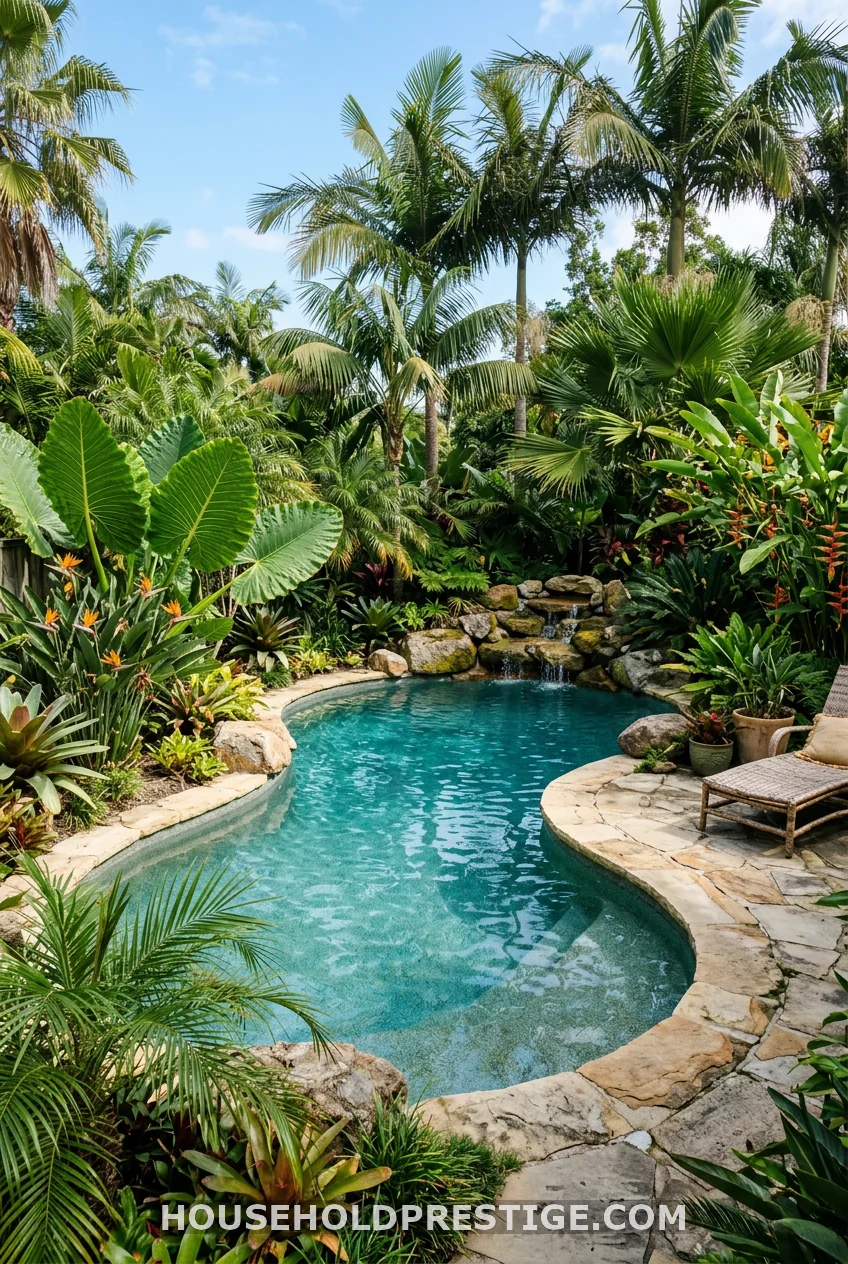
Straight lines feel formal. Curves feel like a getaway. A freeform fiberglass pool — the C Series, I Series, or similar curving designs — pairs naturally with tropical landscaping because the organic shape already echoes the chaos of a lush garden.
The landscape trick is layering. Place large-leaf plants (bird of paradise, elephant ear, canna lily) closest to the pool. Medium shrubs (dwarf oleander, areca palm) in the middle ring. Canopy trees (bismarckia palm, Sylvester date palm) at the back perimeter for privacy. Total plant cost for a 30×20 ft surround: $800–2,500 depending on plant size. The payoff is a pool that looks like it was carved from the jungle.
Avoid plants that drop debris into the water. Bougainvillea is gorgeous but notorious for clogging skimmers. Stick with plants that hold their leaves.
6. Built-In Spa Combo
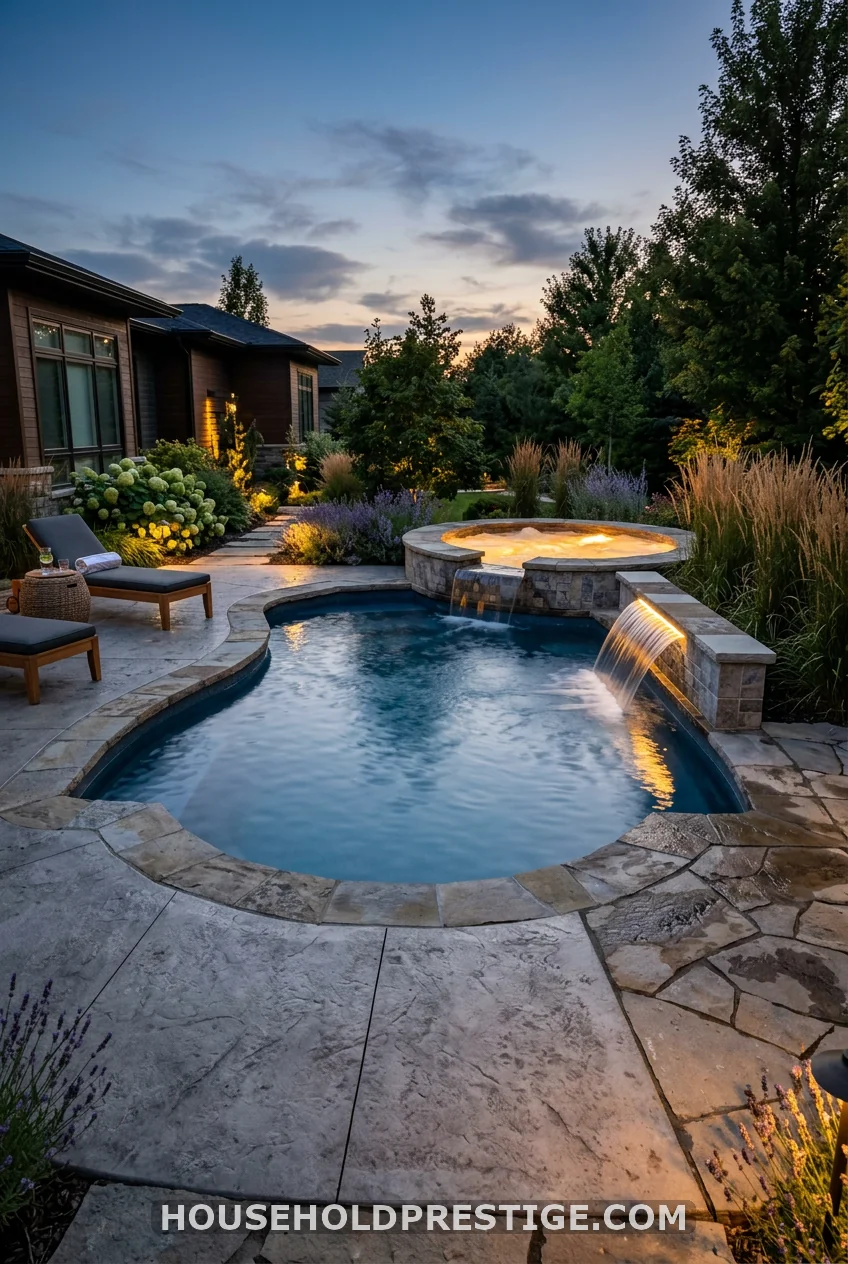
River Pools’ X36 and I25S designs come with a spa built directly into the shell — no separate concrete pour, no awkward attachment. The spa uses the same filtration system as the pool when combined through a spillway. Expect a 20–30% addition to your base pool cost for a pre-integrated spa design vs. a standalone pool.
The spillover waterfall effect between spa and pool serves double duty: it’s beautiful, and it aerate the water, which keeps chemistry more stable. If your pool is 10 feet or closer to the spa, the spray sound is genuinely relaxing.
7. Rectangular Pool With Auto Cover
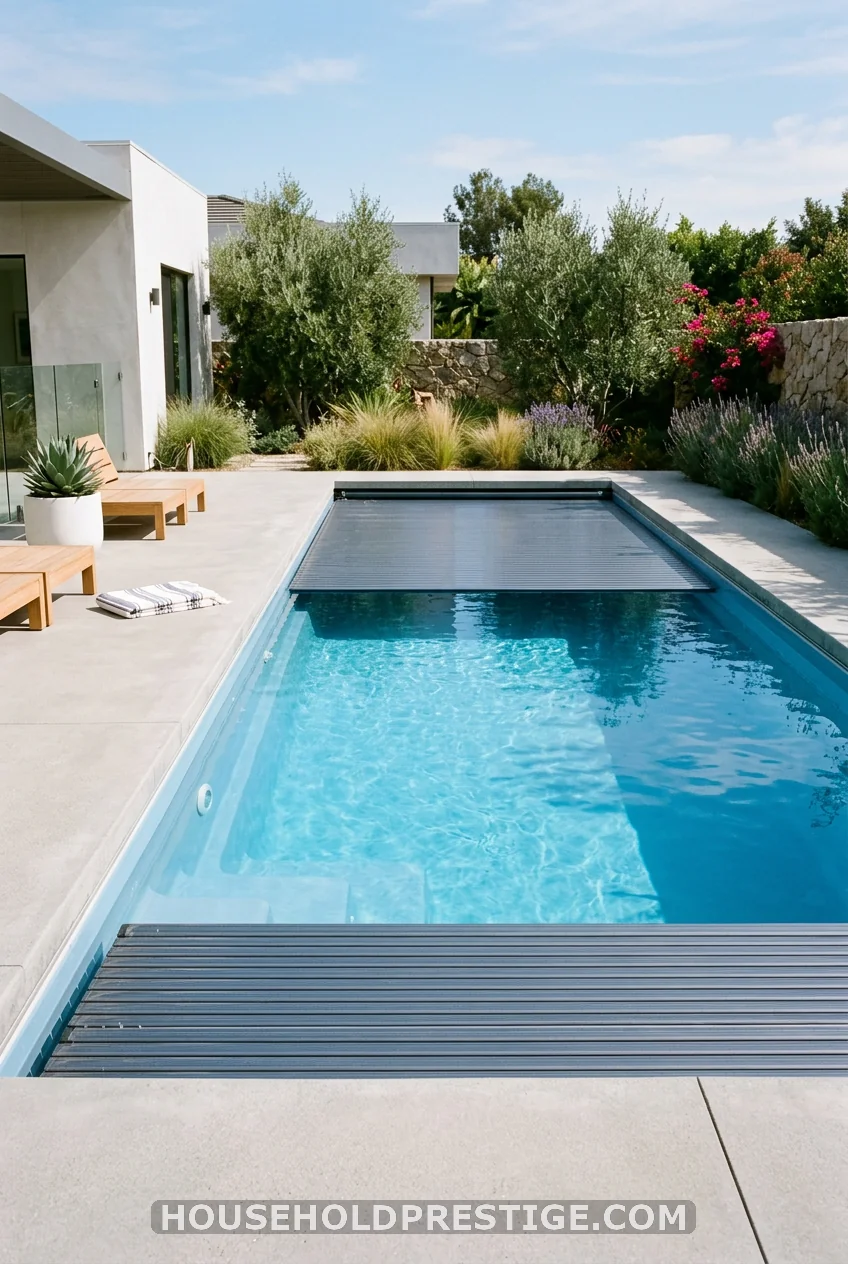
An automatic pool cover on a rectangular fiberglass pool makes child safety invisible. The cover retracts under the coping so you see nothing until you need it. Cost: $8,000–$15,000 installed. It cuts evaporation by 95% and reduces chemical use significantly. Only rectangular pools accommodate these — another reason to consider linear shapes for family yards.
8. Rock Waterfall Feature
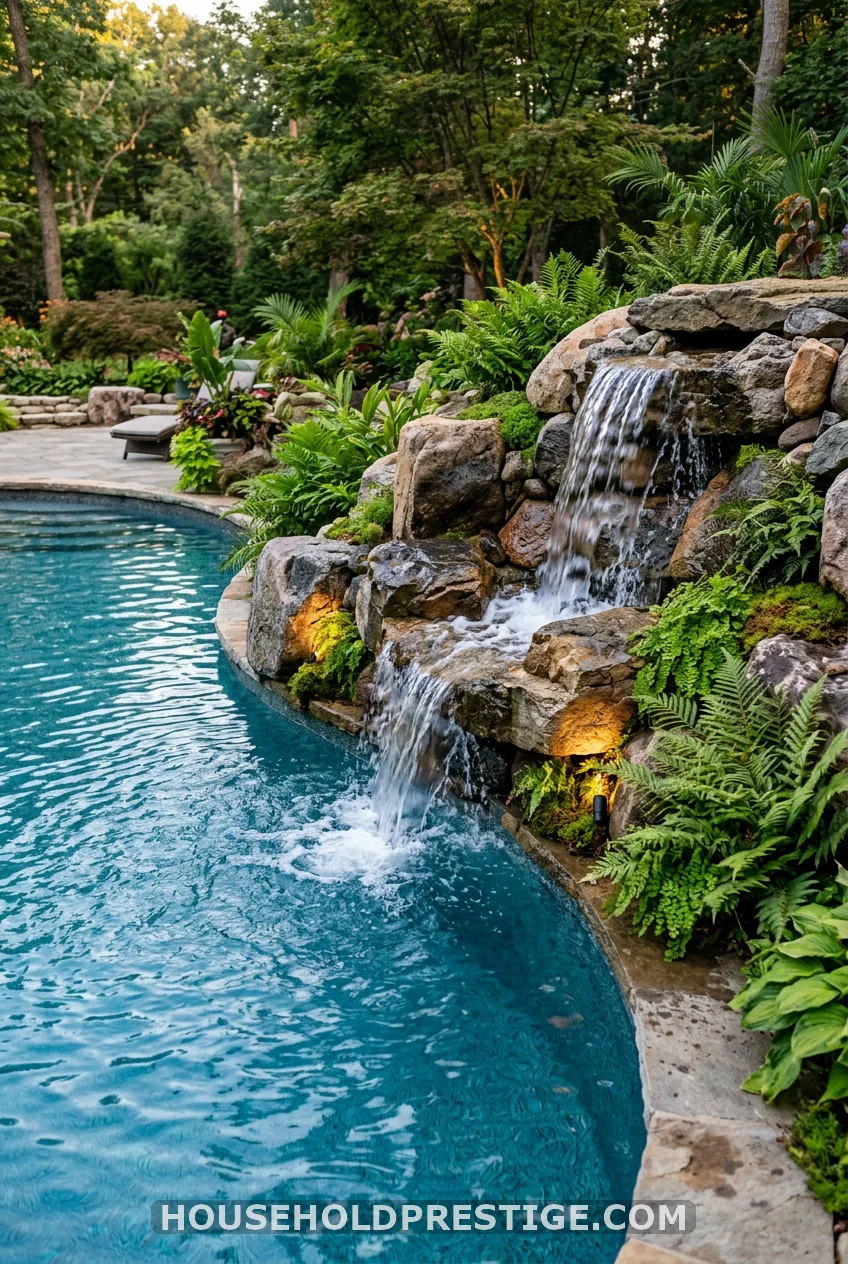
A rock waterfall is the single add-on that gets the most “wow” per dollar on Pinterest. Installed alongside a fiberglass pool, a naturalistic boulder waterfall using faux-rock construction (steel armature + shotcrete + acid stain) costs $3,000–$8,000. Real stacked boulders run $5,000–$12,000. The feature oxygenates the water and masks traffic noise with white noise. Your pool instantly reads as a resort, not a rectangle.
The install happens after the pool shell is set, but before the deck is poured, so it needs to be in your original project scope.
9. LED Color-Changing Lighting
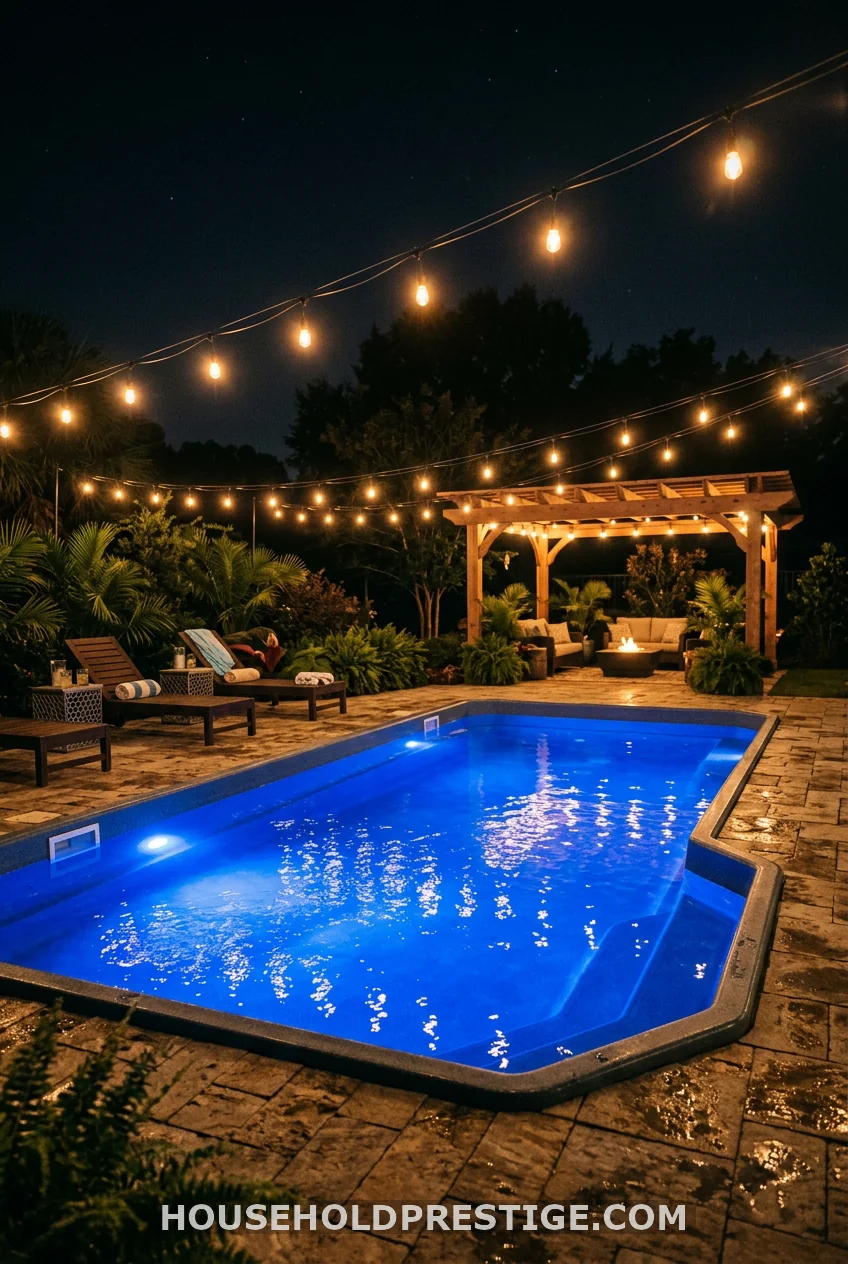
Underwater LED lighting on a fiberglass pool costs $300–$800 per light installed, and most pools need 2–3 fixtures for full coverage. Color-changing LEDs (Hayward ColorLogic, Pentair IntelliBrite) can cycle through millions of colors and be controlled via smartphone. The visual effect at night is dramatic — and it adds functional evening hours to your pool season. If you’re adding them later, expect a premium for cutting into an installed shell. Plan them during the initial build.
10. Pavers vs. Stamped Concrete Deck — The Myth Everyone Gets Wrong
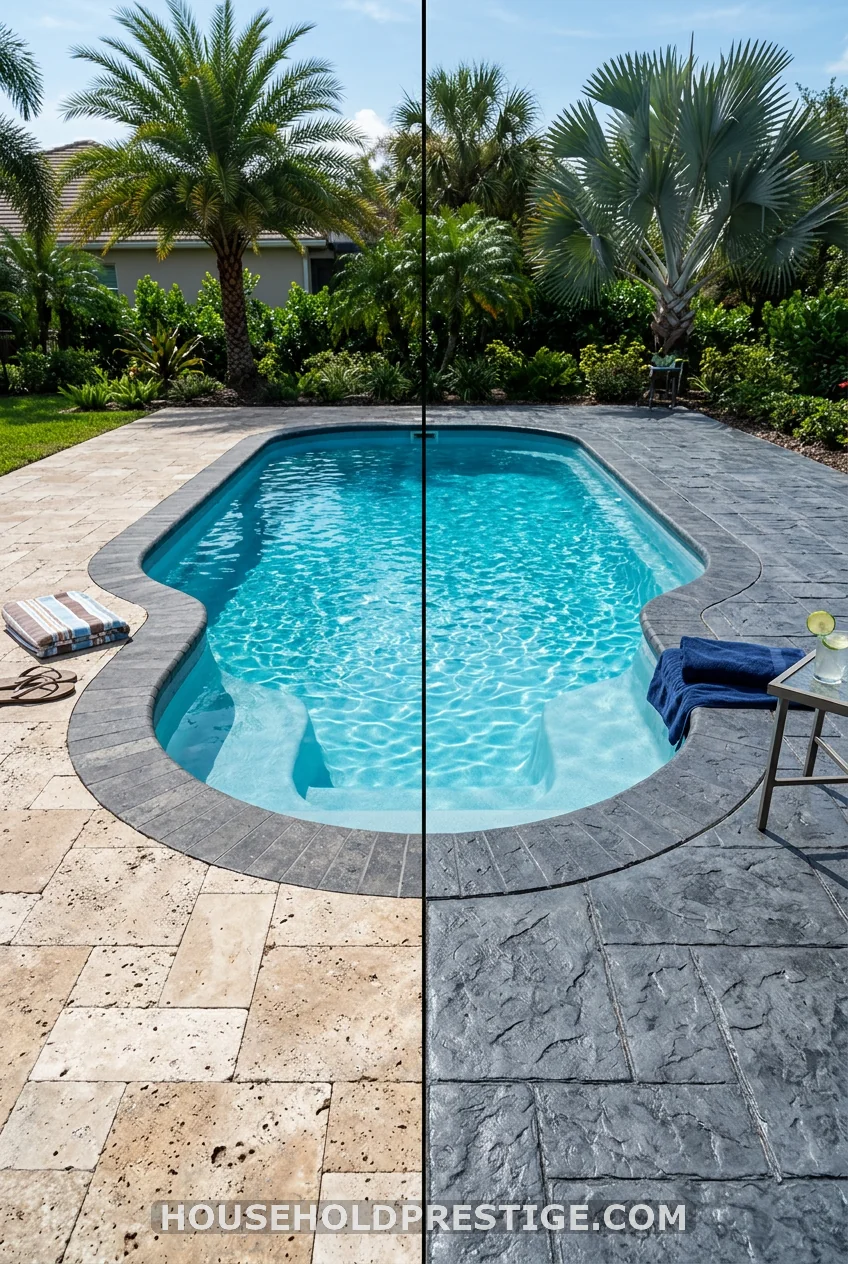
Here’s what most pool contractors won’t tell you upfront: the deck material has as much impact on your pool’s overall look as the pool itself. And there are two myths circulating that cost homeowners money.
Myth #1: “Pavers are always more expensive than stamped concrete.”
Not anymore. Travertine pavers now run $12–$20 per square foot installed. Basic stamped concrete is $8–$15 per square foot. But basic stamped concrete often cracks within 5–10 years in freeze-thaw climates, requiring $2,000–$5,000 in repairs per episode. Pavers can be individually replaced for $5–$20 each. Long-term, pavers often win on cost.
Myth #2: “Stamped concrete looks just as good.”
It looks great when it’s new. Three summers of pool chemical exposure, sunscreen, and pressure washing tends to fade stamped concrete’s color and soften the pattern. Unsealed natural travertine actually improves with age — it develops a patina that looks more natural over time, not less.
Reality: If you’re in a climate with hard winters, go pavers — the ability to pop individual ones up and relay them is worth it. If you’re in a mild climate and working with a tight budget, quality stamped concrete with a 3-year resealing schedule is perfectly serviceable. Either way, budget a minimum 400 square feet of decking around a standard 16×36 pool, at $6,400–$8,000 for stamped concrete and $9,600–$16,000 for travertine pavers.
The slip resistance matters too. For fiberglass pools (which already have a smooth surface), a slightly textured deck surface prevents accidents. Ask for a broom-finished concrete or a tumbled paver finish. Polished travertine around the water edge is a fall waiting to happen.
11. Privacy Screen Landscaping
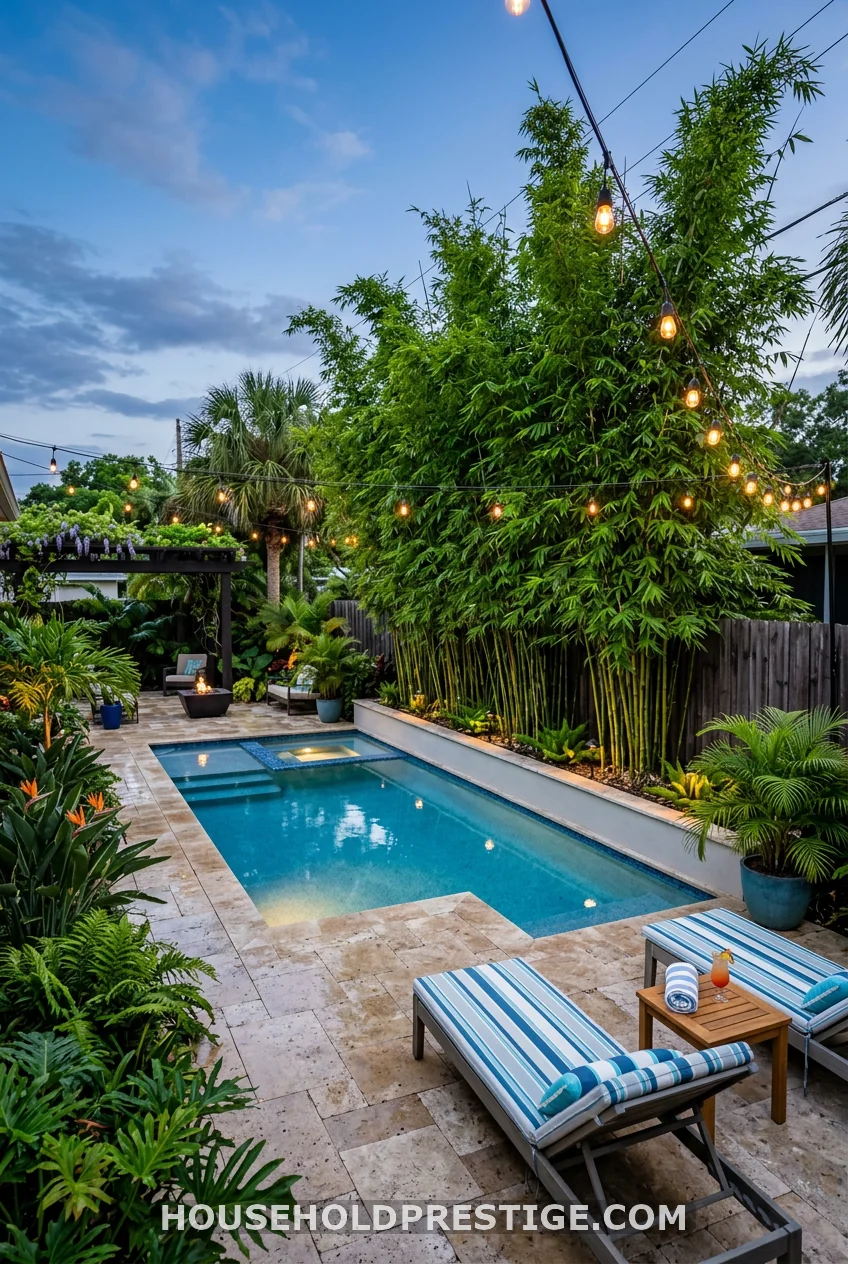
Neighbors plus a pool equals an audience you didn’t invite. The cleanest solution isn’t a tall fence — it’s a living privacy screen. Clumping bamboo (non-invasive varieties like Fargesia robusta) planted in a 12-inch deep raised planter along the property line grows 10–15 feet tall within 3 years. Cost: $60–$120 per plant at 3-foot spacing. For a 30-foot run, that’s $600–$1,200. Add a simple cedar trellis with Confederate jasmine for corners, and you’ve built a wall that looks better every year.
Arborvitae (Green Giant variety) is slower but even more evergreen and dense. Clumping bamboo in a planter bed is the faster, more dramatic option.
12. Pergola Shade Structure Over Pool Deck
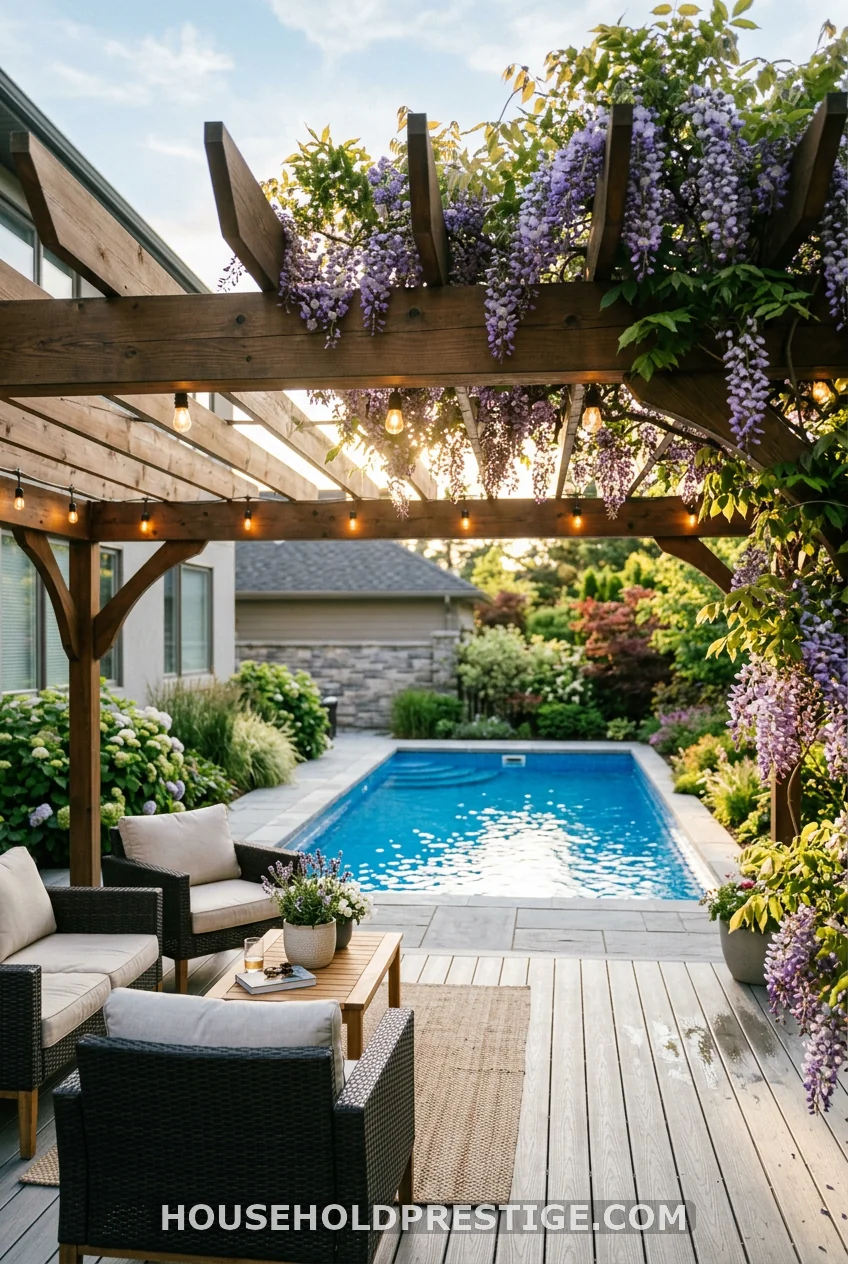
A pergola parallel to the pool’s long edge, set back 4–6 feet from the coping, gives you a shaded lounge zone without blocking pool sun. Cedar or pressure-treated pine pergola kits: $2,000–$4,000 for a 12×16 ft kit, or $5,000–$12,000 custom-built. Powder-coated aluminum pergolas ($6,000–$15,000) are the low-maintenance version.
The spacing matters. Too close and the pergola shades the water, which slows algae-fighting UV penetration and cools a pool you’ve paid to heat. Position it to shade the deck seating area, not the water.
13. Cocktail Pool Configuration for Entertaining
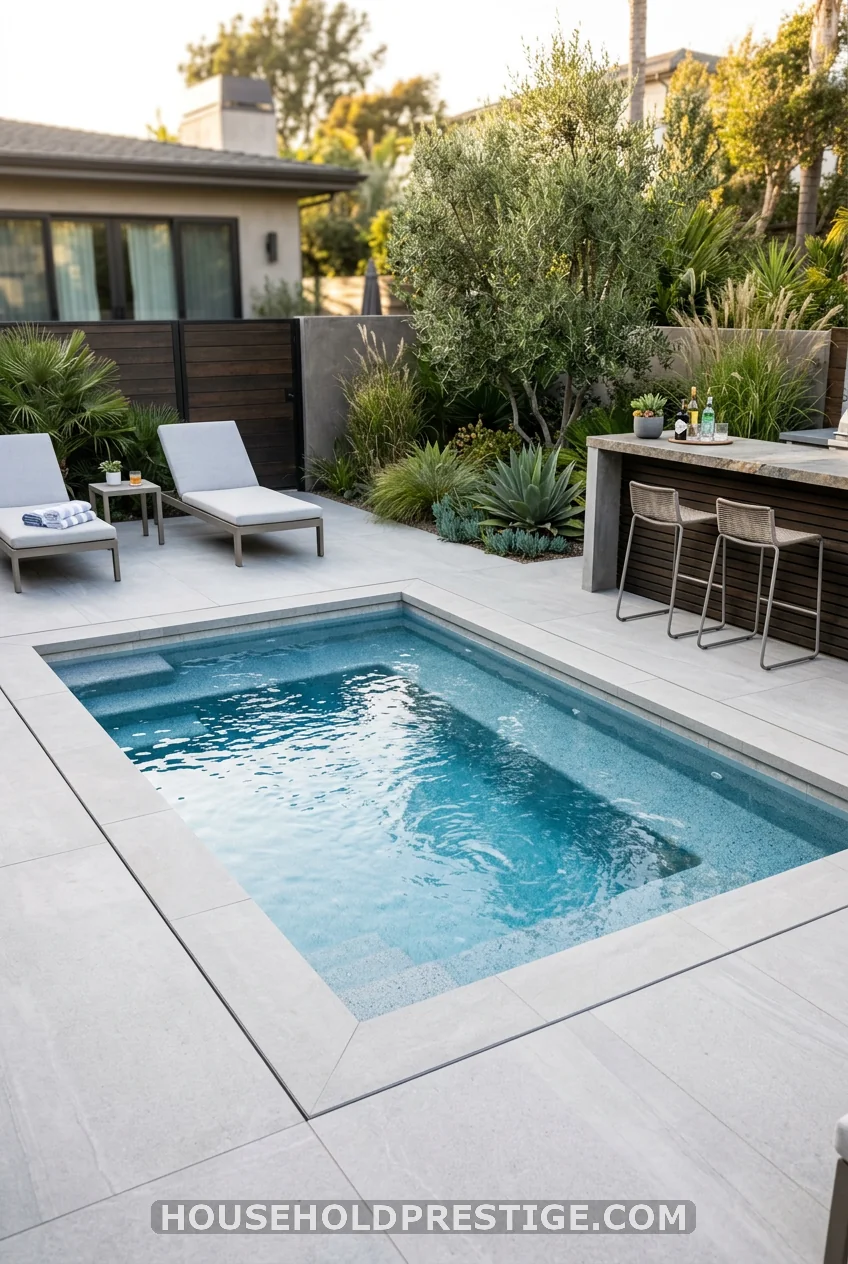
A cocktail pool (10×20 ft or smaller, 4–5 ft uniform depth) is not a compromise — it’s a design choice. Uniform depth means everyone can stand. Built-in bench seating around three walls means it functions like an outdoor living room that happens to be filled with water. Total cost: $45,000–$65,000 installed. You’re not swimming laps, but you’re not trying to.
14. Fire Feature Poolside
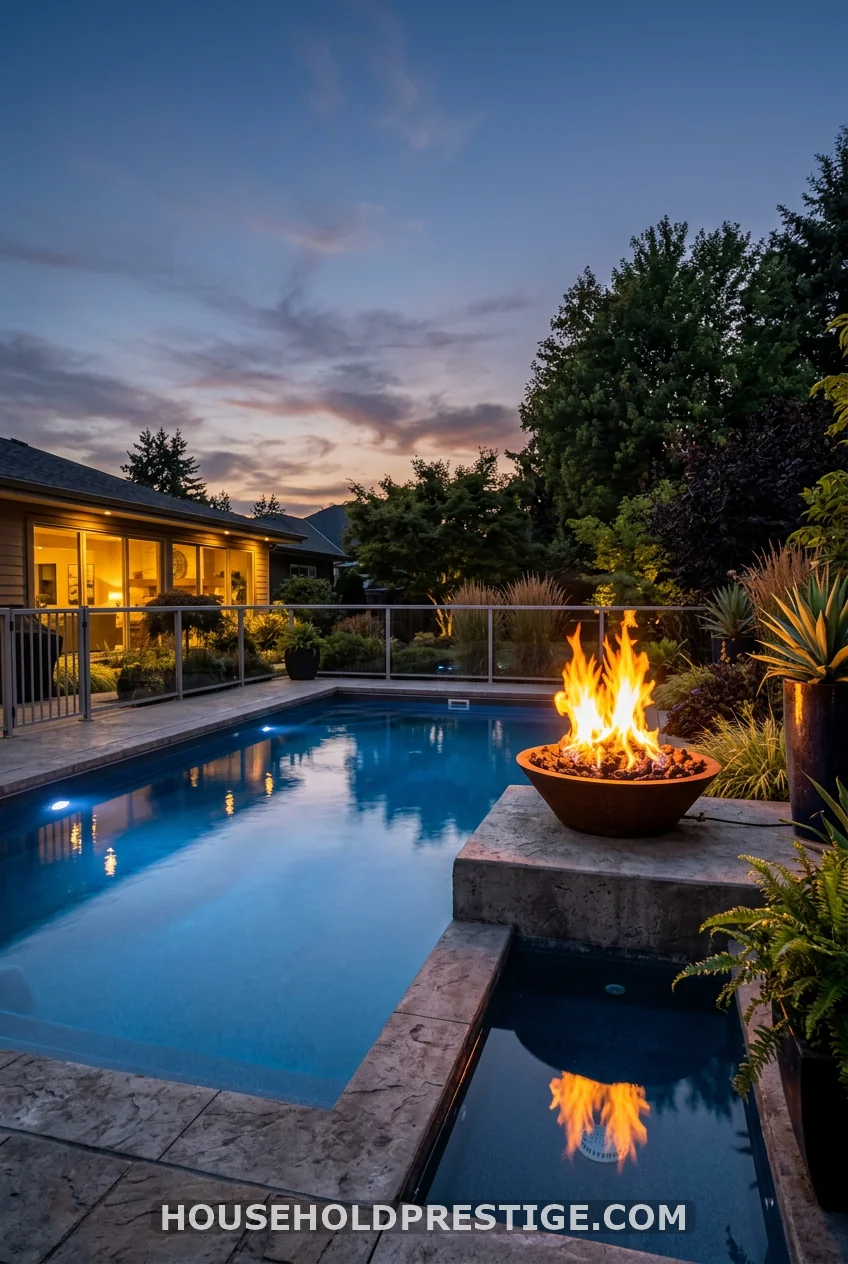
A natural gas fire bowl or fire pit positioned 6–8 feet from the pool edge creates an extension of the pool season into cool evenings. Round gas fire bowls (American Fire Glass, Fire Pit Art) run $800–$2,500. Gas line connection adds $500–$1,500. The warm glow reflecting off the water at night is genuinely stunning — every pool photo that gets thousands of saves has some kind of fire element in it.
One rule: never place fire features directly adjacent to vinyl liner pools (off-gassing risk). Fiberglass has no such concern.
15. Gelcoat Color Selection: The Decision That Lasts 30 Years
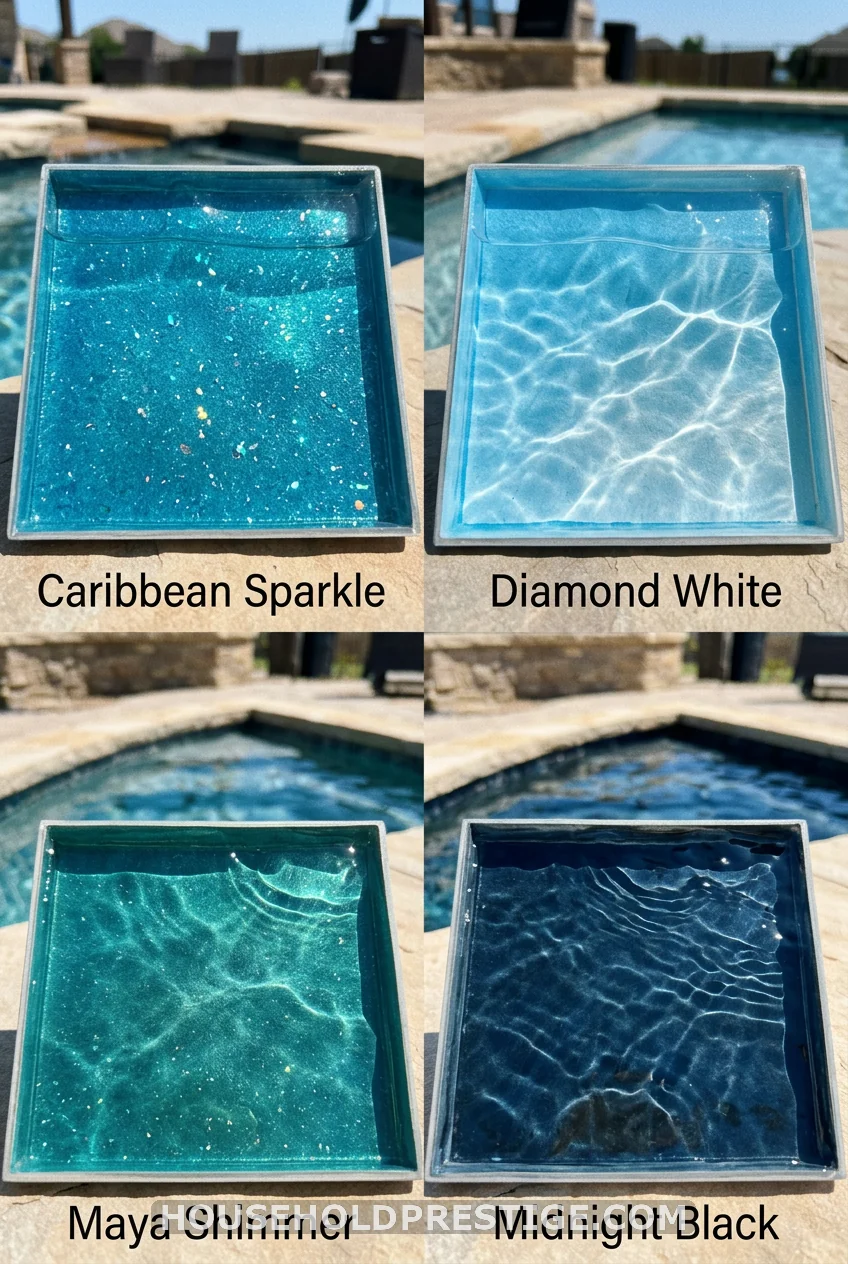
Pool color is permanent. You can’t repaint a fiberglass gelcoat on a whim, so this decision deserves more than a two-minute glance at a sample chip.
Here’s what the colors actually look like filled with water:
- White/Pearl gelcoats (River Pools Diamond, Thursday Pools White Pearl): The water reads bright turquoise-blue in sunlight, almost Caribbean. Visually the most resort-like. Shows algae staining fastest. Great for warm climates with lots of sun.
- Blue-green shimmer finishes (Maya Shimmer, Caribbean Sparkle): The water reads deep blue-green. More forgiving with minor algae before it becomes visible. Feels more “natural.” Trending heavily right now.
- Gray/Silver (Silver Grey, Pebble Grey): The water reads sophisticated blue-gray. Pairs beautifully with white concrete or limestone decking. Modern, not tropical. Less popular on Pinterest but growing.
- Dark/Black (Midnight Blue, Onyx): The water goes almost black-reflective. Stunning in photos. Hides the pool bottom, which some parents hate. Heats water faster (solar gain). Stunning with natural stone decks.
One practical note: lighter colors make it easier to see the pool bottom — helpful for monitoring children and for finding dropped items. Darker colors obscure depth, which creates an illusion of more depth than exists.
Ask any potential manufacturer to show you photos of the color in full sunlight, not the showroom. Colors shift dramatically between indoor lighting and outdoor pool conditions.
16. Fiberglass Pool With Outdoor Pool House
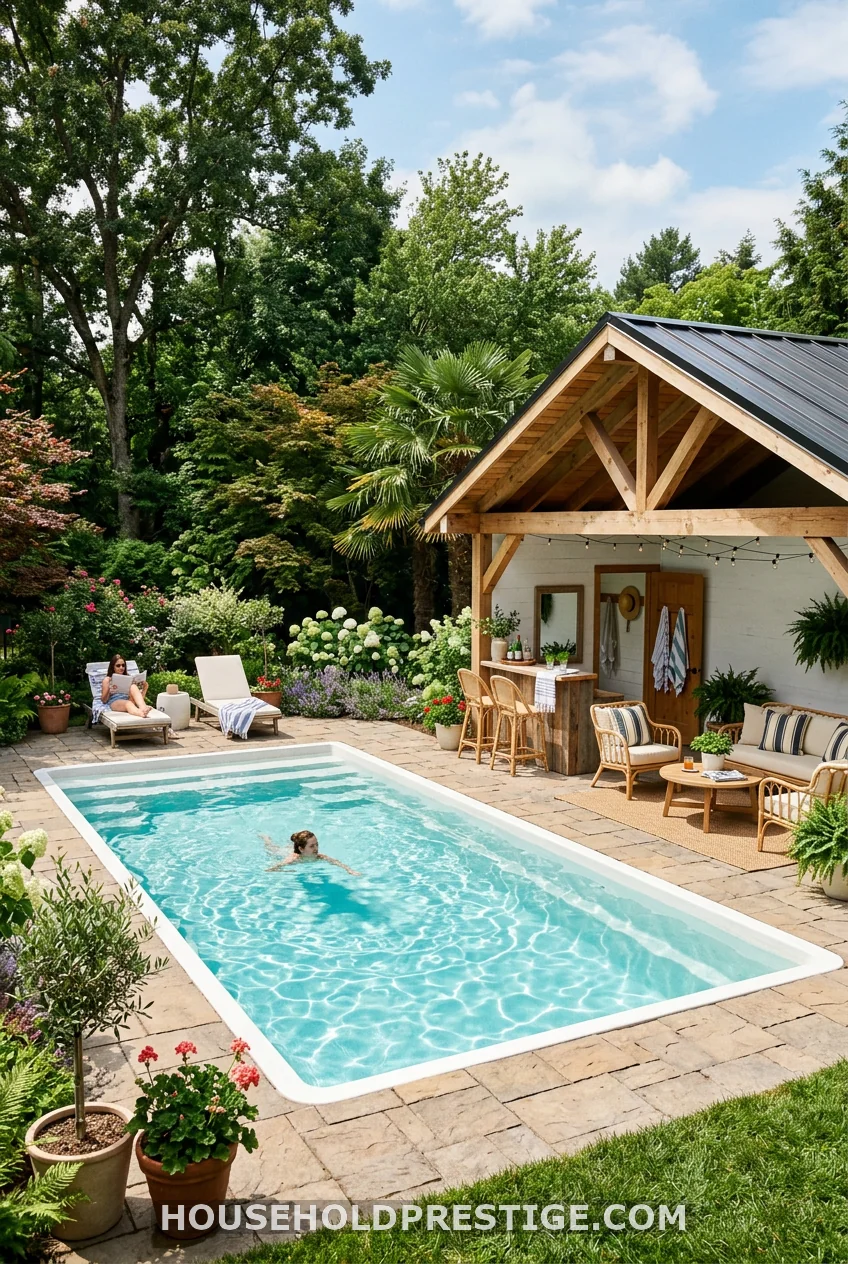
A pool house doesn’t need to be a full structure. A 10×12 ft prefab shed converted to a pool house ($3,000–$8,000 for the structure, $2,000–$5,000 for conversion) gives you a bathroom/changing room, storage for chemicals and toys, and a mini outdoor bar. The functional value is immediately obvious the first time a guest asks where the bathroom is.
Site the pool house so its shade falls away from the pool. And run electrical during the pool project — adding it post-construction is expensive.
17. Bench Seating as a Social Feature
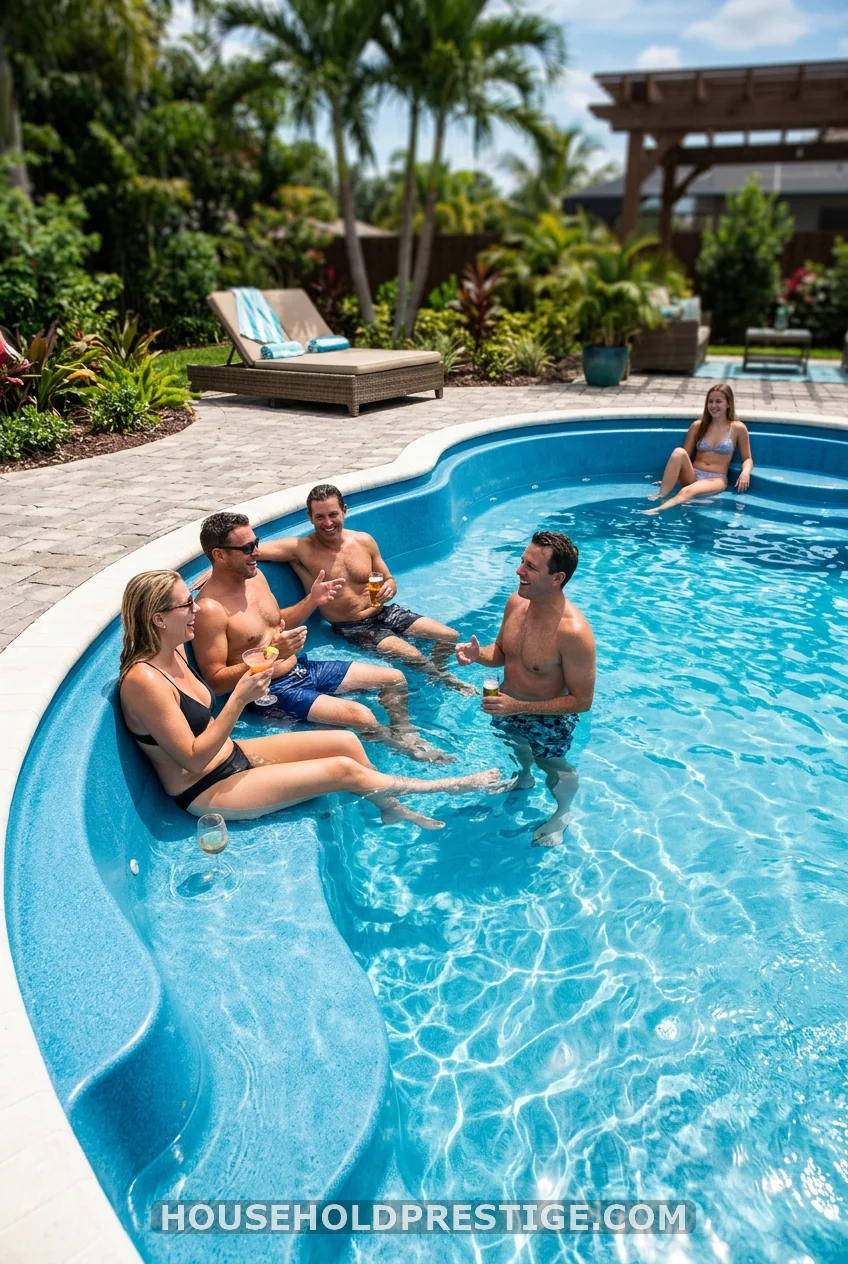
Fiberglass pools have bench seating molded directly into the shell at zero added cost. Use it intentionally. A pool with a long shallow-end bench becomes a cocktail party venue — guests stand in 3-foot water, drinks in hand. The deep-end bench is perfect for tired swimmers who want to rest without getting out.
18. Kids’ Play Zone With Bubblers
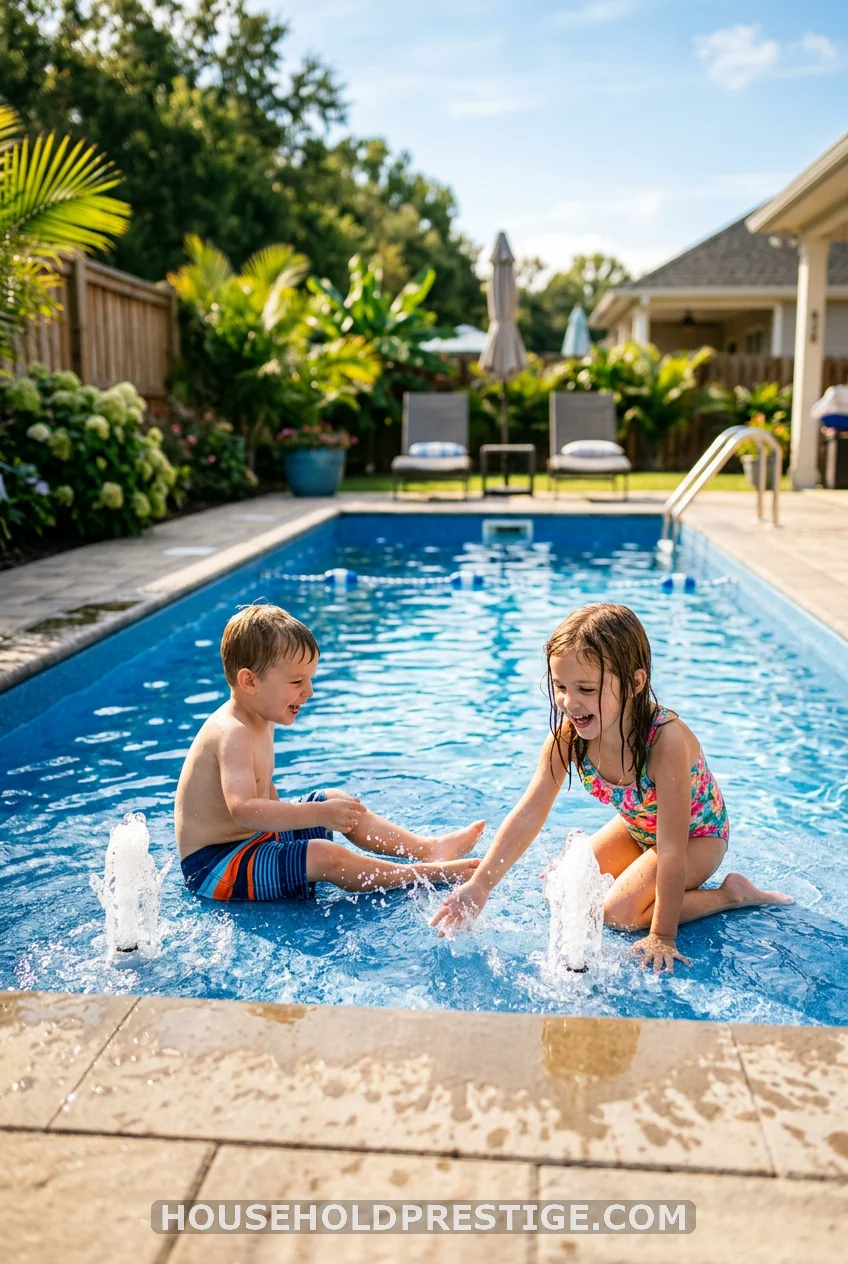
Bubblers are small upward-spraying jets installed on tanning ledges and shallow areas. They cost $200–$500 each plus plumbing. For kids under 8, a 6-inch deep tanning ledge with two bubblers is the most-used feature in the entire pool. It’s interactive, safe, and completely photogenic. Install them during the initial build — adding them post-pour requires cutting concrete.
19. Resistance Swim Jet System for a Plunge Pool
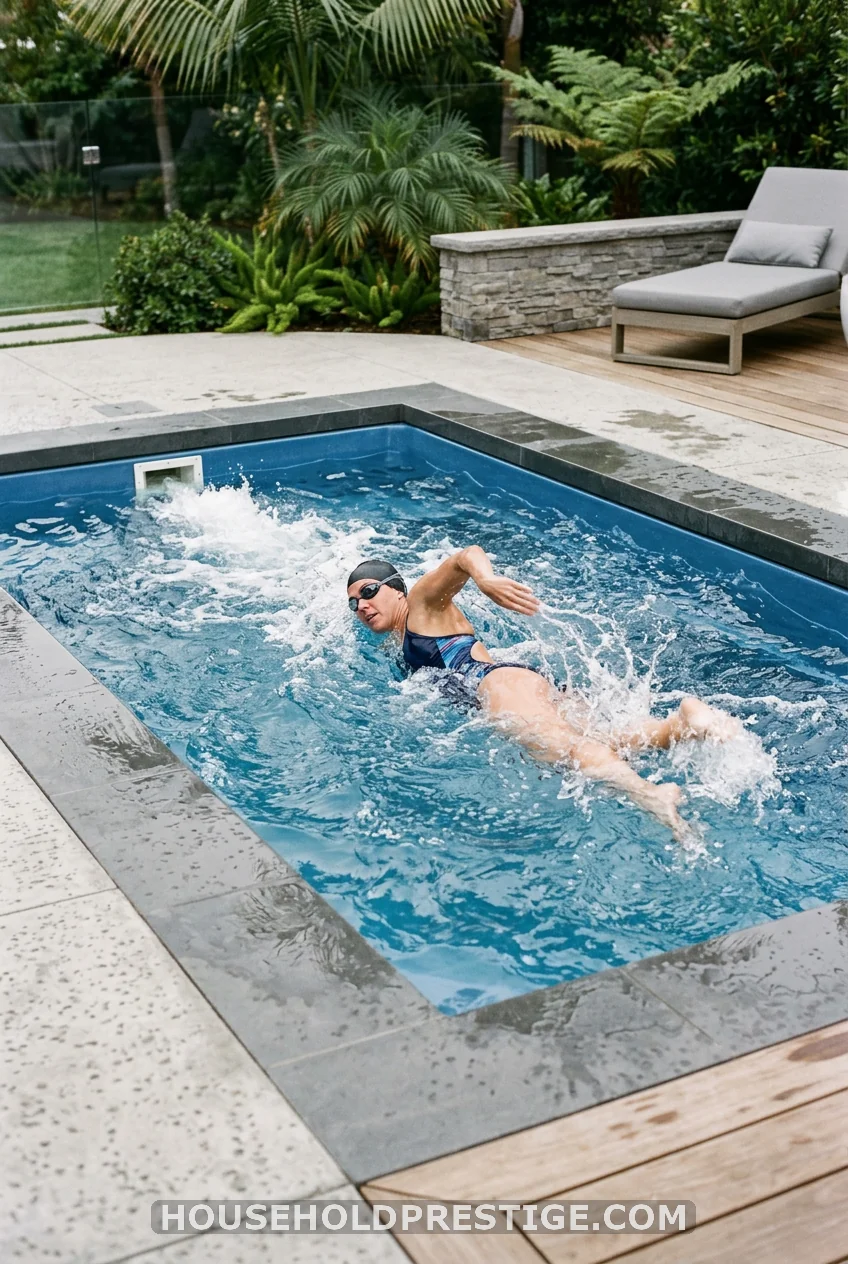
A 10×20 ft plunge pool becomes a lap pool with a resistance swim jet. Systems like the Endless Pools E500 Swim Machine ($3,400–$5,000 installed) or the Pentair Laminar Jet mount at one end and push a paddling current strong enough for adult lap swimming. You never touch the far wall. It’s the best solution for anyone who wants genuine exercise capability from a compact fiberglass pool and doesn’t want to buy a 40-ft shell.
The Bottom Line
Fiberglass pools work because the hard design decisions get made at the factory. Your gelcoat, your built-in seating, your tanning ledge — they’re already perfect when the shell arrives. The ideas in this list are about layering everything else on top to make your yard feel like the place you actually want to spend your summer.
Start with what you know you want non-negotiably (size, beach entry vs. steps, saltwater vs. chlorine). Then add the features that fit your budget in the order they matter most to your lifestyle. A plunge pool with bubblers and good landscaping will outperform a neglected 40-footer every single summer.
Frequently Asked Questions
How long does it take to install a fiberglass pool?
Most fiberglass pool installations take 3–6 weeks from excavation to first swim. That’s significantly faster than concrete (3–6 months) because the shell arrives pre-manufactured. Weather and site complexity — slopes, rocky soil, limited access — are the main variables that extend timelines.
What is the average cost of a fiberglass pool installed?
A base installation with minimal decking typically runs $45,000–$85,000. A full turn-key project with a patio, heater, salt system, and basic accessories lands between $85,000–$150,000 in most US markets. High-end builds with water features, pool houses, and premium hardscaping can exceed $200,000.
Are fiberglass pools good for saltwater systems?
Yes — fiberglass is the best pool type for saltwater. The non-porous gelcoat surface resists corrosion from salt, requires fewer chemicals overall, and doesn’t need resurfacing the way concrete pools do. Saltwater fiberglass pools also tend to have lower annual maintenance costs.
What shapes do fiberglass pools come in?
Fiberglass pools come in rectangular (linear), freeform (organic curves), Roman-end (rectangular with semicircular ends), and L-shaped configurations. Unlike concrete pools, fiberglass shapes are limited to what manufacturers have in their molds — typically 10×20 ft up to 16×40 ft. The trade-off is faster installation and lower maintenance.
Do fiberglass pools add value to a home?
Generally, yes, though the ROI varies by market. In warm-climate states (Florida, Texas, California, Arizona), a fiberglass pool can return 50–80% of its cost in home value. In colder climates, the return is lower (20–40%). The pool’s condition, surrounding landscaping, and the neighborhood’s pool prevalence all factor in.