

When our neighbors finally put in their pool three summers ago, the fence went up in a single afternoon. Black aluminum picket. Standard 4-foot height. Functional. Safe. And absolutely soul-crushing next to the gorgeous new blue water and fresh travertine deck. Every time I walk by, I think — that fence didn’t have to look like that.
Finding the right pool fence ideas means balancing real safety requirements, local building codes, your existing backyard aesthetic, and whatever budget you’re actually working with. Most articles give you a pretty picture and a vague material suggestion. This one gives you costs per linear foot, brand names worth knowing, and the honest tradeoffs nobody mentions at the showroom.
Here are 17 pool fence ideas — from ultra-budget to luxury investment — that work for inground pools, above-ground pools, small backyards, and sprawling estates alike.
1. Frameless Glass Pool Fence
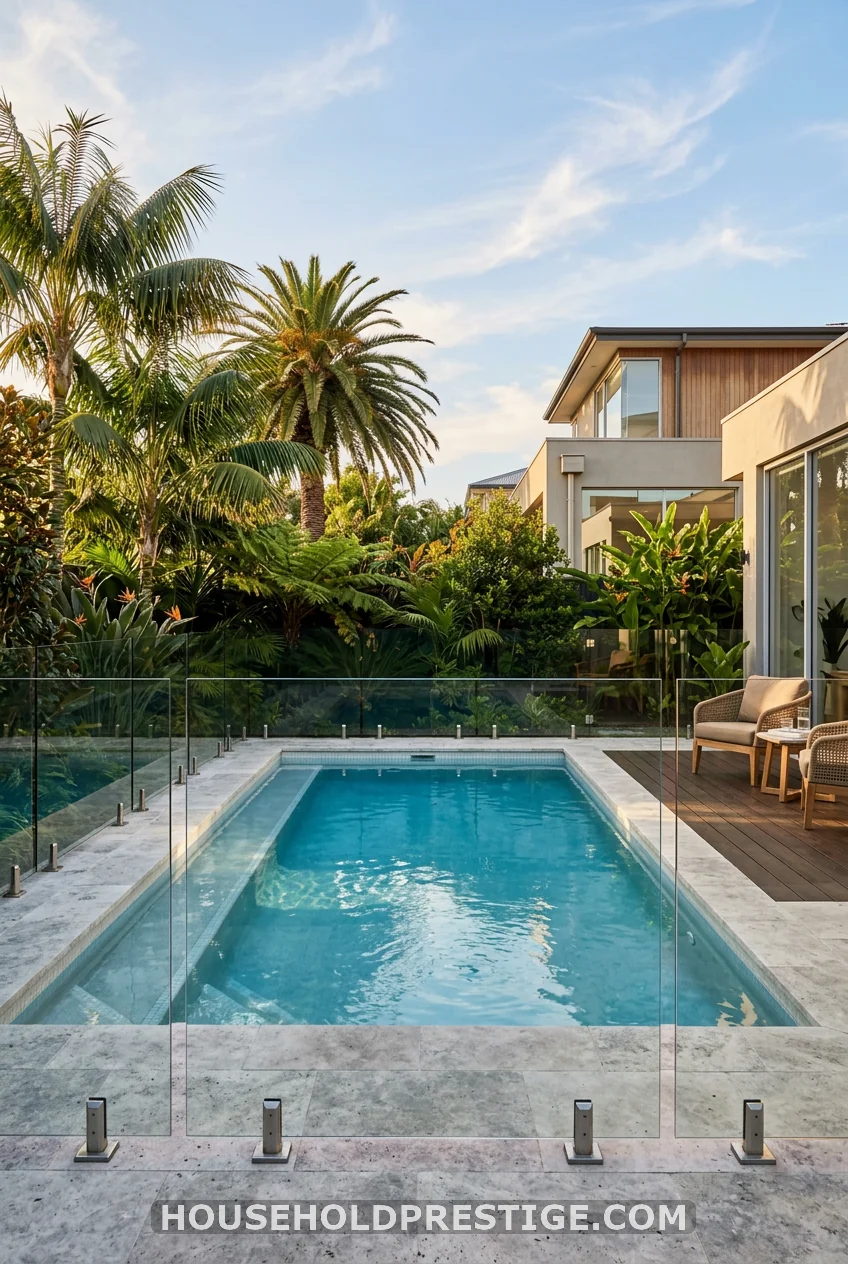
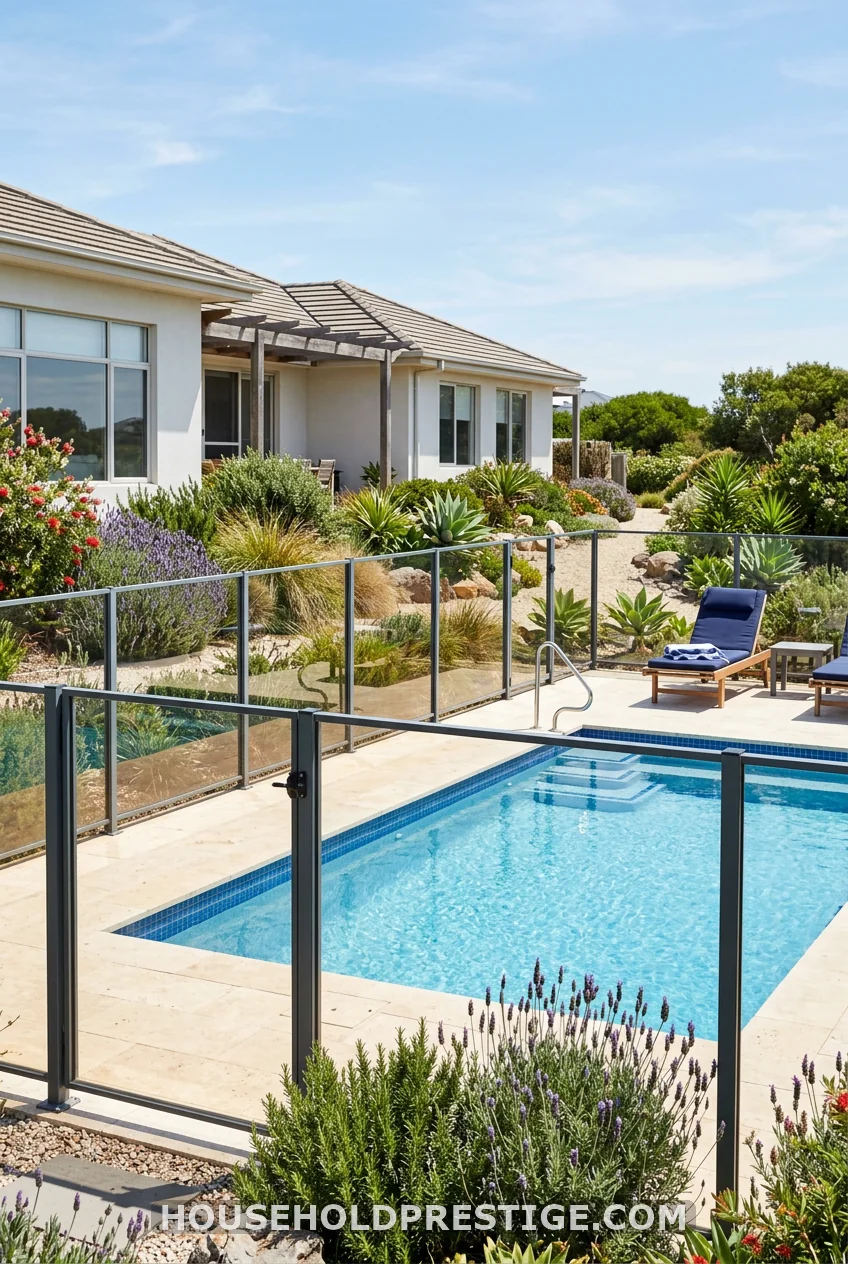
If you want your pool to look like it belongs in a boutique hotel, frameless glass is the pool fence idea that does it most completely. No vertical posts breaking up the view. No visual barrier between the pool and the rest of your yard. Just clear, uninterrupted sightlines — and a fence that genuinely disappears into the background.
Here’s what makes it worth the cost. And when it isn’t.
Why It Works
A frameless glass fence uses thick tempered safety glass panels (typically 10mm–12mm) slotted into low-profile stainless steel spigots drilled directly into your pool deck or coping. There are no top rails. No mid-rails. The glass does all the structural work. In open backyards where you’ve invested in landscaping or have a view worth preserving, this fence type disappears visually instead of competing with it.
Tempered glass is also climb-resistant in a way that traditional picket or mesh fences are not — the smooth surface offers no footholds, no horizontal bars, nothing to grab.
Cost Reality
Expect to pay $150–$250 per linear foot installed in most markets. For a standard 60-linear-foot pool perimeter, that’s $9,000–$15,000 all-in. Materials only (panels plus spigots) run $90–$150 per linear foot if you’re using a general contractor rather than a specialty fence company.
| Component | Cost |
|---|---|
| 12mm tempered glass panels | $40–$80/linear ft |
| Stainless steel spigots | $25–$45 each |
| Self-closing glass gate | $400–$800 |
| Professional installation | $60–$120/linear ft |
| Pool-safe silicone + hardware | $150–$300 total |
Brands Worth Knowing
- CRL (C.R. Laurence) — the industry standard for glass railing hardware. Their SDR series spigots are rated for coastal salt environments.
- Aquaview Fencing — manufactures complete frameless systems with pre-engineered specs that simplify permit approval.
- Dekor Systems — good for semi-DIY installation; panels come in standard 24″ and 36″ widths with pre-drilled holes.
Step-by-Step Installation
- Check your local pool fence code first. Most jurisdictions require a minimum 4-foot height, self-closing gate, and specific gap limits between panels. Get this in writing before purchasing anything.
- Measure perimeter and plan panel layout. Mark spigot positions every 24–36 inches along the fence line using chalk.
- Core drill spigot holes. Use a diamond-tipped core bit sized to your spigot diameter (typically 1⅝”). Drill 3–4 inches deep into the concrete deck.
- Set spigots with marine-grade epoxy. 3M DP-420 works well here. Let cure fully — 24 hours minimum — before loading any glass weight.
- Insert glass panels. Slot each panel into opposing spigot pairs. The rubber grip pads inside the spigot head should hold the glass without visible adhesive.
- Shim and plumb each panel. Use plastic horseshoe shims under each panel base to achieve level. Check plumb before moving on.
- Apply silicone at panel joints. Use UV-stable, pool-safe silicone at each panel gap — typically ⅜”–½”, which is both code-compliant and allows for thermal expansion.
- Install the self-closing gate. Non-negotiable in virtually every municipality. Use a pivot hinge system that closes and latches from both sides. The MagnaLatch by D&D Technologies is the standard here.
Common Mistakes to Avoid
- Ordering 8mm glass to save money. It flexes noticeably in wind and may fail your permit inspection. Always use 12mm minimum for freestanding panels.
- Skipping the self-closing gate. Multiple jurisdictions will fail your inspection without one, and you’ll pay to redo it.
- Installing near large trees. One falling branch can crack a glass panel. Replacement runs $200–$600 per panel.
- Underestimating maintenance time. A 60-foot glass fence needs cleaning every 2–3 weeks to stay streak-free. That’s a genuine time commitment across a full summer.
Pro Move
If full frameless glass is out of budget, consider a semi-frameless hybrid instead: glass panels supported by aluminum posts rather than spigots. You get 80% of the visual effect at $90–$140 per linear foot installed. Look for systems from TUFFBILT or Fortress Fencing that use powder-coated posts in black or bronze — nearly invisible against any dark landscape background.
2. Black Powder-Coated Aluminum Picket
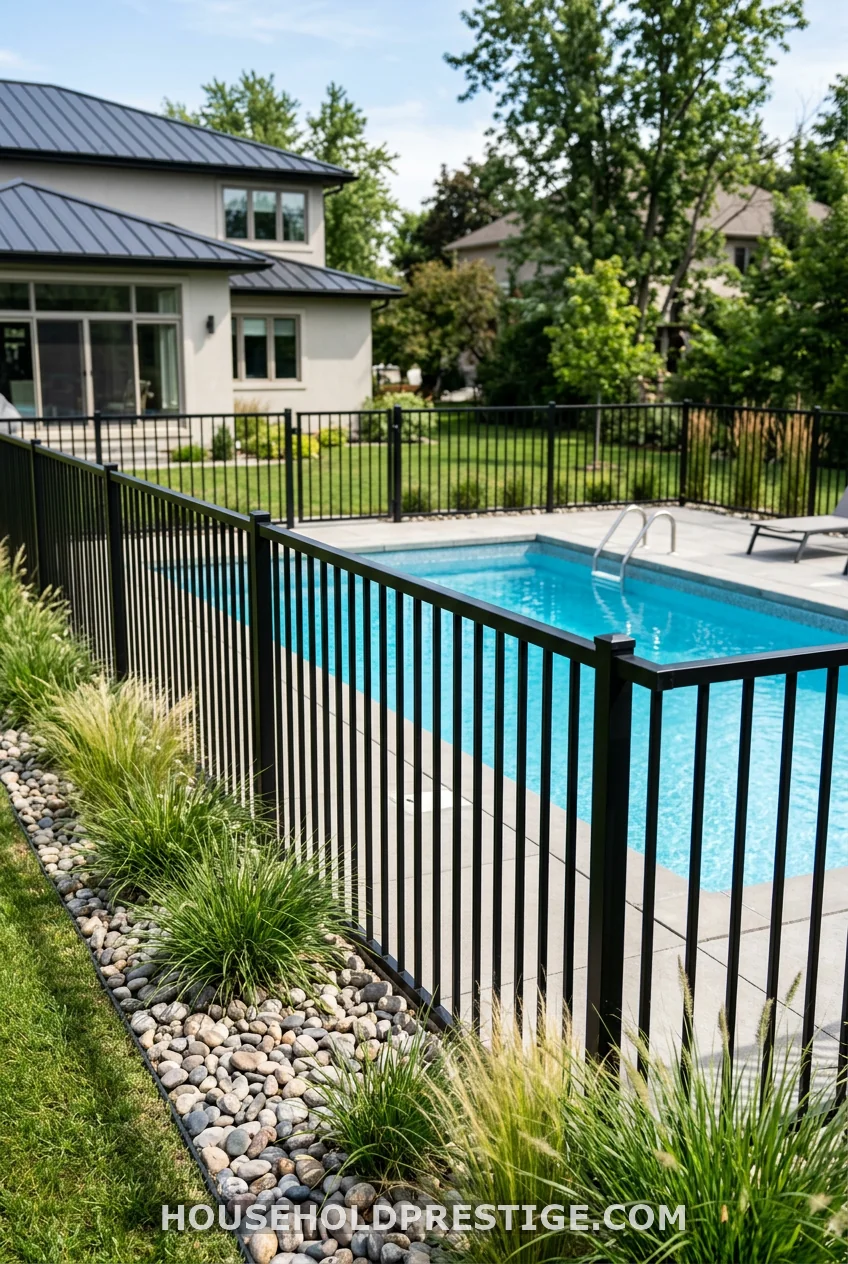
This is the most common pool fence idea for a reason. Black powder-coated aluminum doesn’t rust, doesn’t need painting, and costs $25–$75 per linear foot installed depending on post spacing and height. It lasts 30–50 years with zero maintenance beyond an occasional hose-down. The classic look pairs equally well with contemporary, traditional, and coastal home styles.
3. Removable Mesh Safety Fence
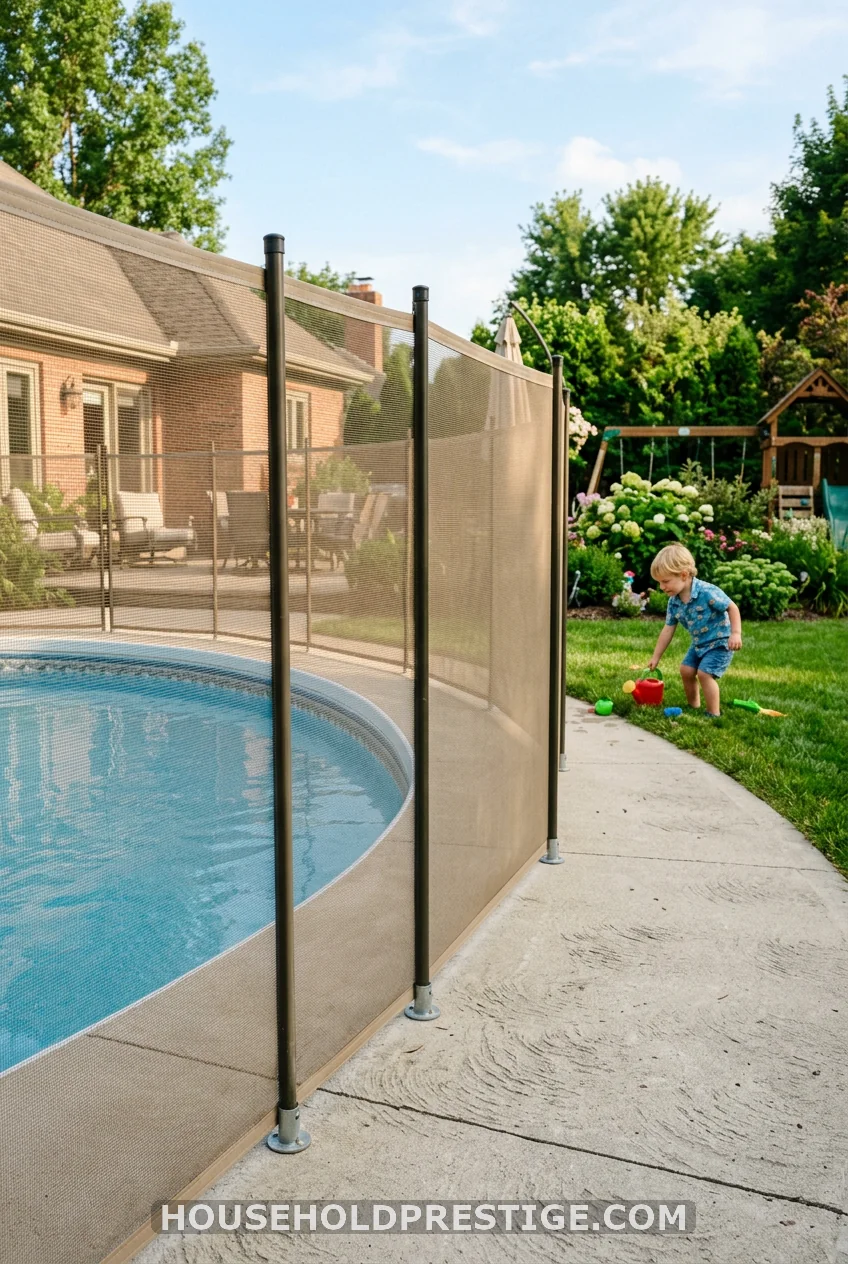
This is the pool fence idea most parents of toddlers don’t know enough about — and it’s worth knowing in detail.
A removable mesh pool fence uses high-tensile polyester mesh stretched between slender fiberglass or aluminum poles drilled into the pool deck. The system installs in a few hours, removes in about 30 minutes, and reinstalls in any configuration that fits your pool shape. You can bag the whole thing in a single large duffel when it’s not needed.
What makes it genuinely safe: Pool Guard and Life Saver — the two leading brands — build their systems to ASTM F2286-16 standards (the American Society for Testing and Materials pool safety barrier specification). Life Saver’s poles individually withstand 105+ pounds of horizontal pressure. The mesh itself is rated to 387 pounds per square inch.
Cost: $1,500–$3,500 professionally installed for a standard 30-foot perimeter. DIY installation kits from Pool Fence DIY start at $975 for a 50-foot kit. You’ll need a hammer drill and a 5/8″ masonry bit — the whole kit ships with a drilling guide.
One honest caveat: Mesh fences can be pushed loose at the base by larger dogs. If you have a 60-pound Labrador who’s serious about the pool, reinforce the base poles with optional ground stakes in high-traffic dog zones.
4. Cable Rail Pool Fence
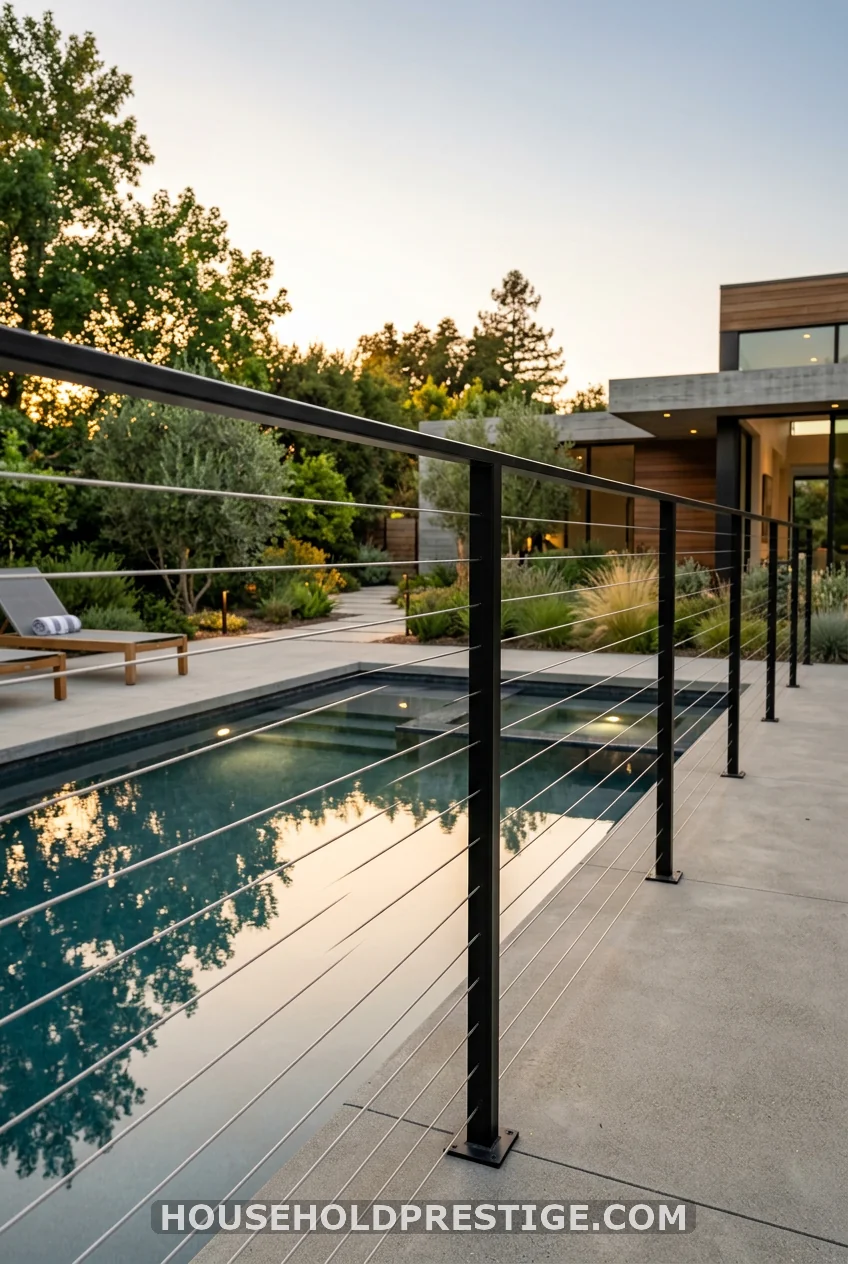
Seven horizontal stainless steel cables stretched between posts at 3-inch intervals. Barely visible from 20 feet away. Costs $60–$180 per linear foot installed. One code note before you order: some jurisdictions classify cable rail as a “climbable” fence and require a minimum height of 54 inches instead of 48 inches for pool applications. Confirm with your local building department first.
5. Cedar Wood Privacy Fence
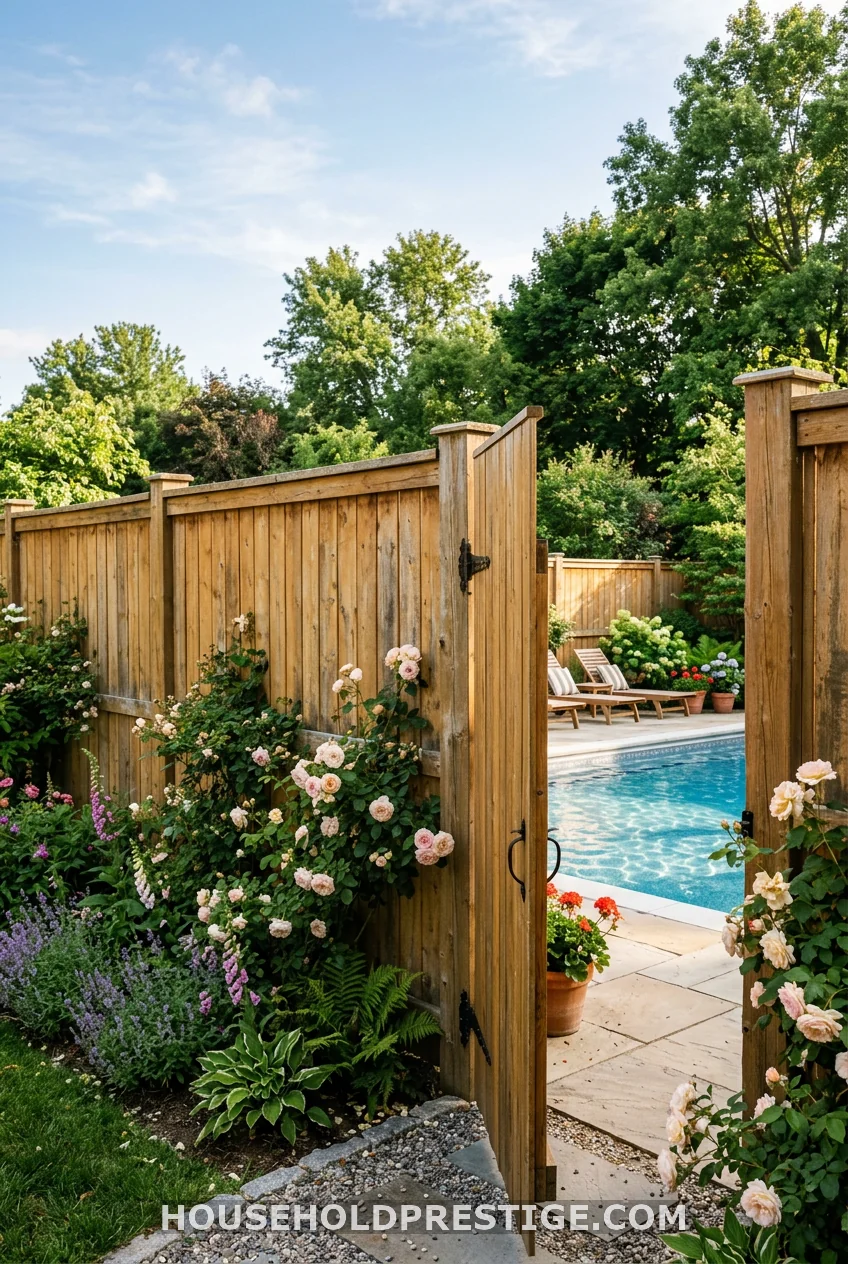
Cedar has one quality most wood species don’t: it produces its own natural oils that resist rot and insects without chemical treatment. That’s why you’ll find cedar used in outdoor furniture, saunas, and pool fencing in climates that see real rainfall.
A cedar pool fence costs $15–$30 per linear foot for materials, or $30–$55 per linear foot installed. That’s a middle-ground price point — more expensive than mesh, significantly less than glass. The privacy is total, which is exactly what some backyards need.
The maintenance reality: Cedar left untreated will gray to a silver tone within two years. That can look genuinely beautiful — it’s the same weathered finish you see on coastal shingled homes. If you want to keep the warm honey-brown, apply a clear UV-protective sealer every 12–18 months. Budget about 2 hours and $40–$80 per gallon of sealant (one gallon covers roughly 250 square feet of fence).
Above-ground pool note: Cedar privacy fences work especially well around above-ground pools because fence height can be set to align with or exceed the pool wall, creating a seamless visual transition instead of a mismatched layered look.
Style pairing: Cedar is at home with farmhouse, craftsman, cottage, and Pacific Northwest architecture. It can look out of place against modern stucco or raw concrete — for those settings, see #12.
6. Vinyl Pool Fence
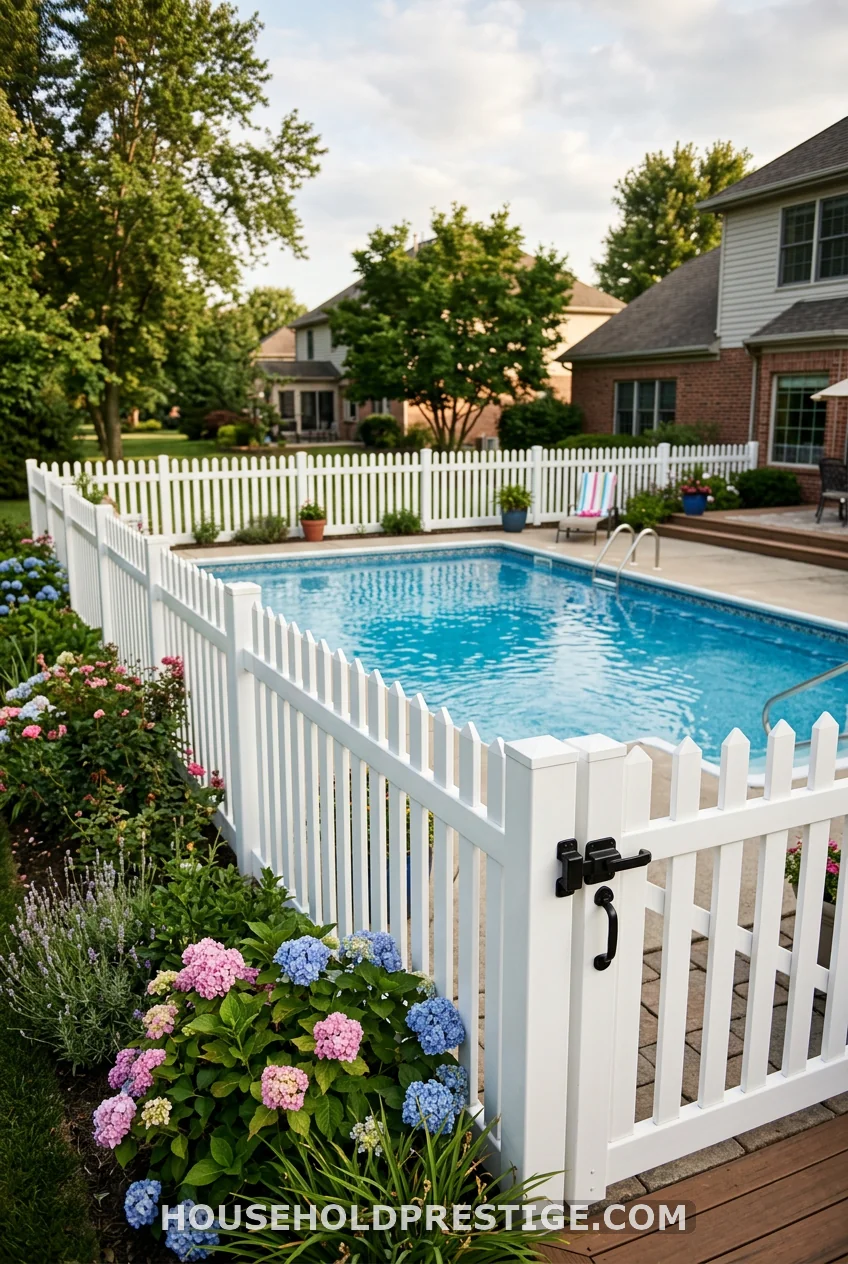
White vinyl doesn’t rot, doesn’t peel, and wipes clean with a garden hose. It costs $20–$40 per linear foot installed, making it one of the most budget-friendly permanent fence options available. One real caveat: solid vinyl panel designs are vulnerable to high winds. In coastal areas or tornado-prone regions, choose a vinyl picket or spaced-panel style rather than solid privacy panels — the gaps let wind pass through instead of turning your fence into a sail.
7. Wrought Iron Pool Fence
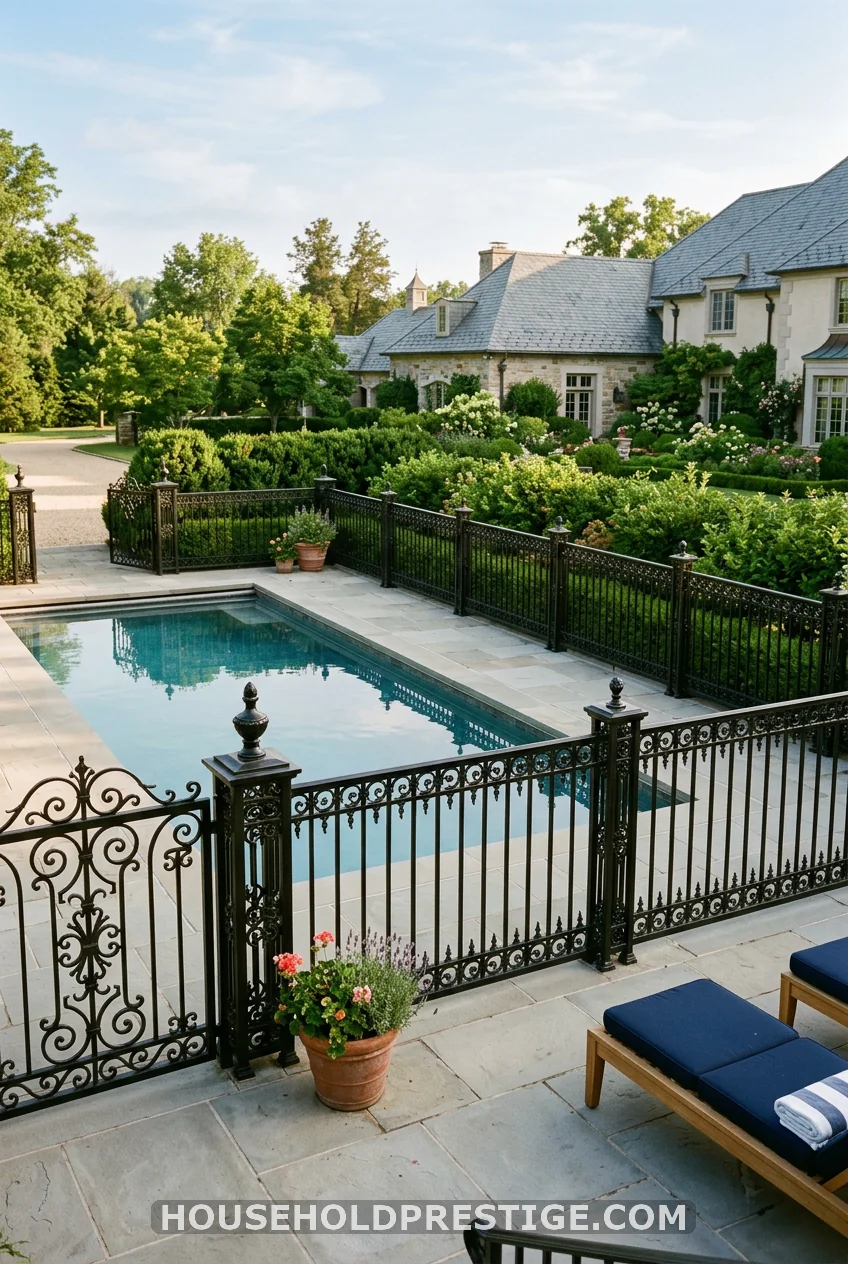
There’s a reason wrought iron pool fences appear on estate properties and historic homes — they don’t just hold up over decades, they look better with age. The material is dense, heavy, and resistant to the flex that cheaper metal fencing develops over time.
Expect to pay $50–$85 per linear foot installed for traditional wrought iron, or $35–$65 per linear foot for ornamental steel, which is a slightly lighter, more affordable alternative. The main maintenance task is rust prevention: inspect each spring for chips in the finish and touch up with a rust-inhibiting spray paint. Rust-Oleum Stops Rust in flat black runs about $8 per can and blends invisibly into the finish.
When wrought iron earns the premium: It’s most defensible when your home has traditional or European architecture, when you’re doing a full pool renovation that will meaningfully affect resale value, or when you want a fence that looks like it was designed for that specific yard rather than ordered from a catalog.
8. Bamboo Privacy Screen
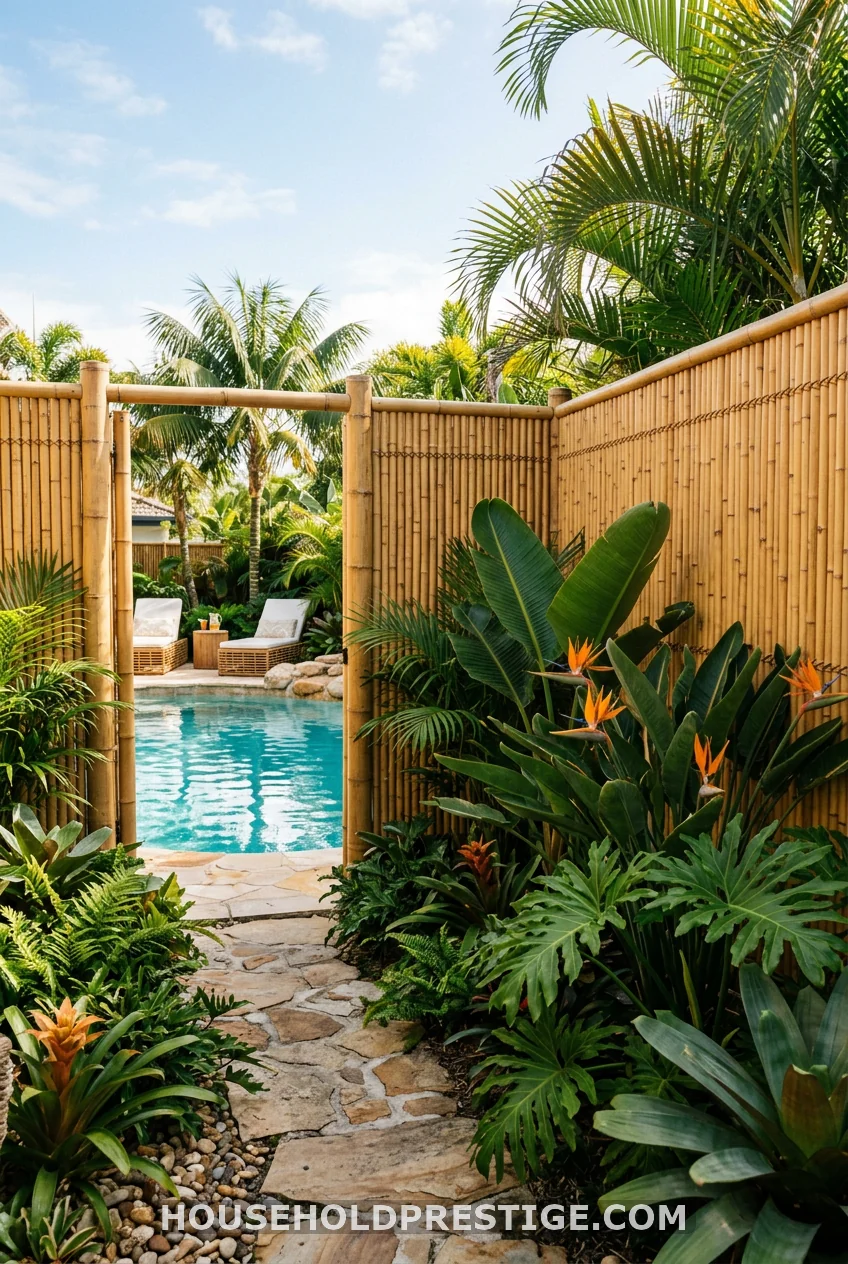
Bamboo looks like a vacation and costs a fraction of stone or glass — $10–$30 per linear foot for materials. The problem is that standalone bamboo usually doesn’t meet pool code safety requirements. Bamboo cane bends. Children can push through gaps between canes. And it degrades faster than you’d expect in persistently wet microclimates.
The fix most people land on is a hybrid approach: install a code-compliant mesh or aluminum fence as the structural barrier, then attach bamboo screen panels to the exterior face. You get the visual completely. You don’t sacrifice safety compliance. Apply a clear exterior sealant annually to prevent mold and UV bleaching.
One regional note: If you’re in a high-fire-risk zone in California, Oregon, or Colorado, bamboo is not appropriate as a permanent perimeter fence. It ignites quickly and burns fast.
9. Stone Retaining Wall Pool Fence
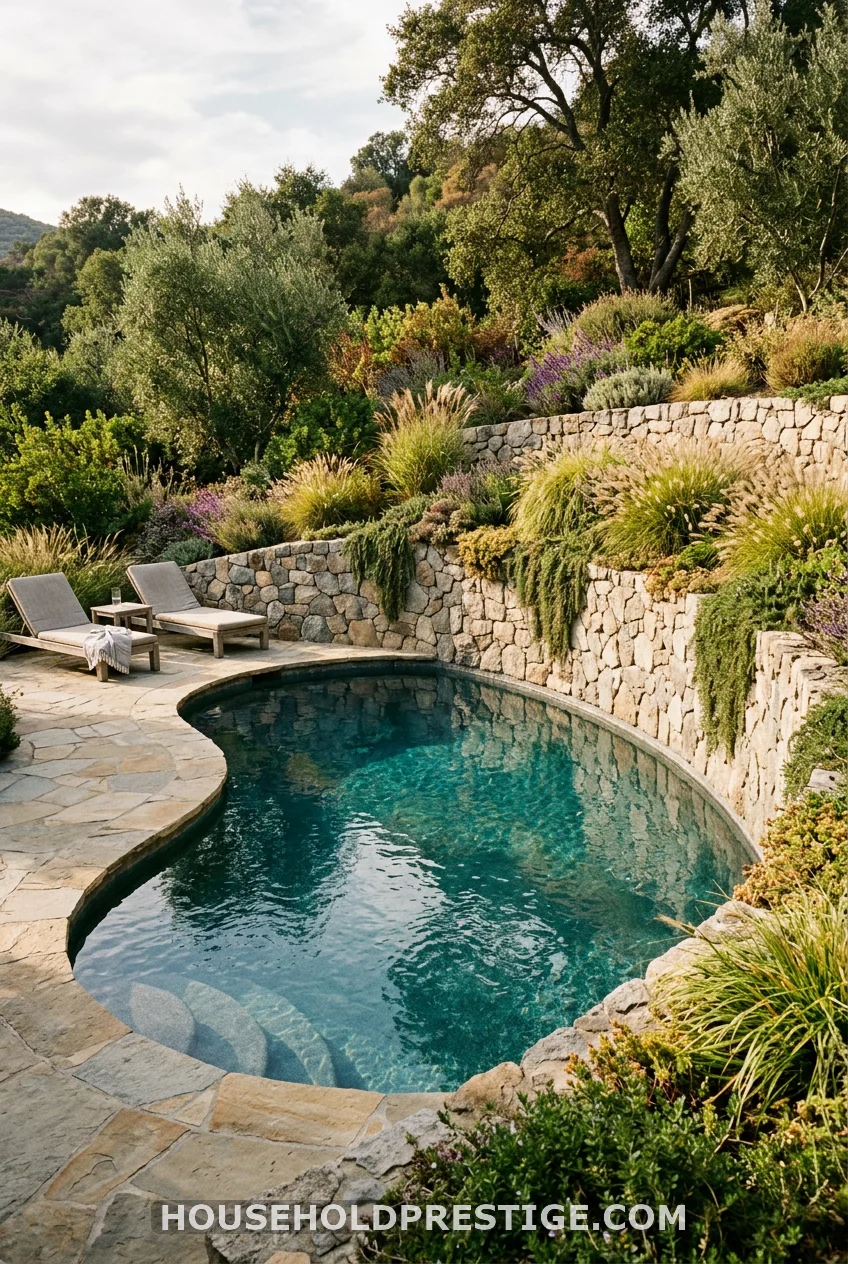
A stone wall is the only pool fence idea that doubles as a full landscaping feature. It adds structural definition to the pool area, creates a thermal mass that holds ambient heat, and pairs naturally with water features — cascading waterfalls are often built directly into the same stone structure.
Cost: Stone wall construction runs $25–$60 per square foot depending on stone type and complexity. A 4-foot-tall, 60-linear-foot perimeter wall (240 square feet of face area) costs $6,000–$14,000 in most markets. That’s comparable to frameless glass for a similar perimeter — but the aesthetic payoff is completely different.
| Stone Type | Approximate Cost (installed) |
|---|---|
| Dry-stack fieldstone | $25–$35/sq ft |
| Mortared limestone | $35–$50/sq ft |
| Travertine block | $40–$60/sq ft |
| Natural granite | $50–$70/sq ft |
Pro pairing: Travertine block walls with matching travertine pool coping create a Mediterranean estate look that photographs exceptionally well. If resale value and visual impact are both priorities, this combination is hard to beat.
Height note: Stone walls used as pool barriers must meet the same minimum height requirements as any other fence type — usually 4 feet. A 48-inch stone wall with no footholds or ledges is compliant in most jurisdictions.
10. Living Hedge Fence
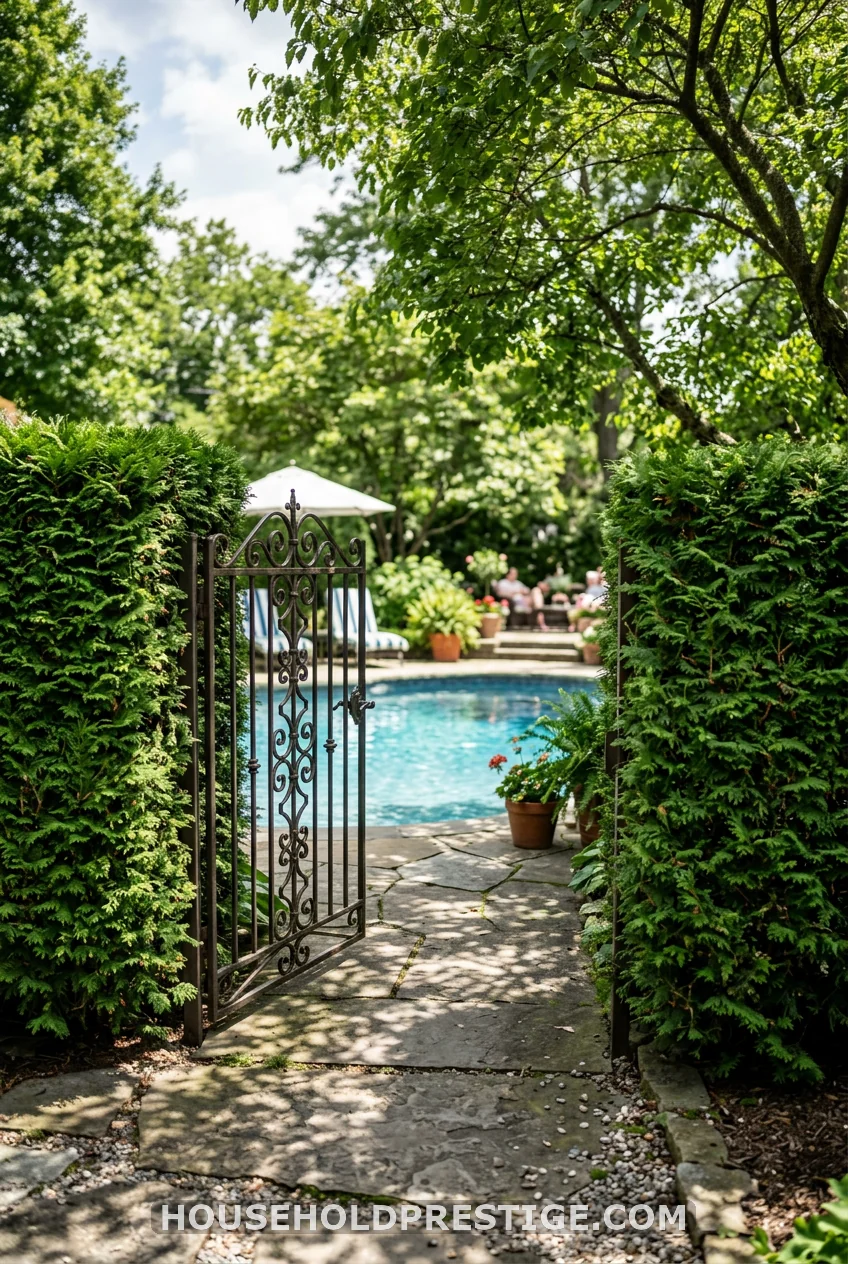
Green Emerald arborvitae planted 2–3 feet apart forms a dense visual screen within 3–5 years. Once established, it needs only two trimmings per year. Plant materials run $15–$30 per linear foot. The significant catch: living hedges rarely satisfy pool code requirements as standalone barriers — the gap between plants during establishment, and the natural variability of plant spacing, creates climbable opportunities that inspectors will flag. Use a hedge as the visual layer outside a code-compliant mesh or low metal interior fence, and let it eventually become the feature.
11. Lattice Wood Fence
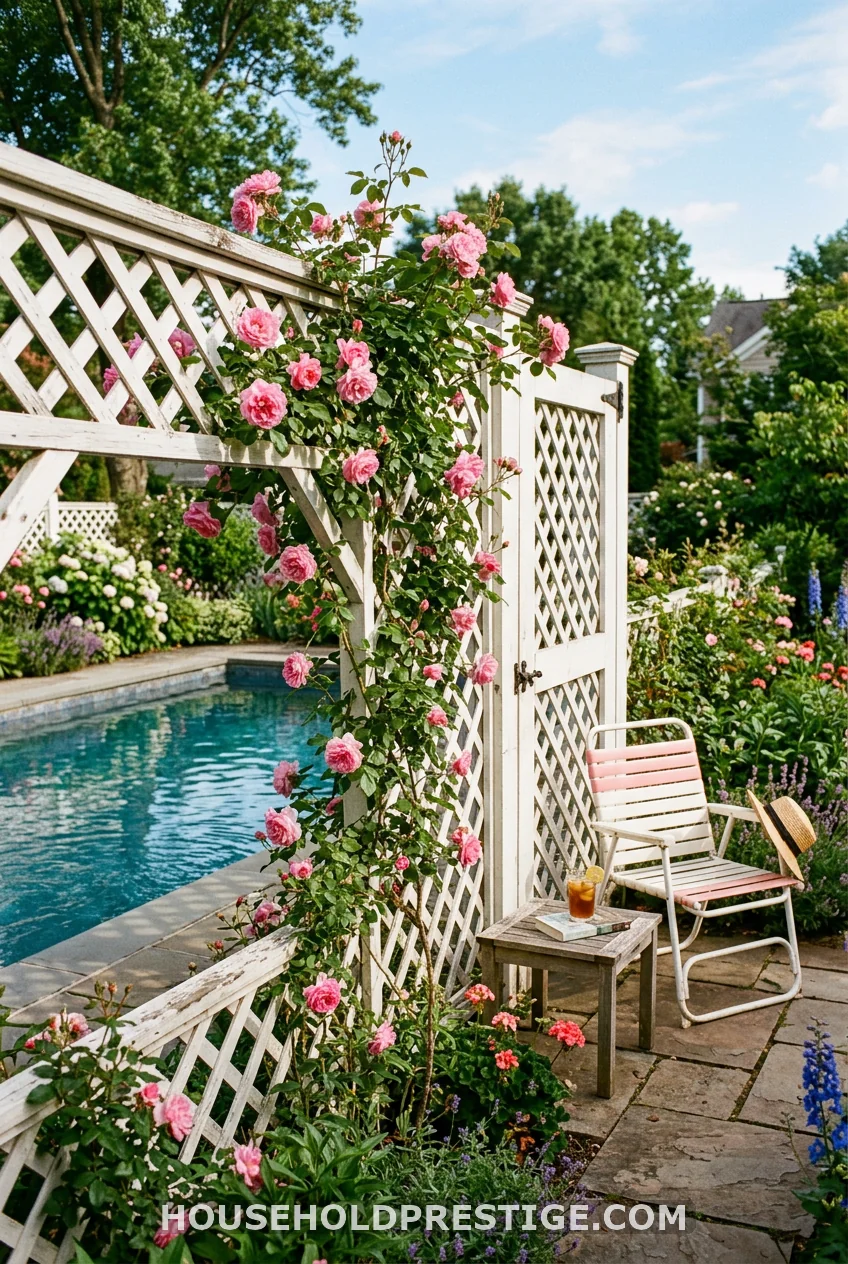
Diagonal crisscross wood lattice panels cost $4–$30 per linear foot — among the cheapest permanent pool fence ideas available. They let light and breezes through, look genuinely charming, and work beautifully with climbing plants. One code note you need to check: the openings in standard lattice (typically 2″–3″) are often large enough to be climbable by small children, which means your jurisdiction may require lattice with 1¾” or smaller opening spacing. Verify with your building department before purchasing any materials.
12. Powder-Coated Steel Horizontal Slat Fence
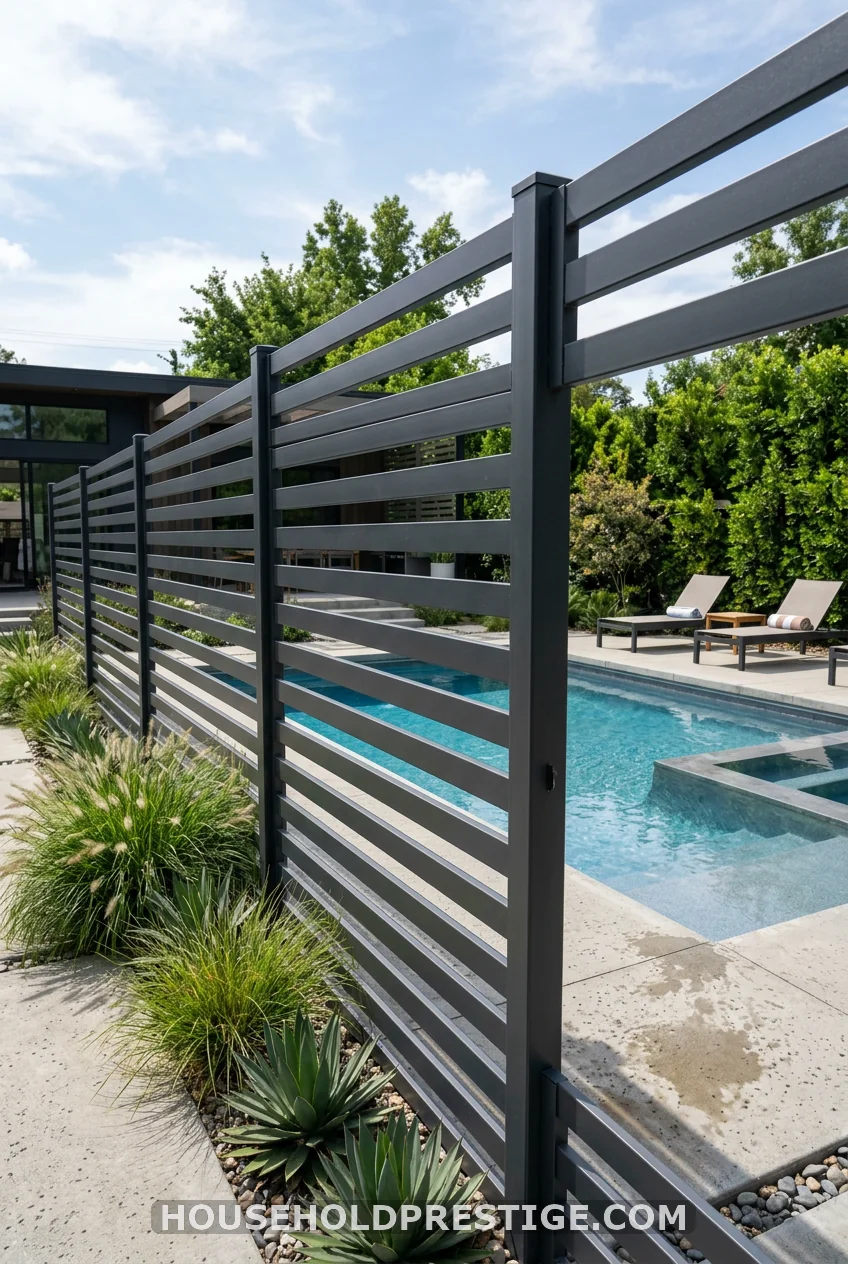
If you love the look of horizontal wood slats but want something built for 30 years of pool-adjacent moisture, powder-coated steel panels deliver the same modern aesthetic with zero annual maintenance. Costs run $40–$80 per linear foot installed — more than aluminum picket, less than glass.
The horizontal orientation creates a layered visual effect that makes most backyards read as more spacious. When ordering, specify RAL 7016 (anthracite gray) or RAL 9005 (jet black) — both read as contemporary and pair well with natural stone, poured concrete, and cedar wood accents without looking like they’re trying too hard.
13. The Concrete Block Wall — What Everyone Gets Wrong
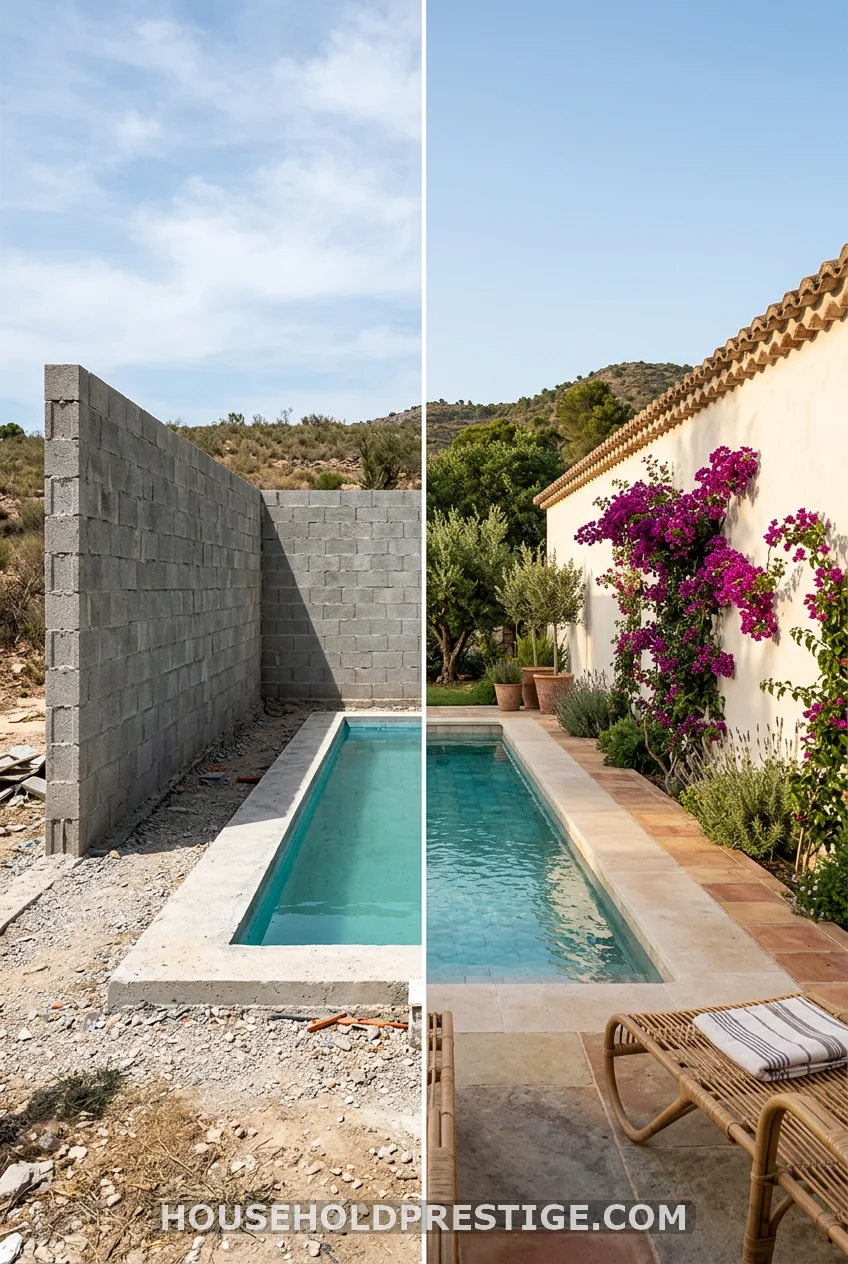
Here’s what most people assume: a concrete block wall is the cheapest pool fence option. You see the blocks at the supply yard for $2–$3 each and start doing mental math toward a budget shortcut.
Here’s what actually happens.
Concrete block (CMU) walls require a footing, rebar reinforcement, mortar between courses, and a finished surface — because bare block looks exactly like a construction site in progress. By the time you add the footing ($8–$15/linear ft), the block and mortar ($10–$20/linear ft), and a stucco or tile finish ($12–$20/sq ft of wall face), you’re looking at $30–$60 per linear foot total. That’s comparable to natural stone, without stone’s natural beauty.
What most people think: It’s a cheap shortcut that looks decent enough.
The reality: Done correctly, a concrete block pool wall is a premium construction choice that happens to use an unglamorous raw material. The finished product — smooth stucco, tile coping, maybe a painted color that matches the home exterior — is indistinguishable from a custom masonry wall and can be stunning.
When it genuinely makes sense: Concrete block walls earn their place in two situations. First, in wind-prone areas where you need structural mass that won’t flex or fail in a serious storm. Second, when you’re designing around a Mediterranean or Spanish Colonial aesthetic where a thick plastered wall with terracotta tile coping is the correct design choice — not a compromise.
The myth is that it’s a budget hack. The reality is that done improperly, it’s an ugly, expensive mess. Done properly, it’s a feature.
14. Frosted or Privacy Glass Panels
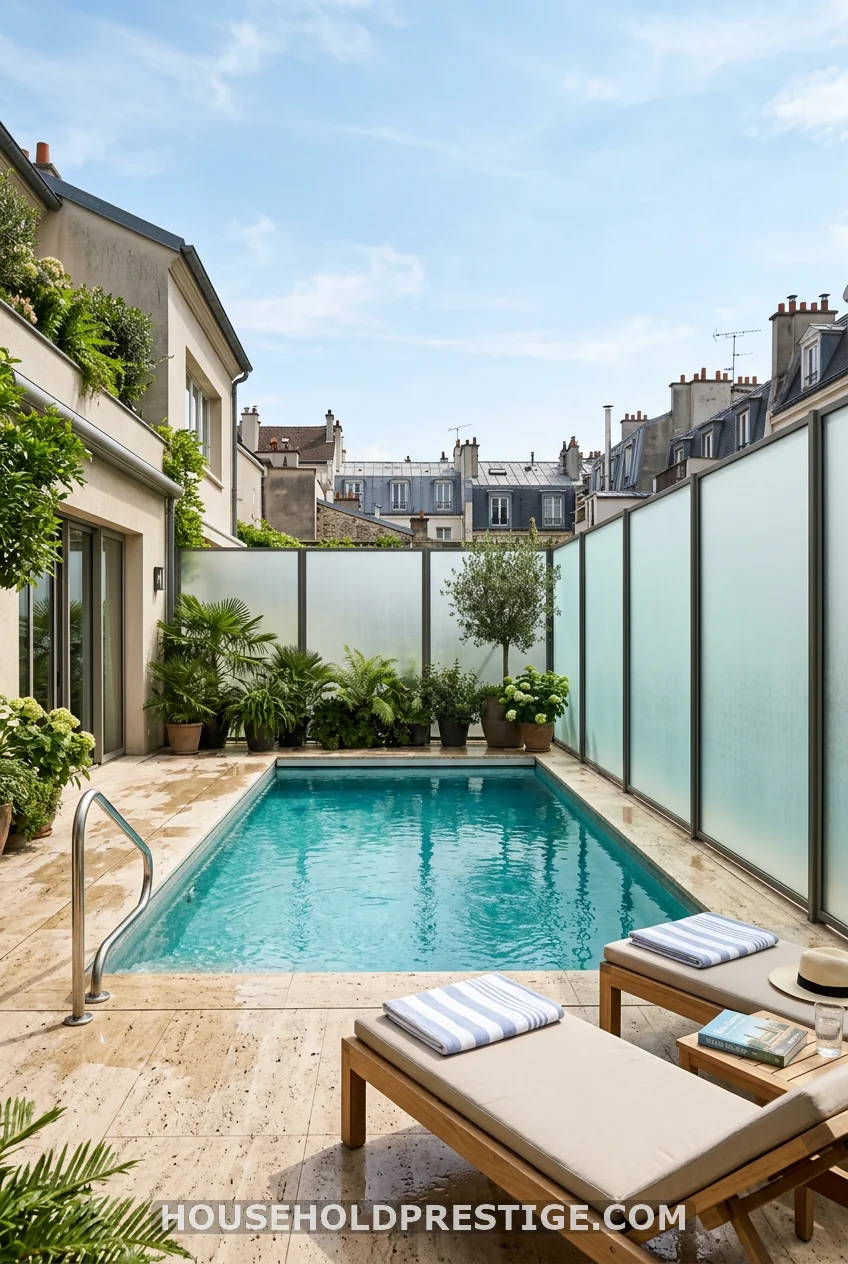
Standard frameless glass is transparent — your neighbors see your pool clearly. Frosted glass panels solve that. They use the same 12mm tempered glass structure but with an acid-etched or sandblasted finish that scatters light without blocking it completely. You get privacy. You keep the modern glass aesthetic. You lose the view-through quality — which, depending on your neighbors, might be exactly the tradeoff you want.
Frosted panels cost $10–$40 more per linear foot than clear glass. Best application: urban or dense suburban backyards with close neighboring properties, or pools that face street traffic.
15. Composite Fence
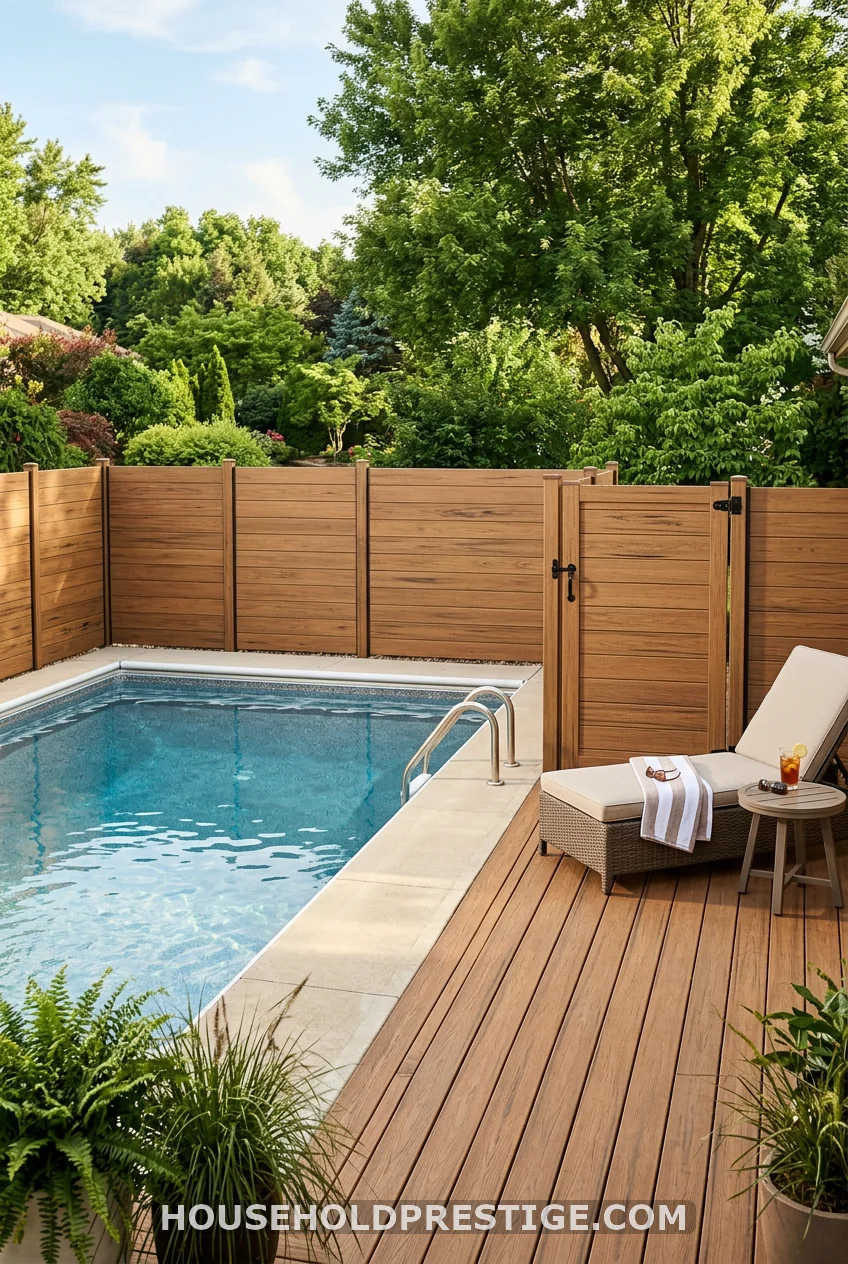
Composite fencing looks like wood, feels like wood, and never needs staining, sealing, or painting. It costs $25–$50 per linear foot installed — roughly the same as cedar but with dramatically less upkeep. The material won’t rot, crack, splinter, or fade for 25–30 years.
Trex Fencing and Fiberon both offer composite fence systems rated for high-moisture environments, making them genuinely appropriate for pool applications where standard painted wood often struggles with ground contact and splash zone degradation. If you want the warm organic look of wood without the summer maintenance ritual, composite is the straightforward choice.
16. Glass + Cedar Hybrid Pool Fence
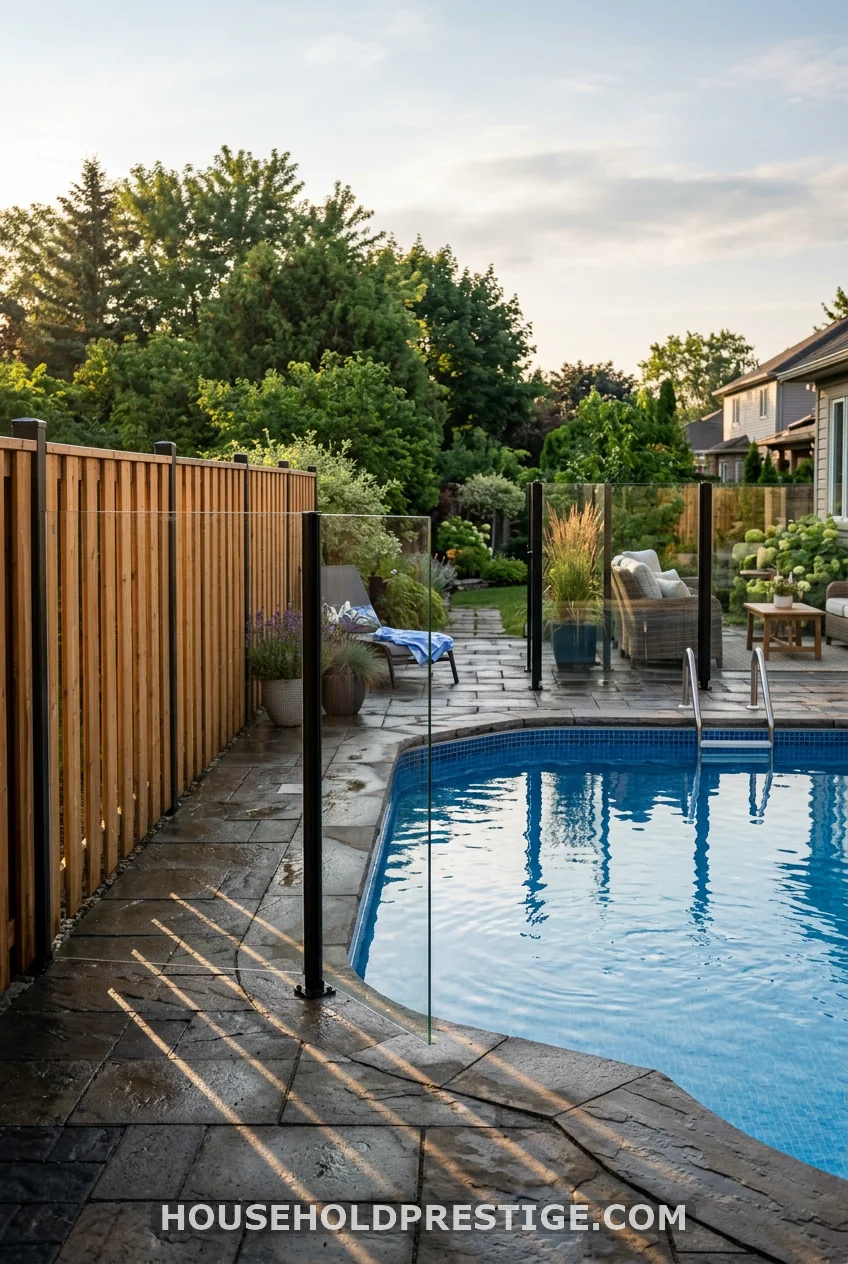
This is the pool fence idea designers use when the budget is real but not unlimited.
Glass panels where you want the view — typically the sections facing the house, the deck seating area, or an attractive landscape feature. Cedar privacy panels where you need seclusion — typically sections facing neighboring properties or the street.
The hybrid approach costs 20–35% less than all-glass while preserving the premium aesthetic on the angles that matter most. Structurally, both materials can share the same post system if planned during the installation design phase. Most pool fence contractors can execute this, though you’ll want a clear drawing of which sections get which material before anyone prices the job.
17. Polycarbonate Panel Fence
Polycarbonate is what you choose when you want the glass look without the glass fragility or glass price. A 6mm twin-wall polycarbonate panel is virtually unbreakable compared to tempered glass — it’s the same material used in greenhouse roofing and certain ballistic applications. It costs $30–$60 per linear foot installed, roughly 40–50% less than frameless glass.
The tradeoff: polycarbonate scratches more easily than glass and yellows over time under UV exposure. Specify UV-stabilized clear polycarbonate with a 10-year UV warranty — Palram’s Sunlite series and TUFFAK GP from Plaskolite are solid choices — and plan to replace panels every 10–15 years depending on your sun exposure.
Best fit: Coastal and high-wind areas where flying debris could crack glass panels; properties where a toddler-safe transparent fence is needed at lower cost; above-ground pool applications where the fence perimeter is shorter and glass cost is harder to justify.
Conclusion
Pool fence ideas aren’t one-size-fits-all — and they shouldn’t be. Your fence has to clear your local safety code, survive your climate, match your backyard aesthetic, and work within a real budget. Those four filters together usually narrow a list of 17 down to 3 or 4 serious options pretty quickly.
Before you call a single contractor, write down your three non-negotiables: budget range, primary aesthetic goal, and whether privacy matters. Those three answers will do more work than any amount of Pinterest browsing. Then get at least two quotes and ask each contractor to show you an installed example of the material they’re recommending.
The fence you actually want is out there. It probably costs less than the glass and more than the mesh — and that’s almost always fine.
Frequently Asked Questions
What is the most affordable pool fence option?
Removable mesh safety fences and vinyl picket fences are the most budget-friendly pool fence ideas. DIY mesh kits start around $975 for a 50-foot kit from Pool Fence DIY; vinyl installed runs $20–$40 per linear foot. Both meet ASTM safety standards and most local pool codes without requiring a contractor for installation.
What is the minimum height for a pool fence?
Most U.S. jurisdictions require a minimum of 48 inches (4 feet) for pool fencing, though some states require 60 inches (5 feet). Always confirm with your specific local building department before purchasing or installing any fence. Getting the height wrong means failing your permit inspection and paying to redo the work.
Do pool fences need a self-closing gate?
Yes — in virtually every jurisdiction that requires pool fencing. The gate must be self-closing, self-latching, and the latch must be positioned so a child cannot reach it from outside the fence. The MagnaLatch by D&D Technologies and the TruClose hinge system are the industry standards for pool safety gate compliance.
How much does it cost to fence a pool?
Costs vary significantly by material. For a standard 50-foot perimeter, expect roughly $1,500–$3,500 in mesh, $3,000–$7,500 in aluminum picket or vinyl, $5,000–$12,000 in cedar or composite, and $9,000–$15,000+ in frameless glass. These are installed costs that include a gate.
Can I use plants instead of a fence for pool safety?
A living hedge alone does not satisfy pool safety codes in most jurisdictions — plants can be climbed, have gaps during establishment, and variable spacing that inspectors will flag. Use a hedge as a visual layer outside a code-compliant fence, not as a replacement for one. Check with your local building department before assuming any plant-based solution qualifies.