

The laundry room is usually the last room anyone bothers to decorate. Which makes it, predictably, the most depressing room to spend time in.
Your farmhouse laundry room doesn’t have to be that space. It doesn’t take a full renovation budget or a sprawling 200-square-foot dedicated room to get that warm, airy look you keep saving on Pinterest. The right moves — shiplap, a sliding barn door, a deep apron-front sink — done in the right order, at the right price, are all it takes.
What follows are 23 farmhouse laundry room ideas with real material costs, specific brand recommendations, and renter-friendly workarounds woven in wherever competitors forget to mention them. Read through to the end — the paint color breakdown near the end has saved people hundreds of dollars in choices they’d have regretted.
1. Shiplap Walls: The Farmhouse Foundation
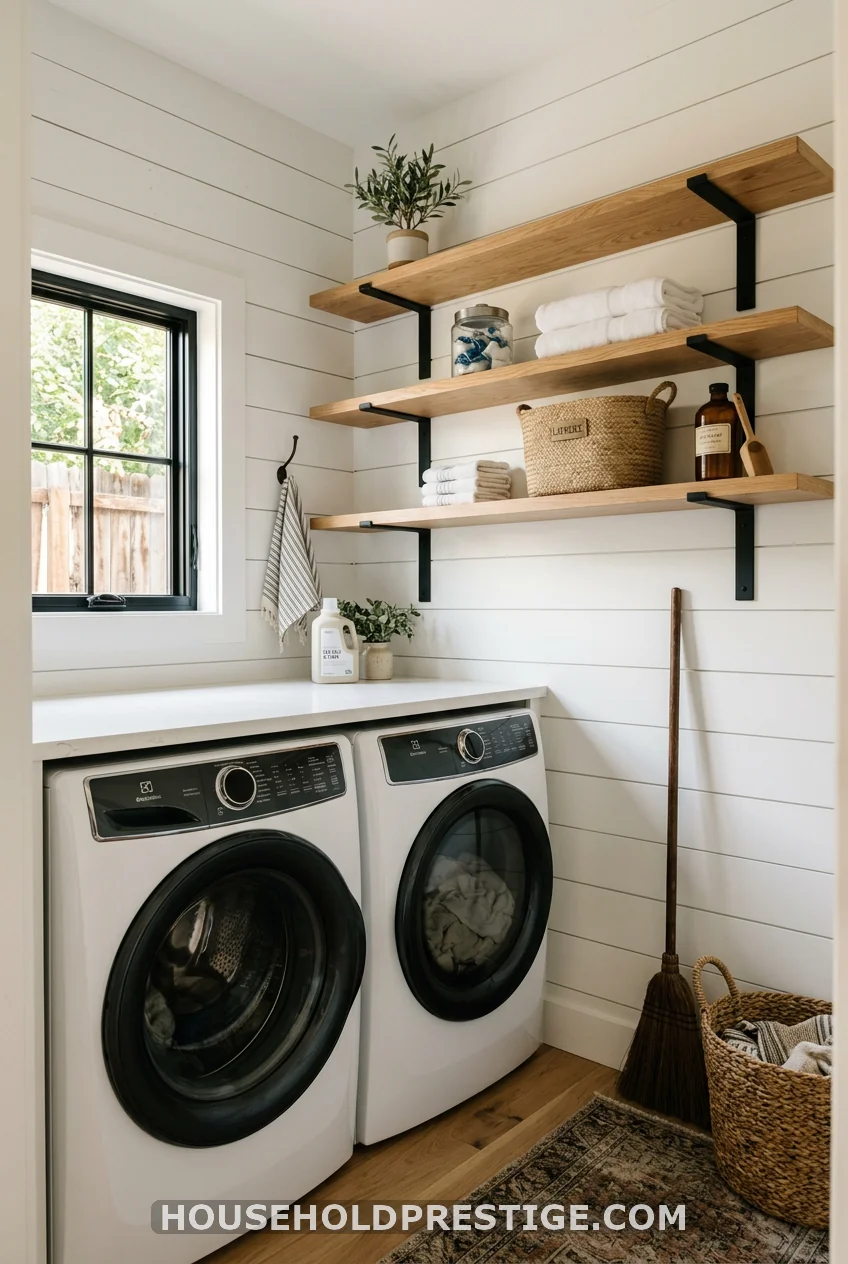
Shiplap is the non-negotiable starting point of the farmhouse aesthetic — and it’s one of the highest-impact, lowest-regret projects in the laundry room. A single wall of shiplap does more for the space than any basket or sign ever could.
Why Shiplap Works in a Laundry Room
The horizontal lines add visual width to a room that’s often narrow laundry room. The texture breaks up the monotony of flat drywall. And the ability to paint it any shade — crisp white, warm cream, soft sage — means it works with virtually any cabinet color you already have. Most people assume it requires a carpenter. It doesn’t.
What You’ll Need (Materials List)
For a standard 8×8-foot laundry room back wall (64 square feet):
- Real shiplap boards (1×6 pine shiplap): approximately $1.50–$2.50 per linear foot at Lowe’s or Home Depot → budget $150–$200 for materials
- Plywood alternative (most popular DIY approach): 4×8 sheets of ¼-inch plywood cut into 3.5-inch strips → total cost $40–$80 for the entire wall
- Adhesive + 2-inch brad nails: $20–$30
- Wood filler and caulk: $10–$15
- Paint (Sherwin Williams Eider White SW 7014): one quart = $25–$30 covers most walls
- Nickel spacers or playing cards for gaps between boards
- Stud finder, level, circular saw or table saw
Total materials for a plywood-strip shiplap wall: $90–$155. Compare that to the $400–$800 a contractor charges for the same result.
Step-by-Step Installation
- Find your studs. Mark them with painter’s tape down the length of the wall.
- Start at the bottom. Rest your first board directly at floor level (or baseboard height if going half-wall). Use a level — if the first board is off, every board above it will be off.
- Secure each board. Apply construction adhesive to the back and shoot 2-inch brad nails into every stud. Two nails per stud per board.
- Create the gap. Slide a nickel between boards as you stack them upward. This creates the authentic shiplap shadow line without buying actual tongue-and-groove lumber.
- Work your way to the top. The last board will need to be ripped (cut lengthwise) to fit. Measure twice before cutting.
- Fill nail holes. Use lightweight spackle. Sand smooth after drying.
- Caulk all seams where shiplap meets ceiling, floor, and adjacent walls. This is what separates a professional finish from a DIY finish.
- Prime and paint. Two coats, painting into the gaps with a small brush first, then rolling the face. Don’t skip priming on raw wood.
Drying time between coats: 2 hours minimum. Full project from start to finish: a weekend.
Cost Reality Check
| Option | Material Cost | Time | Difficulty |
|---|---|---|---|
| Plywood strips (DIY) | $90–$155 | 1 weekend | Medium |
| Real shiplap boards (DIY) | $200–$320 | 1 weekend | Medium |
| Peel-and-stick shiplap panels | $60–$120 | 2–3 hours | Easy |
| Contractor-installed real shiplap | $600–$1,200 | Professional | None |
Common Mistakes That Kill the Look
Not priming the wood. Raw plywood absorbs paint unevenly and looks patchy. Always prime.
Skipping the gap. Without the nickel-width gap, your shiplap looks like plain painted boards. The gap creates the shadow line that makes it read as shiplap from across the room.
Going floor to ceiling in a small space. Full-height shiplap can overwhelm a narrow laundry room. Stop at 4 feet for the most balanced, Pinterest-worthy result — open shelving or painted drywall above it adds breathing room.
2. Open Floating Wood Shelves
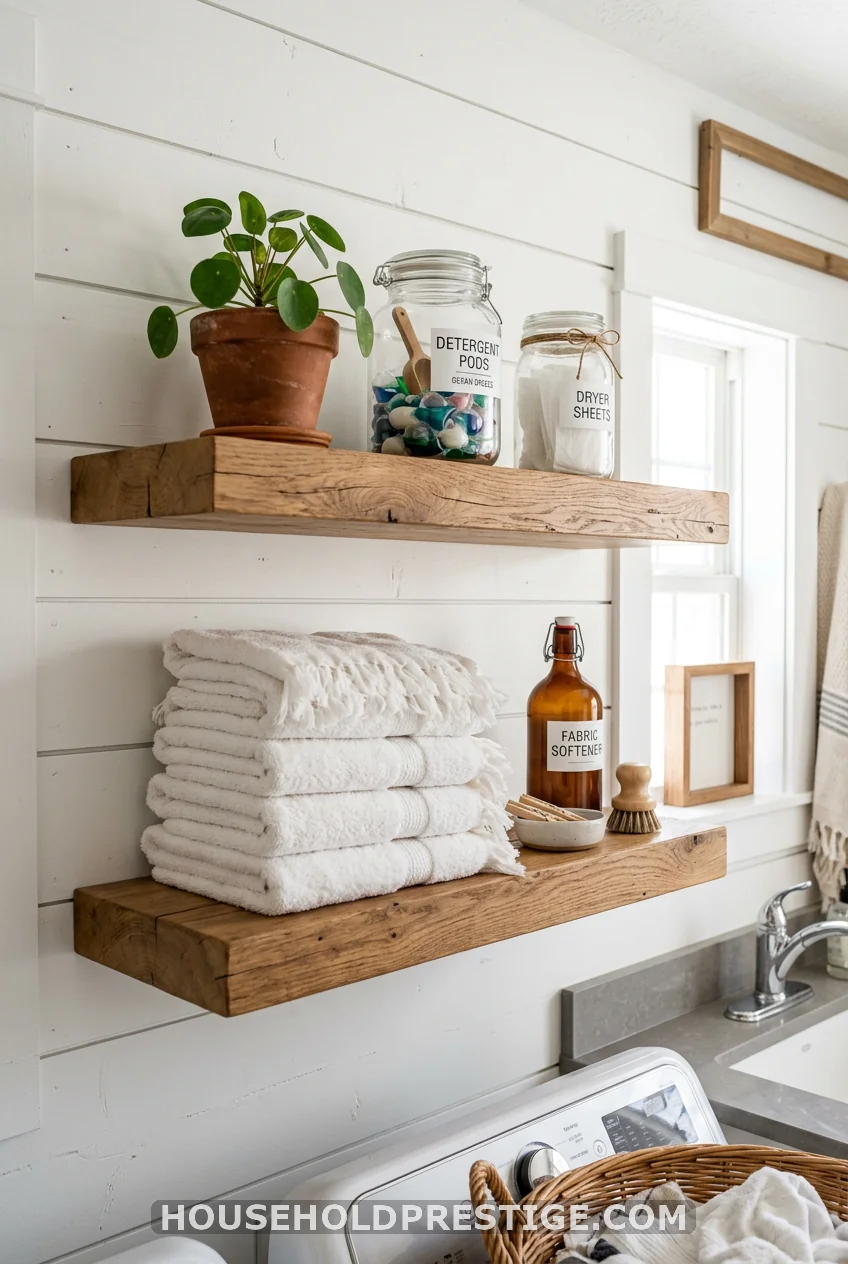
Skip the upper cabinets on at least one wall. Open shelves add that airy, magazine-worthy quality that makes a laundry room feel intentional rather than crammed. Mount them 10–12 inches deep at 18 inches above the countertop. IKEA’s EKBY HEMNES shelf with SIBBHULT brackets runs $15–35 per shelf and hits the farmhouse look without the price tag. Warm oak or pine — never white laminate.
3. The Apron-Front Farmhouse Sink
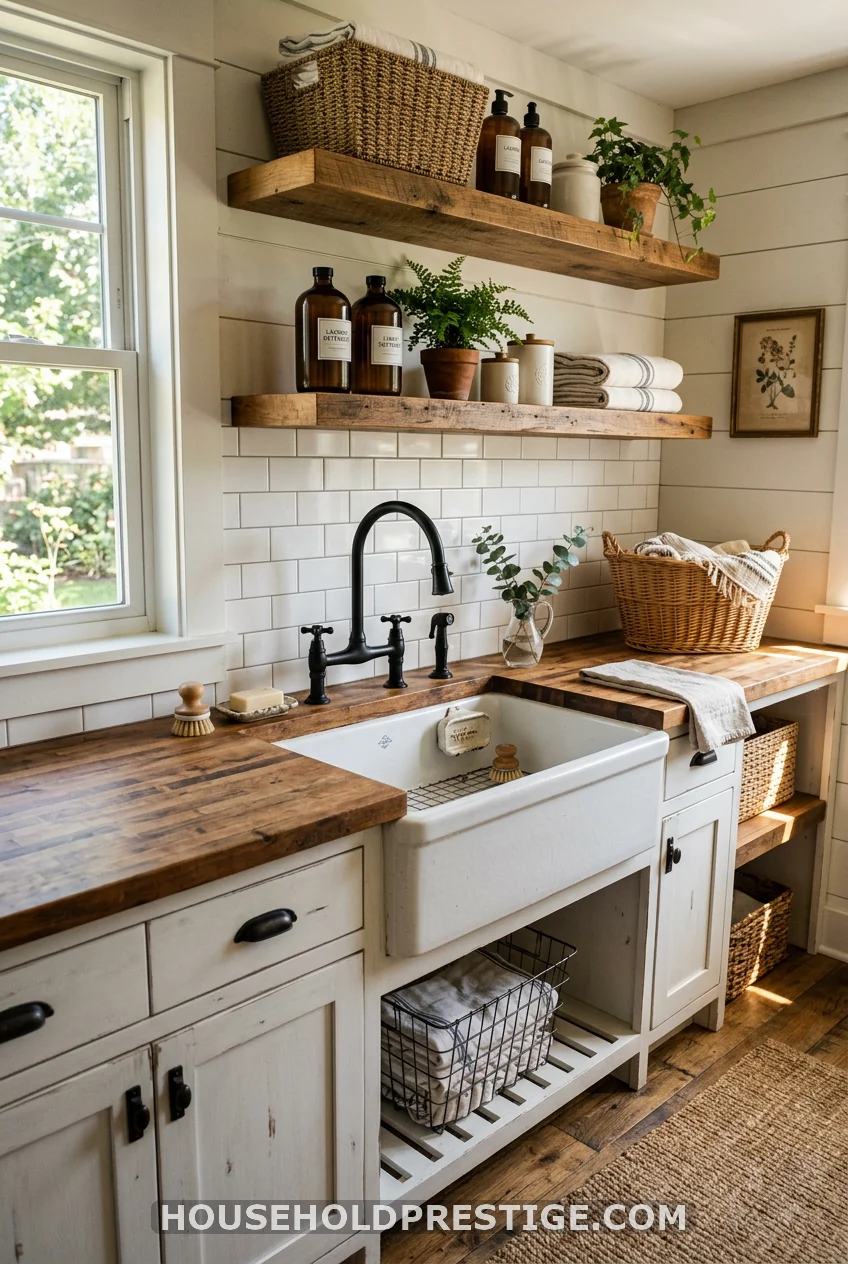
The apron-front sink might be the single most recognizable farmhouse element you can add to a laundry room. That big exposed front panel — typically in white fireclay or cast iron — does what no amount of decor can: it makes the room look deliberately designed.
Material choice matters. Fireclay (like the IKEA HAVSEN at $299 or the Ruvati RVL2331WH at $489) is lighter than cast iron, resists staining, and doesn’t require the structural reinforcement that a heavy cast iron model demands. Cast iron options (like the American Standard Portsmouth at $550–700) are heirloom-grade but need reinforced cabinetry. For most laundry rooms, fireclay is the smarter call.
Installation note: An apron-front sink requires a specific base cabinet configuration — typically a 36-inch wide cabinet with the front face frame removed. Budget an additional $100–200 for cabinet modification if you’re retrofitting existing cabinetry. Alternatively, buy an apron-front-specific base cabinet from IKEA or Home Depot that comes pre-cut for the configuration.
The size sweet spot for a laundry room sink is 24 to 30 inches wide — wide enough to soak full sheets or hand-wash bulky sweaters, but not so wide it eliminates the counter space you need for folding.
4. Matte Black Iron Hardware Swaps
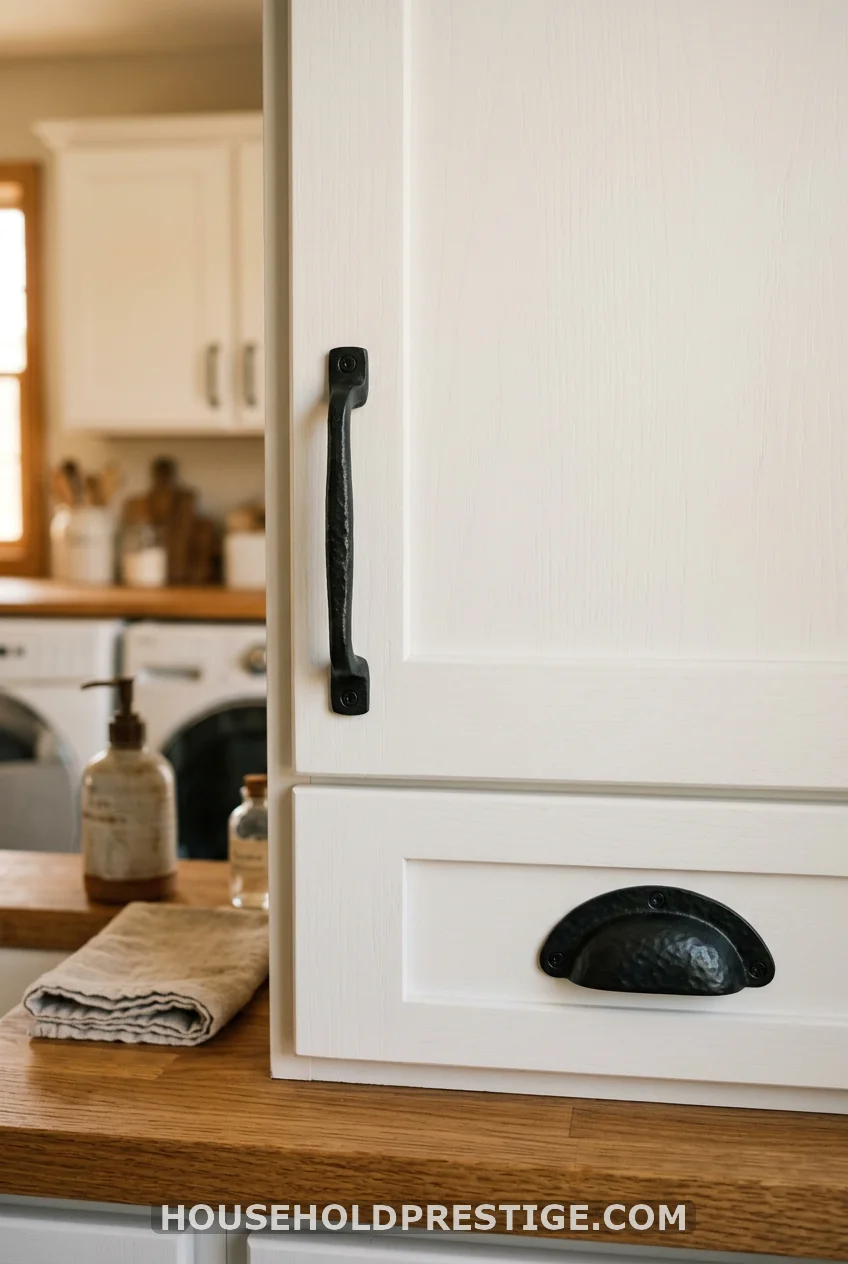
This is the fastest visible upgrade you can make. Swap your existing cabinet pulls and hinges for matte black iron hardware and the whole room reads “intentional farmhouse” in 30 minutes. A full set of pulls for 8–10 cabinets runs $15–40 from Amazon (Franklin Brass, Liberty Hardware, or Cosmas). Standard center-to-center screw hole distance is 3 inches or 3.75 inches for bar pulls — confirm your existing holes match before ordering.
5. Sliding Barn Door
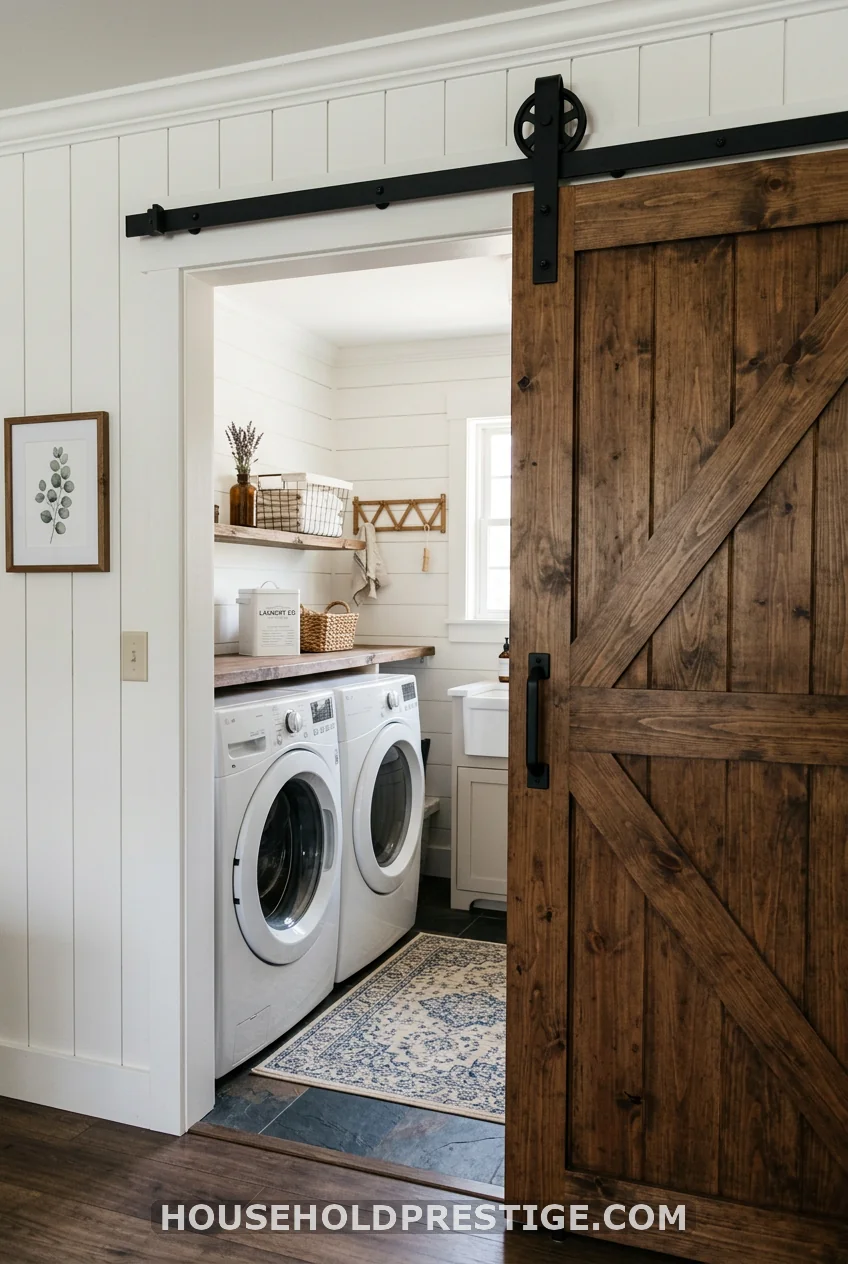
A sliding barn door does three things at once: saves the 14–18 square feet of clearance a hinged door needs, adds an immediate rustic character, and makes a laundry room feel like a room worth having a door on at all.
Budget: A ready-to-hang solid wood barn door runs $150–300 (CALHOME and GLORHOME on Amazon have strong reviews). The hardware track kit adds $40–80. Total DIY cost: $200–$400. Professional installation with door and hardware: $600–900.
The measurement most people miss: Barn doors need 1 inch of overlap on each side of the door opening — order a door 2 inches wider than the opening. You also need wall space beside the opening equal to the door’s width for it to fully slide open. Confirm this before ordering.
Renter option: Many landlords say yes to barn doors when you explain the hardware mounts without damage. Ask before assuming no.
6. Woven Baskets and Vintage Tins
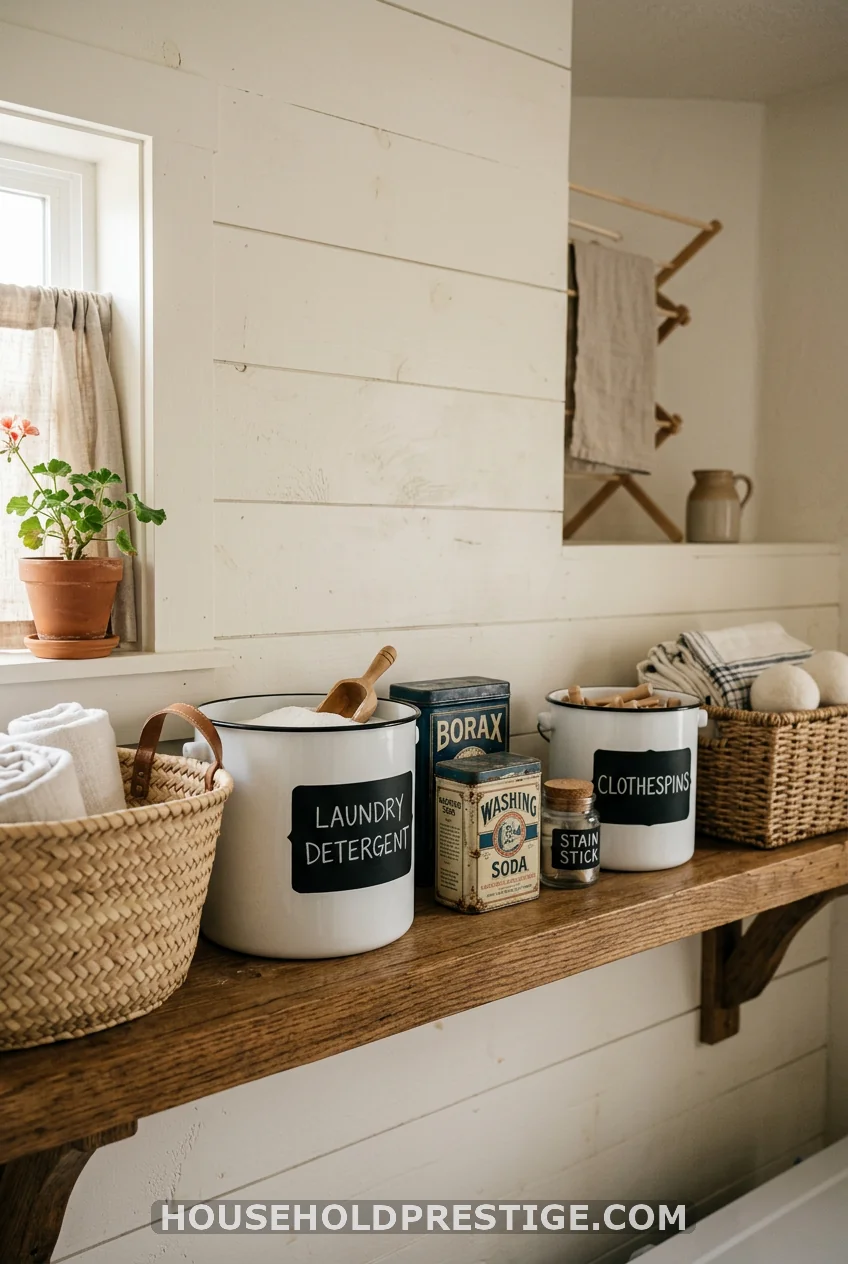
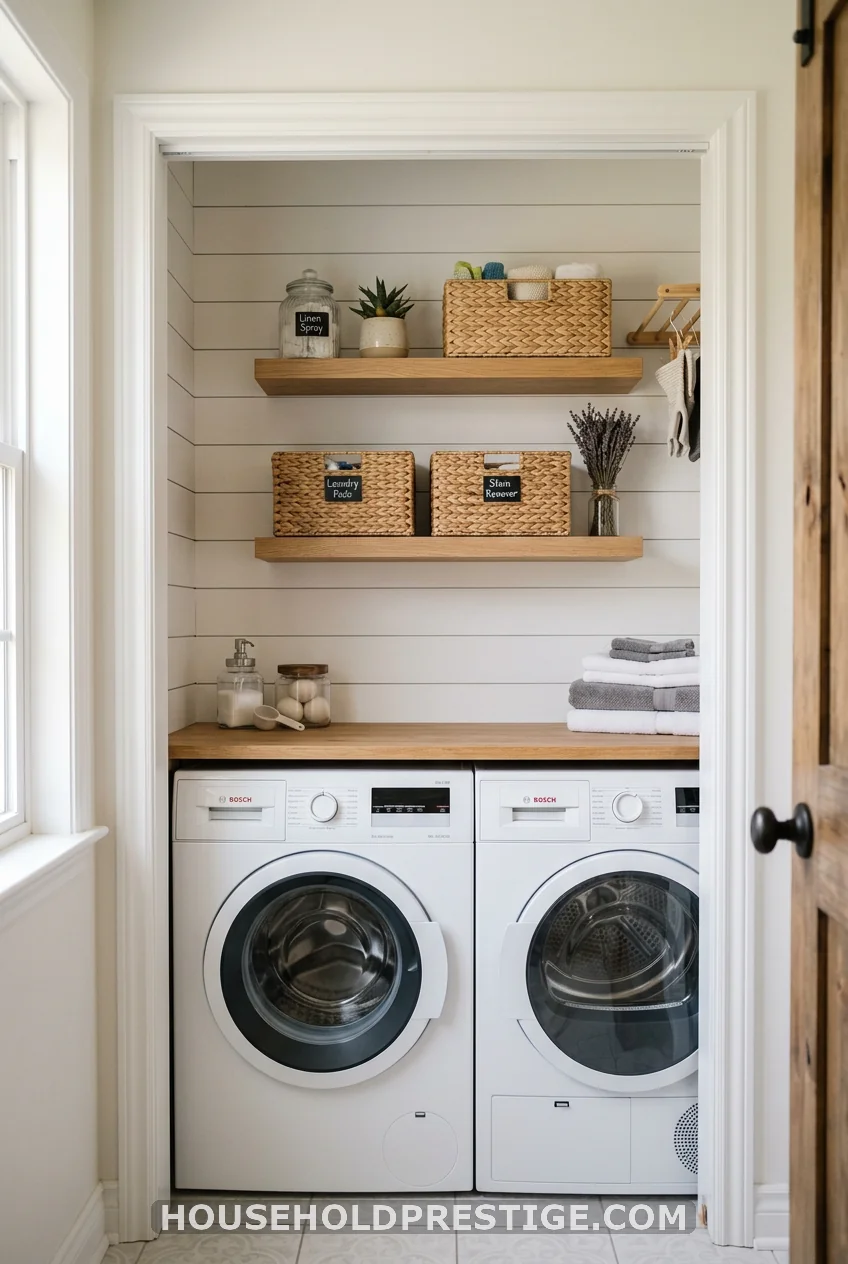
The fastest way to shift a laundry room from clinical to cozy: replace plastic bins with woven baskets and galvanized or enamel tins. Seagrass baskets at HomeGoods run $12–25 each. Vintage-style enamel tins with lids (great for detergent pods) are $8–20 at TJ Maxx or Amazon. Stack them, label them in chalk, and you have a styled farmhouse shelf in under an hour.
7. Wallpaper Accent Wall
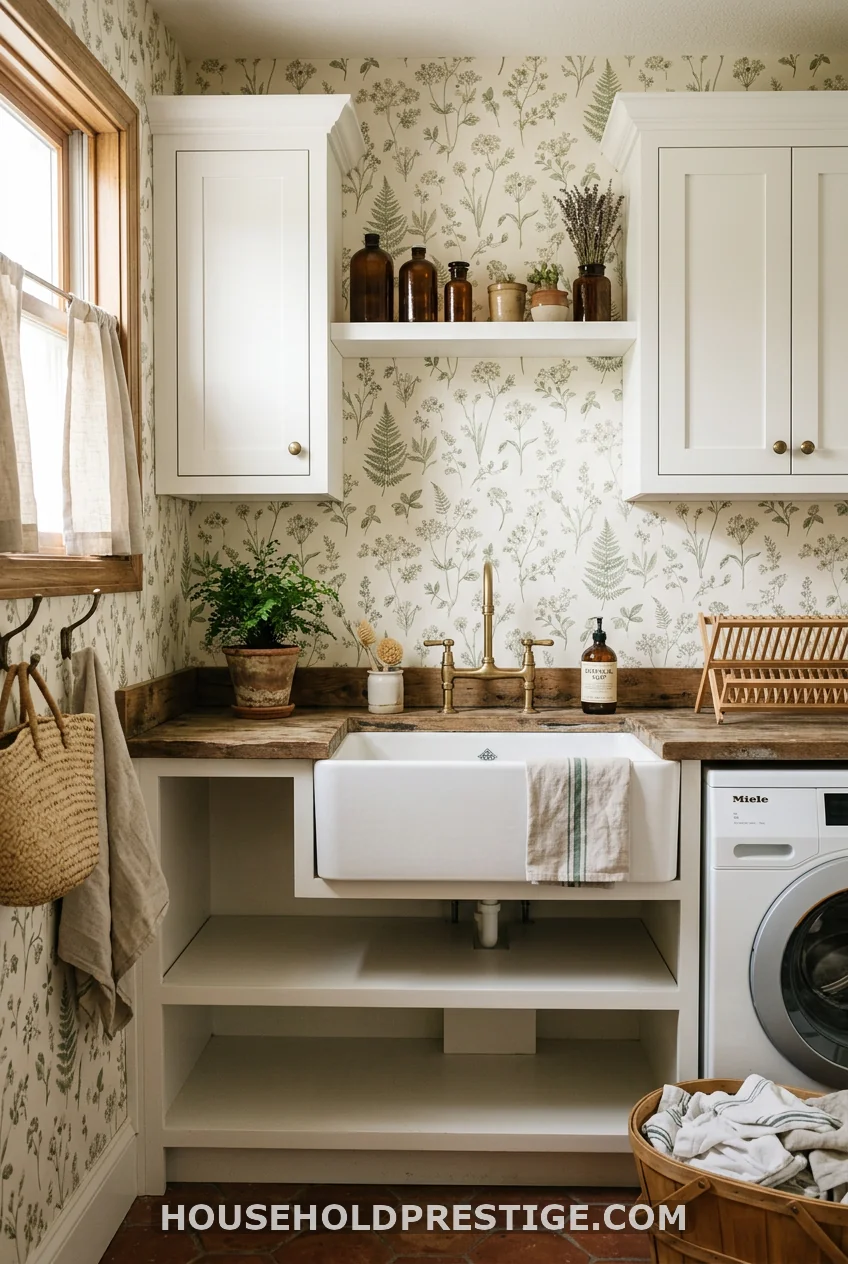
One wall of the right wallpaper can do more for a laundry room than a full paint job. Farmhouse patterns that hold up visually: vintage botanicals, buffalo check in cream and black, French toile, and simple wide stripes. Two-color combinations in neutral-warm palettes only.
For renters: Peel-and-stick wallpaper has improved dramatically. NuWallpaper’s botanical prints ($29/roll) and Tempaper’s vintage patterns ($45–55/roll) remove cleanly without paint damage. One accent wall behind the washer and dryer is typically 30–50 square feet, requiring 2–4 rolls.
For homeowners: Traditional paste wallpaper from Brewster Wallcovering, York Wallcoverings, or Rifle Paper Co. delivers a more polished finish and lasts 15+ years. Look for moisture-resistant or vinyl-coated options rated for high-humidity areas — your laundry room qualifies.
8. The Myth: Farmhouse Style Needs a Big Room and a Big Budget
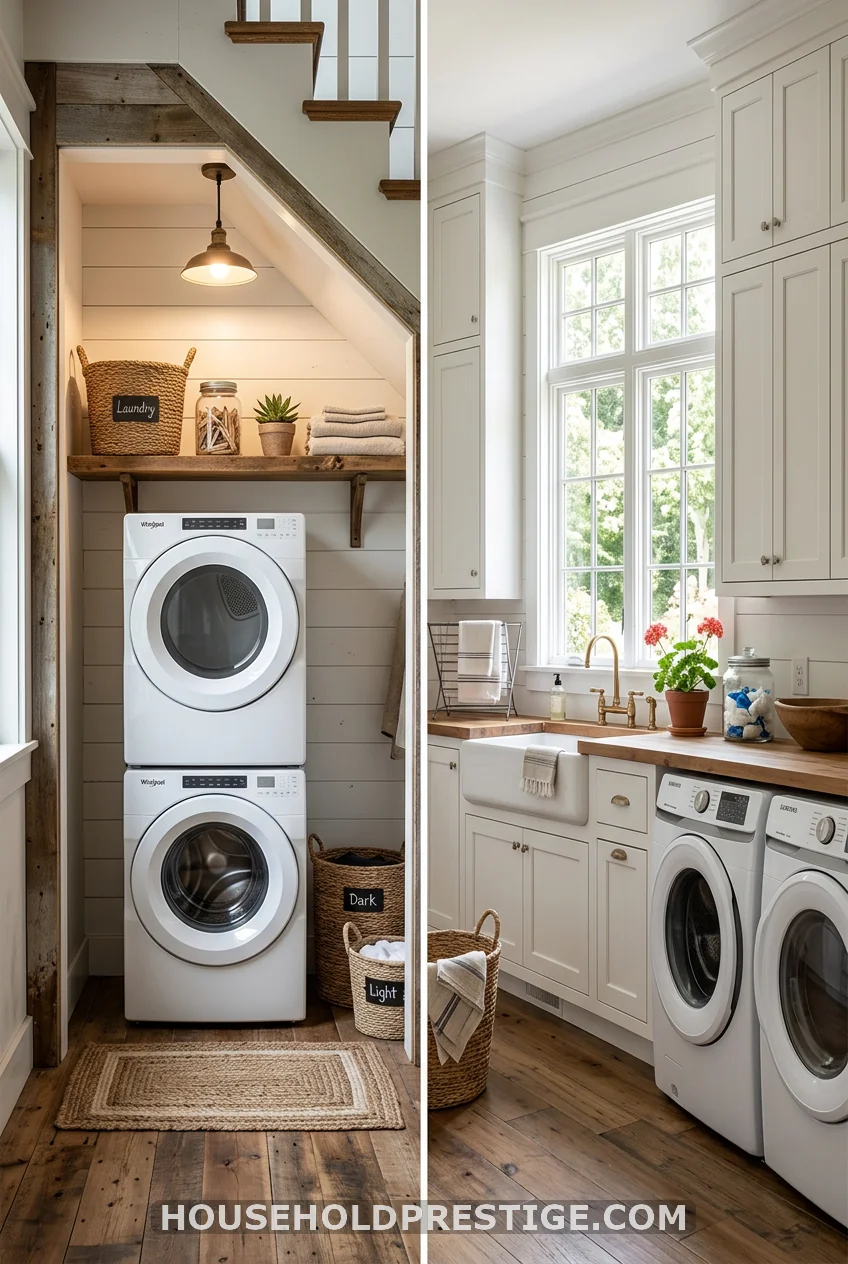
What most people think: A real farmhouse laundry room needs a dedicated 100+ square foot space, custom cabinetry, and $5,000+ to look like the ones on Instagram.
The reality: The most-shared farmhouse laundry rooms on Pinterest are frequently small laundry room. The viral ones are often laundry closets — 5×7 feet or less — with stacked machines, one shelf, three baskets, and a barn door. The farmhouse look is built on texture and restraint, not square footage.
Add elements in order of visual impact:
- Shiplap or beadboard first — biggest texture change for $90–$320 DIY
- Hardware swap second — $15–40, one afternoon
- Lighting third — swap the builder-grade fixture for a lantern pendant, $50–150
- Storage fourth — open shelves with baskets, $30–80 per shelf
A full farmhouse laundry room overhaul for under $500 is realistic — not by cutting corners, but by sequencing moves that hit hardest for the least money.
9. Butcher Block Folding Counter
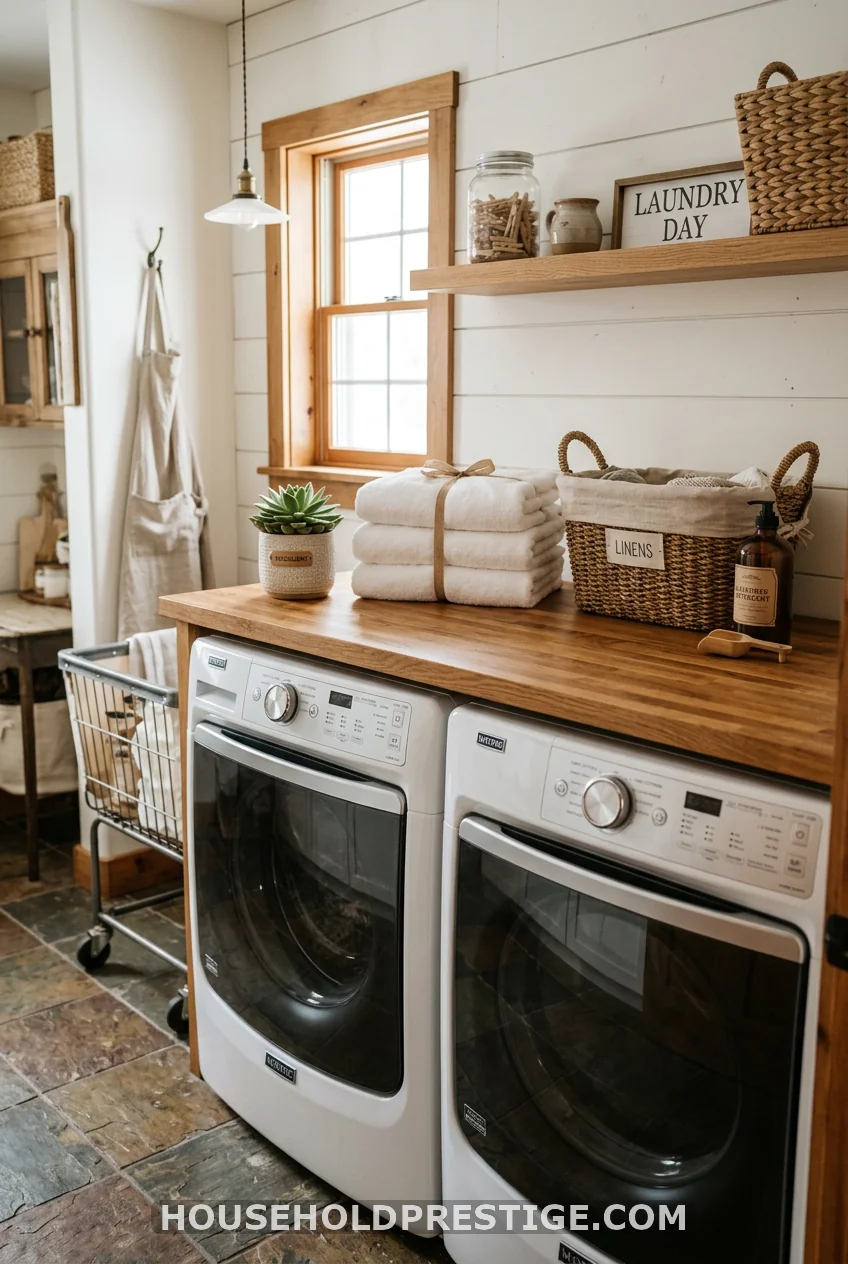
A countertop above the washer and dryer changes how you do laundry. Clothes get folded immediately instead of piling in the basket for three days. Butcher block is the farmhouse material choice because it brings warmth that quartz or laminate can’t match — and it’s the most forgiving countertop material for a room where the occasional drip is inevitable.
Standard washer/dryer height is 36–38 inches. A counter at this height creates a seamless, usable work surface that aligns with kitchen ergonomics. Allow a 1-inch overhang on the front edge.
IKEA’s SALJAN countertop ($129–199 for a 74×1.5-inch section) is the most popular budget option. Seal it with food-safe mineral oil immediately after installation and re-oil every 6–12 months. For a premium version, Lumber Liquidators and BuildDirect sell unfinished butcher block by the linear foot at $10–20 per foot, cuttable to any width.
DIY installation — cut to size, secure to the wall with L-brackets — runs $150–350 total. Professional sizing and installation adds $100–250 in labor.
The catch: Butcher block expands and contracts with moisture. Seal all four edges and the underside, not just the face. Unsealed edges are where most butcher block laundry room countertops start to warp within the first year.
10. Beadboard Wainscoting (The Shiplap Alternative)
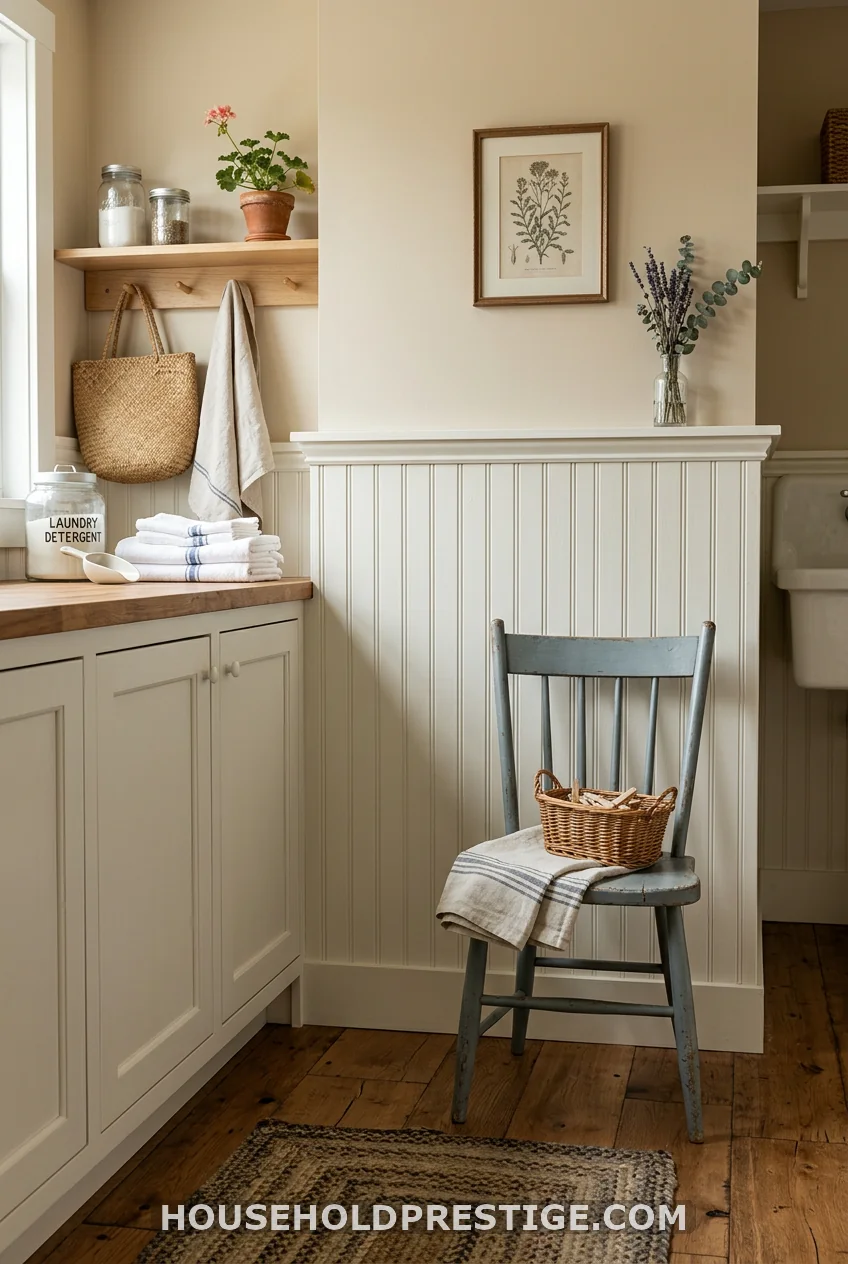
Beadboard runs vertically, creates a softer groove pattern than shiplap, and costs slightly less to install. Pre-made 4×8 beadboard panels from Home Depot or Lowe’s run $0.80–1.50 per square foot — cheaper than most shiplap options. Cut them to half-height (42–48 inches from the floor), cap the top edge with a 1×3 wood rail painted in a complementary color, and you’ve added significant farmhouse texture to the lower third of the room.
Paint choice is critical here. Sherwin Williams Shoji White SW 7042 and Alabaster SW 7008 both read as warm off-whites rather than stark white. Stark white feels clinical. Warm white feels like a farmhouse kitchen.
11. Mason Jar Detergent Dispensers
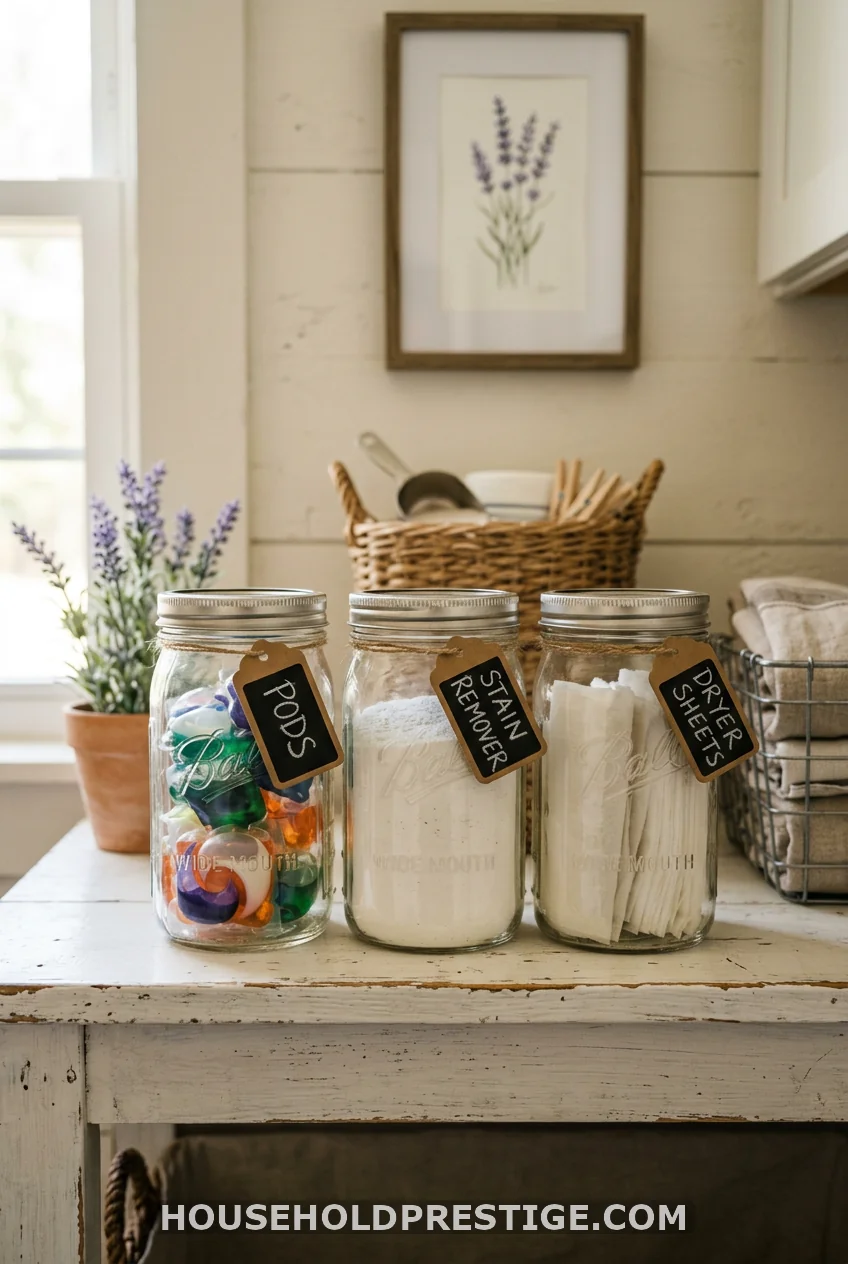
Decant your laundry pods and stain remover into Ball wide-mouth mason jars ($10 for a 12-pack). Add a chalk-ink label. The plastic jugs look like a storage unit; the mason jars look like a farmhouse. Takes 10 minutes. This is the smallest swap with the biggest ratio of visual return.
12. Subway Tile Backsplash
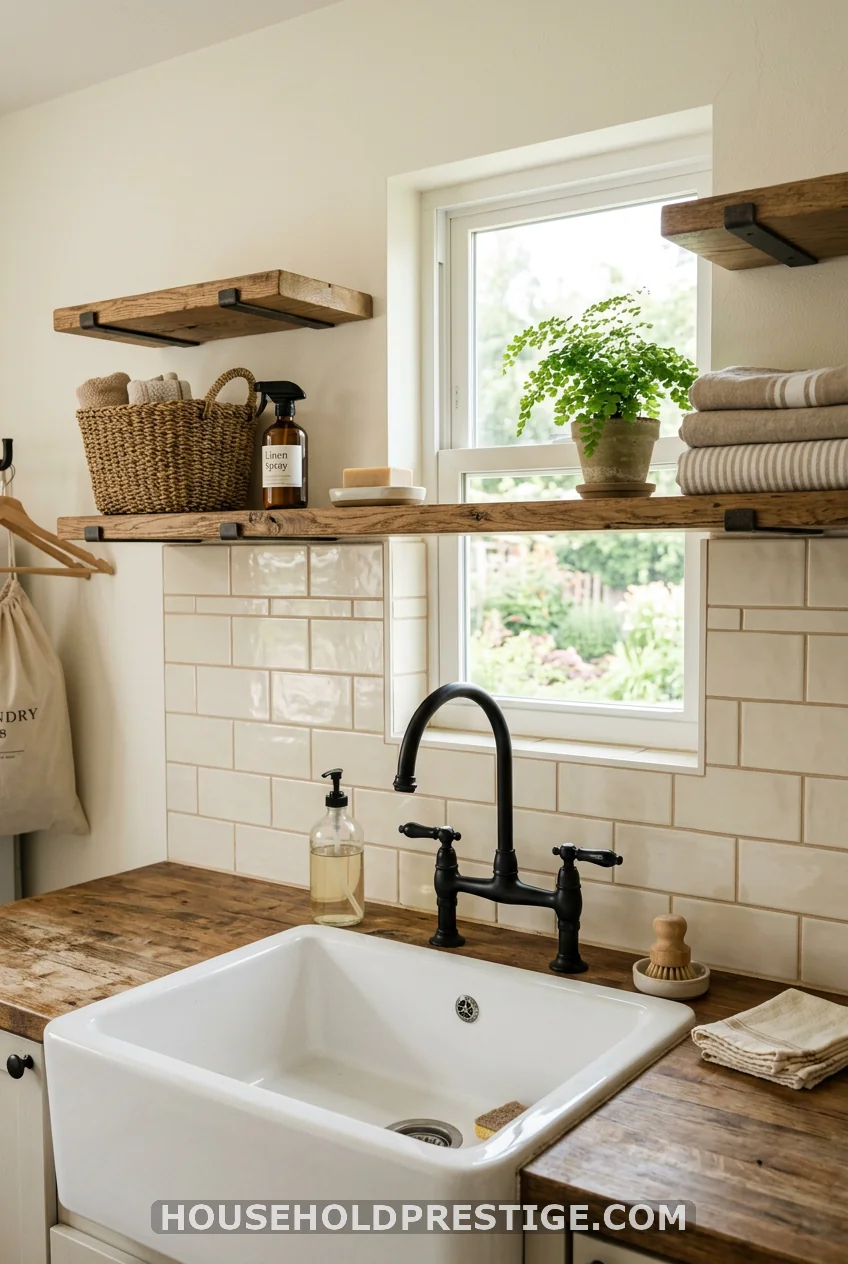
Behind the sink is where subway tile does its best work. The 3×6 cream or off-white subway tile in a horizontal brick pattern is the most farmhouse-specific backsplash you can install. American Olean’s 3×6 White and Merola Tile Metro White both run $1–2 per square foot. A typical 10-square-foot backsplash: $10–20 in tile plus $80–150 for professional installation.
The detail most people miss: grout color. White grout reads clinical. Choose Mapei Warm Gray or Custom Building Products Sahara Beige — that grout color does 30% of the farmhouse work.
Renter option: Peel-and-stick subway tile from Art3d or SmartTiles ($20–35 per 10-square-foot pack) applies directly over existing backsplash without adhesive damage. Removes cleanly.
13. Vintage Laundry Signs
Hang a “Wash. Dry. Fold. Repeat.” wood sign above the machines. The Blulu 5-piece rustic sign set on Amazon runs $22–28 and contains everything needed for an instant farmhouse wall moment. The lowest-cost item on this list and the most immediately recognizable farmhouse detail — don’t skip it.
14. Built-In Pull-Out Hamper Cabinet
A tilt-out hamper kit converts any standard 15–18 inch base cabinet into a built-in dirty laundry station. The Rev-A-Shelf 563 Series hamper kit ($60–100 at Amazon or Home Depot) fits most standard cabinet openings and installs in about 45 minutes. No more laundry basket on the floor. No more looking at it.
If you don’t have existing base cabinets, IKEA’s SEKTION 15-inch base cabinet ($75) plus the hamper hardware gets you there for under $175 total — a solution that removes cleanly when you move.
15. Farmhouse Lantern or Schoolhouse Light Fixture
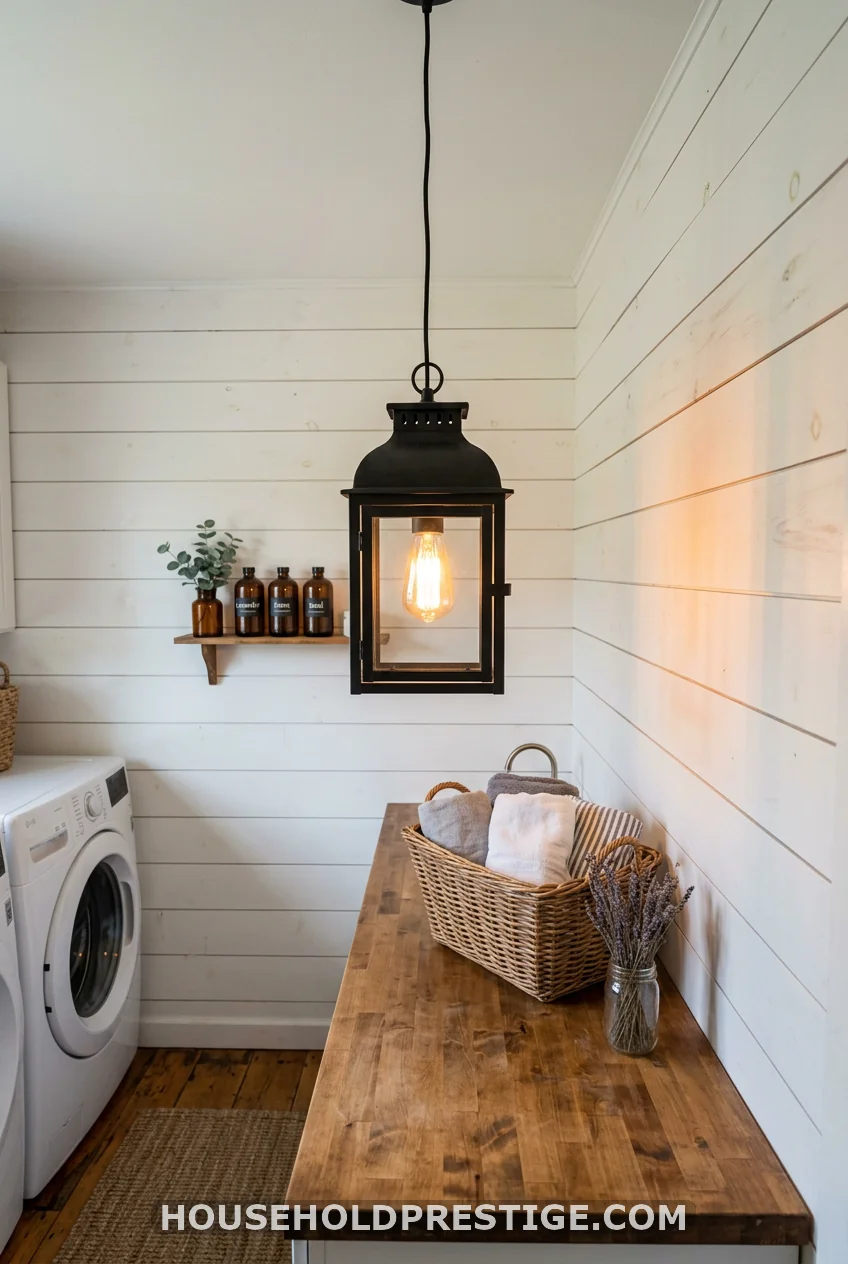
The builder-grade flush-mount fixture is one of the most overlooked aesthetic problems in laundry rooms. One swap to a matte black metal lantern ($50–150) or a white-globe schoolhouse pendant ($60–120) immediately reads as considered design. Rejuvenation, Pottery Barn, and Amazon’s Stone & Beam line all have options shipping under $100.
Bulb choice matters. Use a warm Edison-style LED at 2700K color temperature — not daylight. Daylight bulbs make a farmhouse laundry room feel cold and medical. 2700K makes it feel like late afternoon sun in a farmhouse kitchen.
16. Renter-Friendly Peel-and-Stick Shiplap
For renters who can’t touch the walls, NuWallpaper’s Shiplap Collection (model NUS3450) applies like wallpaper, peels off without paint damage, and reads as shiplap from a few feet away. At $29–35 per roll (covering approximately 28 square feet), a 6×8 back wall runs $60–80 in materials.
Alternatively: mount pre-primed MDF strips (1×4, cut to length) to the wall using heavy-duty Command Strips rated 3–5 pounds per strip, spaced every 12 inches. This method costs $80–120 for materials, gives you actual wood texture, and holds up to repainting. Both options leave the walls intact when you move out.
17. Galvanized Metal Accents
Galvanized metal belongs in a farmhouse laundry room the way matte black hardware belongs in a farmhouse kitchen. Three galvanized buckets — one for rags, one for clothespins, one for dryer sheets — lined up on a shelf cost $15–25 total at HomeGoods or Walmart. Galvanized pipe shelving brackets ($8–15 each) reinforce the industrial-farmhouse mix. No special installation required.
18. An Antique-Style Laundry Rug
A rug grounds the room. Full stop. In a laundry room, it also protects the floor from drips and reduces the echo that makes small utility spaces feel like storage units. A 2×3 or 3×5 Persian-style flatweave rug (washable — non-negotiable) or a jute rug costs $20–80 at Target, Wayfair, or HomeGoods. If it isn’t machine-washable, it has no business being in a laundry room.
19. Plants and Greenery
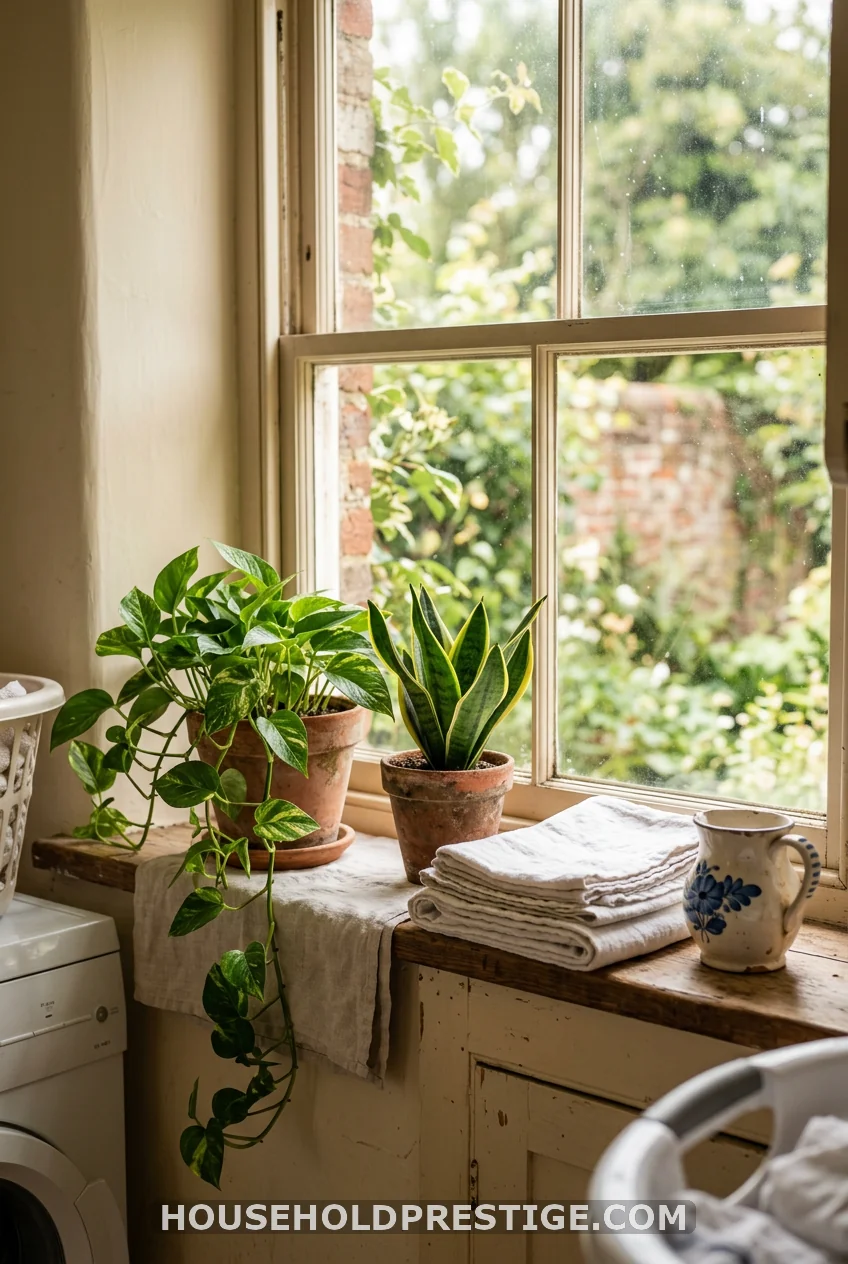
A laundry room with plants feels cared-for. Without them, even a well-organized space reads as utilitarian.
What grows well in a laundry room: pothos and snake plants handle low light and laundry humidity easily. Air plants (Tillandsia) thrive on steam from the dryer and need no soil — just a quick misting once a week. Spider plants do well near indirect light from most laundry room windows. Stay away from anything fussy.
Terracotta pots in the 4–6 inch range ($2–8 at garden centers) look farmhouse-native. The combination of terracotta, trailing greenery, and white linens on a wood shelf is one of the most-pinned farmhouse laundry room aesthetics for good reason.
20. Repurposed Vintage Finds
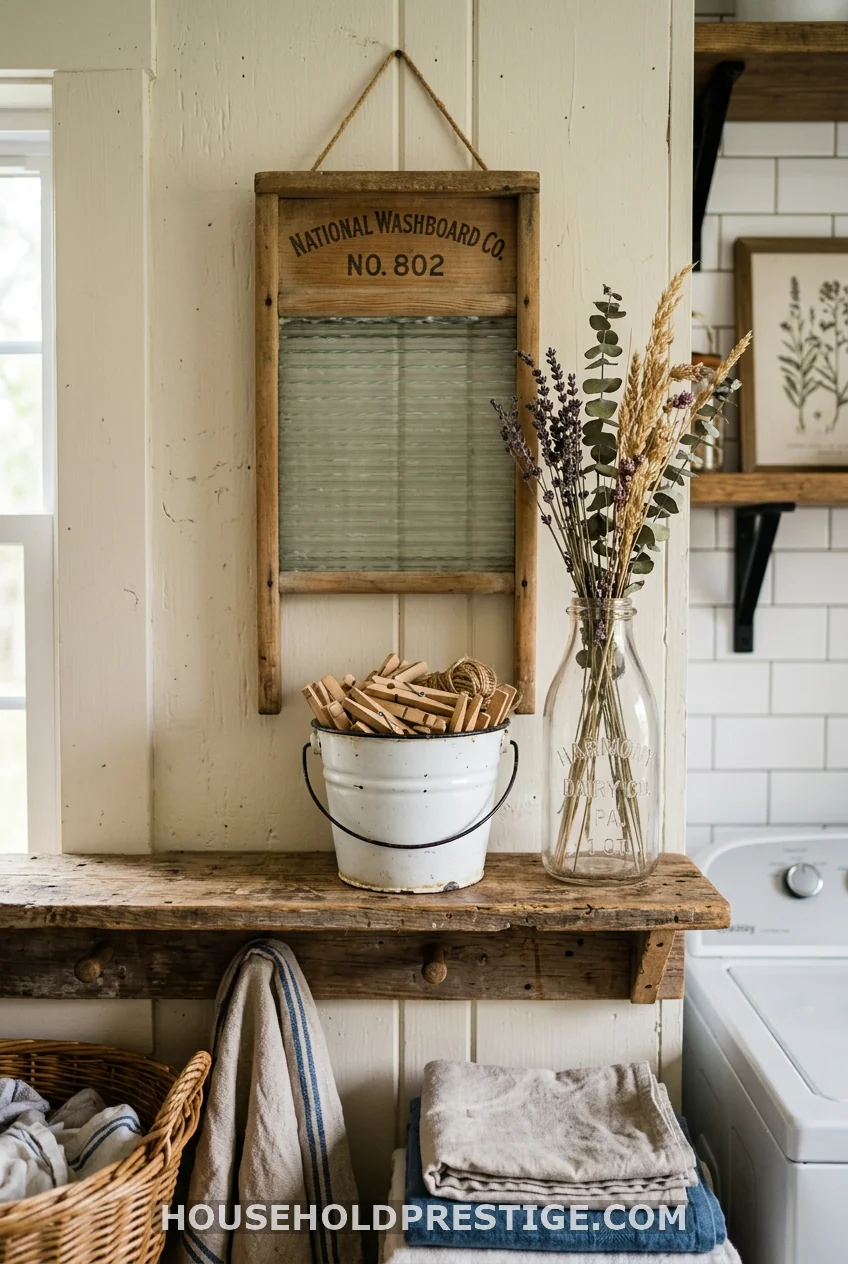
The farmhouse aesthetic partly depends on the illusion that the space has always looked this way — like it evolved naturally rather than being assembled from a shopping cart. Vintage finds create that. An antique washboard ($15–35 at an antique shop or eBay) hung as wall art signals history. An enamel bucket holding wooden clothespins ($8–20) looks like it survived multiple decades. A vintage milk bottle with a dried botanical stem costs practically nothing.
The line between curated vintage and thrift-store clutter is restraint. Three vintage pieces maximum for a small laundry room: one functional (the enamel bucket), one decorative (a washboard or antique sign), one organic (dried botanicals or a small plant). Stop there. More than three in a compact space becomes visual noise.
21. Chalkboard Paint Panel
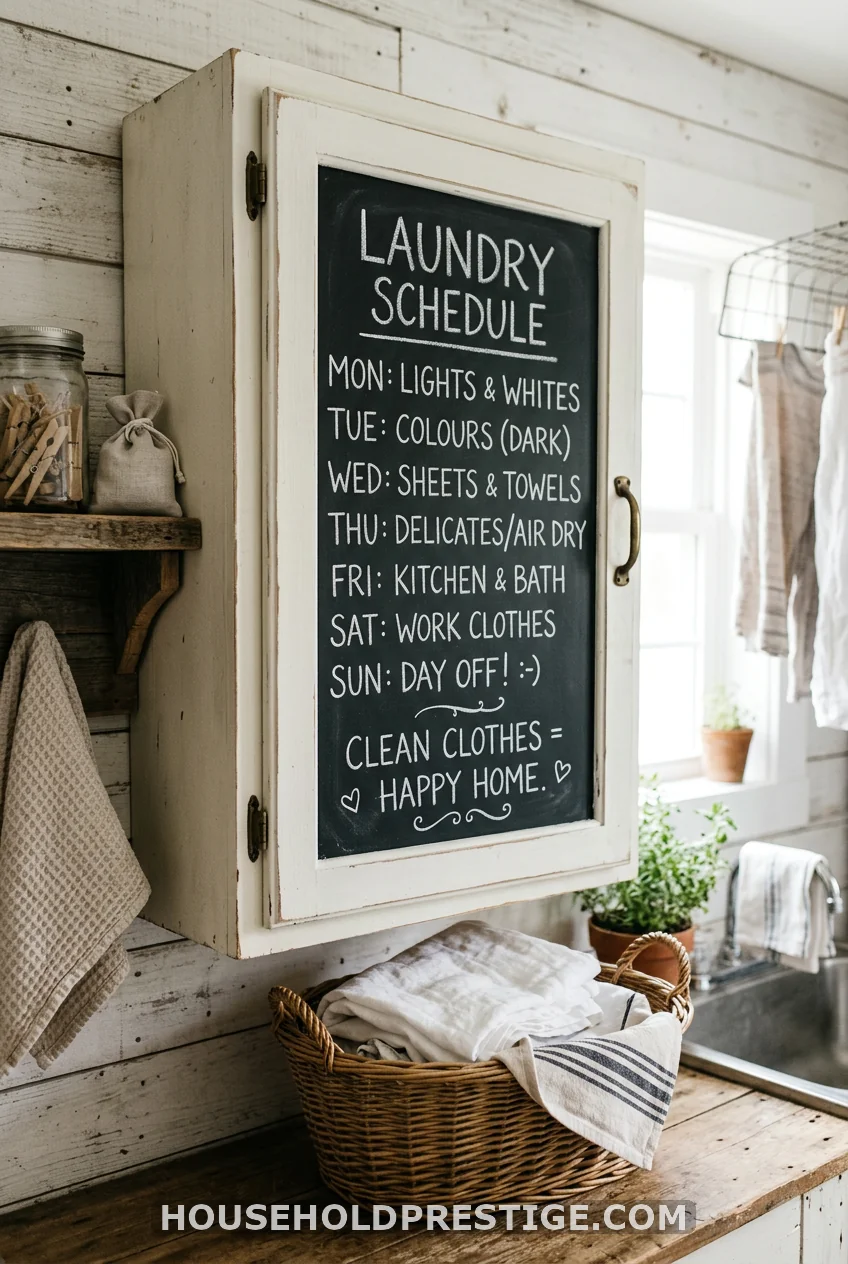
Paint one cabinet door or a 12×16-inch wall section with Rust-Oleum Chalkboard Paint ($8–12 at any hardware store). Write washing instructions, a weekly laundry schedule, or a short message that makes you smile on laundry day. It adds handmade farmhouse character for the cost of an afternoon and one pint of paint. Let it cure for 72 hours before writing on it, or the chalk won’t adhere cleanly.
22. Warm Neutral Paint Colors for Farmhouse Laundry Rooms
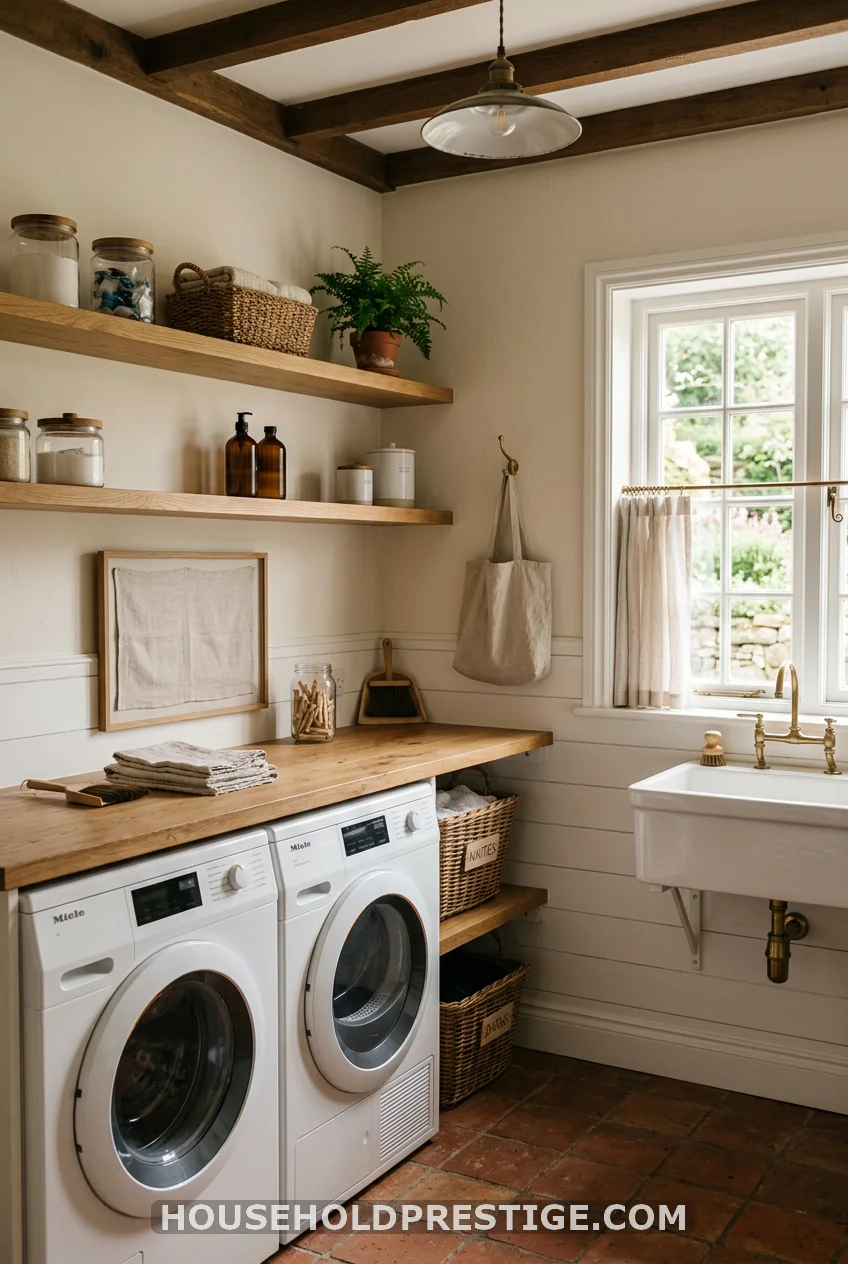
Paint color is where most farmhouse laundry room projects go wrong before they even begin. Cool whites look fine in showrooms and deeply wrong in small, typically north-facing utility rooms. The farmhouse palette skews warm — warm white, warm cream, warm greige — and the difference between those and a clinical cool white is enormous once you’re living with it.
The tested farmhouse laundry room paint colors:
- Sherwin Williams Eider White SW 7014 — The most-used farmhouse paint color in this niche. Reads crisp white in strong light, shifts slightly warm in low light. Works with every hardware finish and wood tone.
- Sherwin Williams Alabaster SW 7008 — Warmer than Eider White. Better for rooms with south- or west-facing windows that bring in strong light. Pairs beautifully with natural wood accents.
- Benjamin Moore White Dove OC-17 — A designer favorite. Balanced warm white without yellow or pink undertones. Works well in almost any lighting condition.
- Sherwin Williams Accessible Beige SW 7036 — For rooms where you want a greige rather than a white. Warm lean, reads refined. Pairs beautifully with black iron hardware and butcher block countertops.
- Farrow & Ball Drop Cloth No. 283 — The premium option at $100+/gallon. A sophisticated warm neutral that reads differently depending on the hour and the light. Worth the price in a room you spend real time in.
One rule before committing: Buy 2–3 sample pots ($5–8 each) and paint 12×12-inch patches directly on the wall. Leave them 24 hours and evaluate under both natural light and your overhead light at night. A color that reads pink in the evening is the wrong color for this room, regardless of how it looked on the chip.
23. White Cotton or Linen Window Treatment
A simple white cotton or linen panel on a tension rod softens the laundry room window without blocking light. IKEA SILVERLONN sheer curtain ($9.99) or Target Room Essentials cotton curtains ($15–25) both read as relaxed farmhouse when paired with the other elements on this list. Hang the rod 2 inches above the window frame and let the curtain drop 1–2 inches below the sill for the cleanest, most polished look.
A Few Final Thoughts
The farmhouse laundry room is one of the most achievable design projects in the home. Every idea on this list is doable on its own. Most of them are doable in a weekend, for under $100, without a contractor.
Start with the item that gives you the most visual return for your specific situation. For renters, that’s usually the hardware swap or peel-and-stick shiplap. For homeowners with a free weekend, real shiplap changes the room more than anything else on this list. For anyone in between: start with the paint color, get the baskets, swap the light.
The whole point of a farmhouse laundry room is to make a space you have to be in feel like one you want to be in. That’s a small but real shift in how a daily chore feels — and it’s completely within your reach.
Frequently Asked Questions
What are the key elements of a farmhouse laundry room?
The foundation is texture and warmth: shiplap or beadboard walls, open wood shelving, an apron-front sink, matte black hardware, woven baskets, and a warm neutral paint color. You don’t need all of them to achieve the look — two or three of these elements together already read as farmhouse.
How do I make a small laundry room look farmhouse-style without renovating?
Start with the no-commitment changes: swap cabinet hardware for matte black iron pulls ($15–40), add woven baskets and mason jar storage, hang a farmhouse word sign, and apply peel-and-stick shiplap wallpaper to the back wall. These four moves cost under $100 combined and require no construction.
What paint color works best in a farmhouse laundry room?
Sherwin-Williams Eider White SW 7014 is the most consistent performer across different lighting conditions. For warmer rooms, Alabaster SW 7008 works beautifully. For a greige look instead of white, Accessible Beige SW 7036 pairs well with natural wood and black hardware. Always test samples directly on the wall before committing.
Can renters create a farmhouse laundry room look?
Yes. Focus on damage-free changes: peel-and-stick shiplap wallpaper, cabinet hardware swaps (most landlords allow this), freestanding open shelving units, peel-and-stick subway tile, and Command Strip-mounted decor. A complete renter-friendly farmhouse overhaul is achievable for $100–250.
How much does a farmhouse laundry room overhaul cost?
A budget-friendly DIY approach — shiplap, hardware swap, new lighting, open shelves, baskets — typically runs $300–600. A mid-range update adding an apron-front sink, butcher block counter, and wallpaper: $800–1,500. A full renovation with custom cabinetry, new tile, and contractor work: $5,000–15,000+. Most of the visual impact comes from the budget end of that range.