

By 1 p.m., my old pool deck was off-limits. The concrete cooked, the water glared, and the only shade was a wobbly umbrella that tipped over every time the wind picked up. We stopped using the pool during the exact hours we wanted it most.
So I started testing. Sails, pergolas, cabanas, trees, the cheap stuff, and the splurges. Some worked. Some were a waste of a weekend. The ideas below are the ones that held up, and I’ve put real costs and measurements next to each so you can pick by budget and yard size instead of guessing. By the end, you’ll know which option fits your space, what it costs, and where people go wrong.
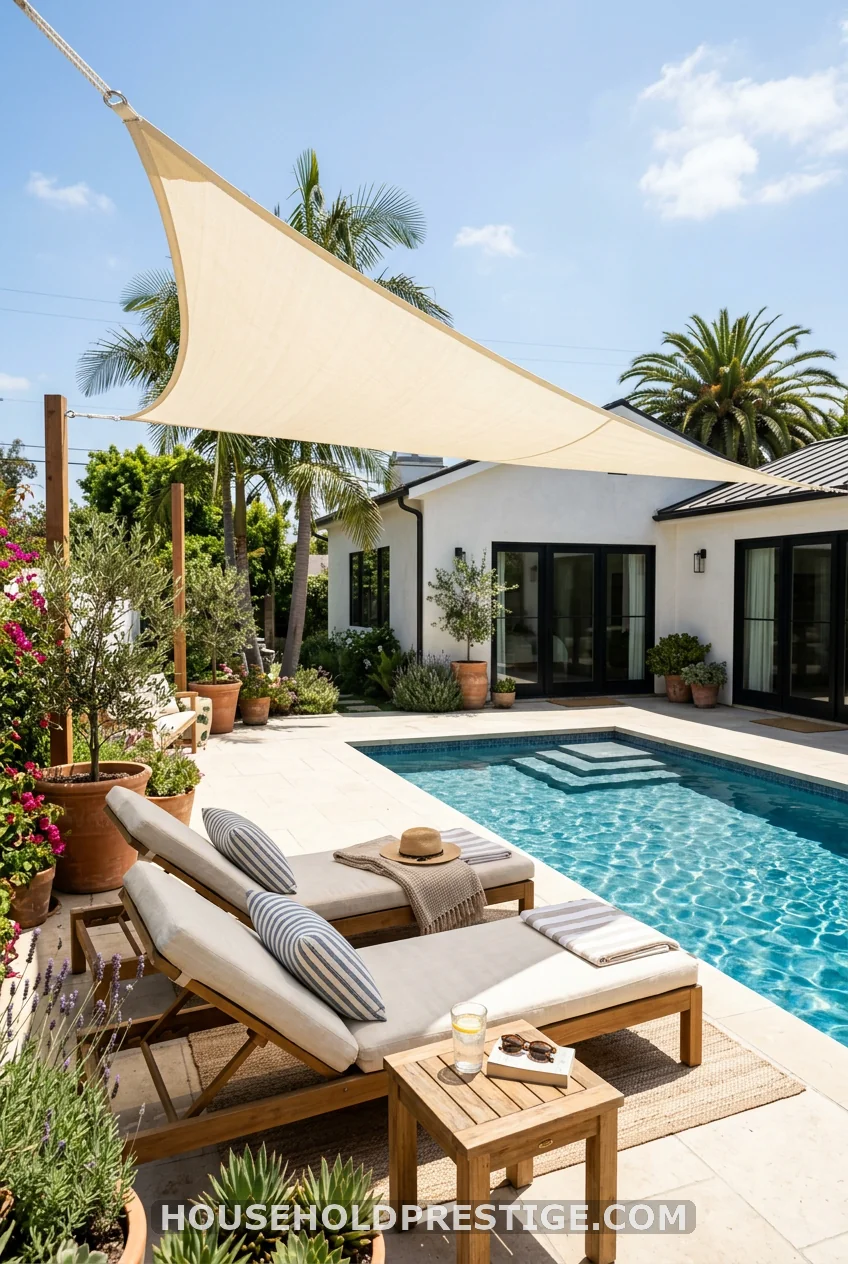
Let’s get you back in the water.
1. Shade Sails (The Workhorse Cover Most Pools Should Start With)
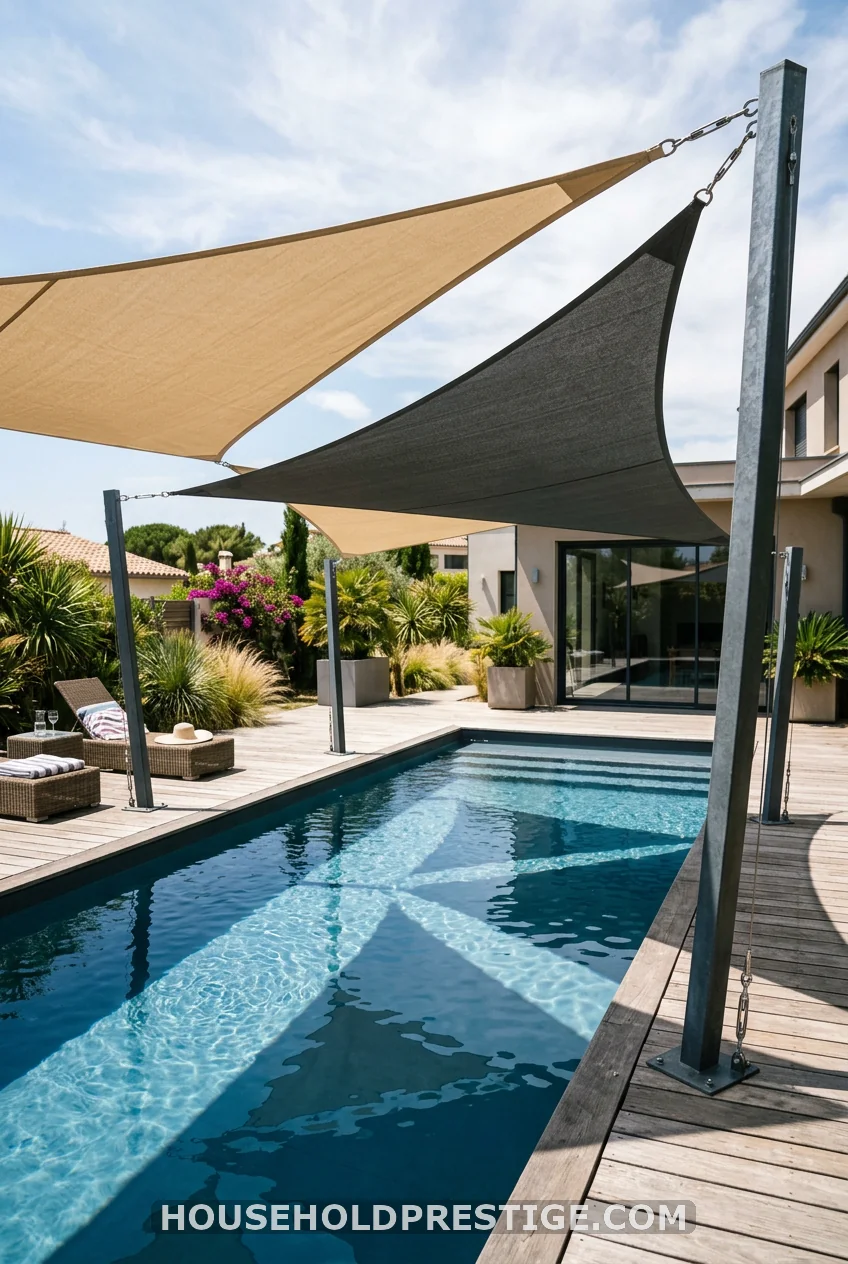
If you only do one thing on this list, do this. A shade sail gives you the most coverage per dollar of anything here, and it suits almost every yard from a tiny plunge pool to a full backyard setup. It’s the reason sails show up in nearly every high-performing pool shade article I studied.
Why it works
A taut piece of high-density polyethylene (HDPE) fabric blocks most of the sun’s rays while letting air flow through the weave. That airflow matters. A solid roof traps hot air underneath; a breathable sail stays cool because heat escapes upward. You get shade without the stuffy sauna feeling.
Dimensions and coverage
Sails come as triangles, squares, and rectangles. A single triangle covers roughly 100 to 150 square feet, depending on size. To cover a standard 16-by-32-foot pool, you’ll want either one large rectangle (think 16 by 20 feet) or two to three overlapping triangles for a layered look. Mount points should sit 8 to 12 feet high, with at least one corner higher than the others so rain runs off instead of pooling on the fabric.
Step-by-step install
- Mark your anchor points. You need three points for a triangle, four for a square. Use existing structures (house wall, sturdy fence post) where you can, and set new posts where you can’t.
- Set your posts. Dig holes 2 to 3 feet deep, drop in 4-by-4-inch steel or treated wood posts, and fill with concrete. Let it cure for 24 to 48 hours before you put any tension on it. Skip this wait, and you’ll regret it.
- Attach hardware. Bolt a turnbuckle and pad-eye to each anchor point. Turnbuckles let you tighten the sail later.
- Hook up the sail. Clip each corner to its turnbuckle with a stainless D-shackle.
- Tension it. Tighten each turnbuckle a little at a time, working in rotation around the sail so the load stays even. The fabric should be drum-tight with no sagging middle.
Materials and rough costs
| Item | Spec | Cost |
|---|---|---|
| Shade sail fabric | 16 ft HDPE, 95% UV block | $40 – $90 |
| Steel or wood posts | 4×4, 10 ft, per post | $25 – $60 each |
| Concrete | One 50 lb bag per post | $6 each |
| Turnbuckles + shackles | Stainless, per corner | $12 – $20 each |
| Total (one triangle, two new posts) | $150 – $300 |
A single sail with one or two new posts costs around $150 to $300 if you do it yourself. Pre-made kits from brands like Coolaroo or ShadeMart run $60 to $120 for the fabric alone, and they hold their color for years.
Pro move
Buy a sail rated for at least 95% UV blockage and 185 to 280 GSM fabric weight. Cheaper sails sag, fade, and tear at the grommets within a season.
Common mistakes to avoid
- Mounting it flat. A level sail collects rainwater, sags, and eventually rips. Always pitch it.
- Skimping on post depth. A 1-foot hole won’t hold against wind. Go 2 to 3 feet and concrete it.
- Buying too small. People measure the pool, not the sun. Shadows shift. Oversize the sail by a few feet on the west side so you stay covered into the afternoon.
2. Cantilever Umbrella
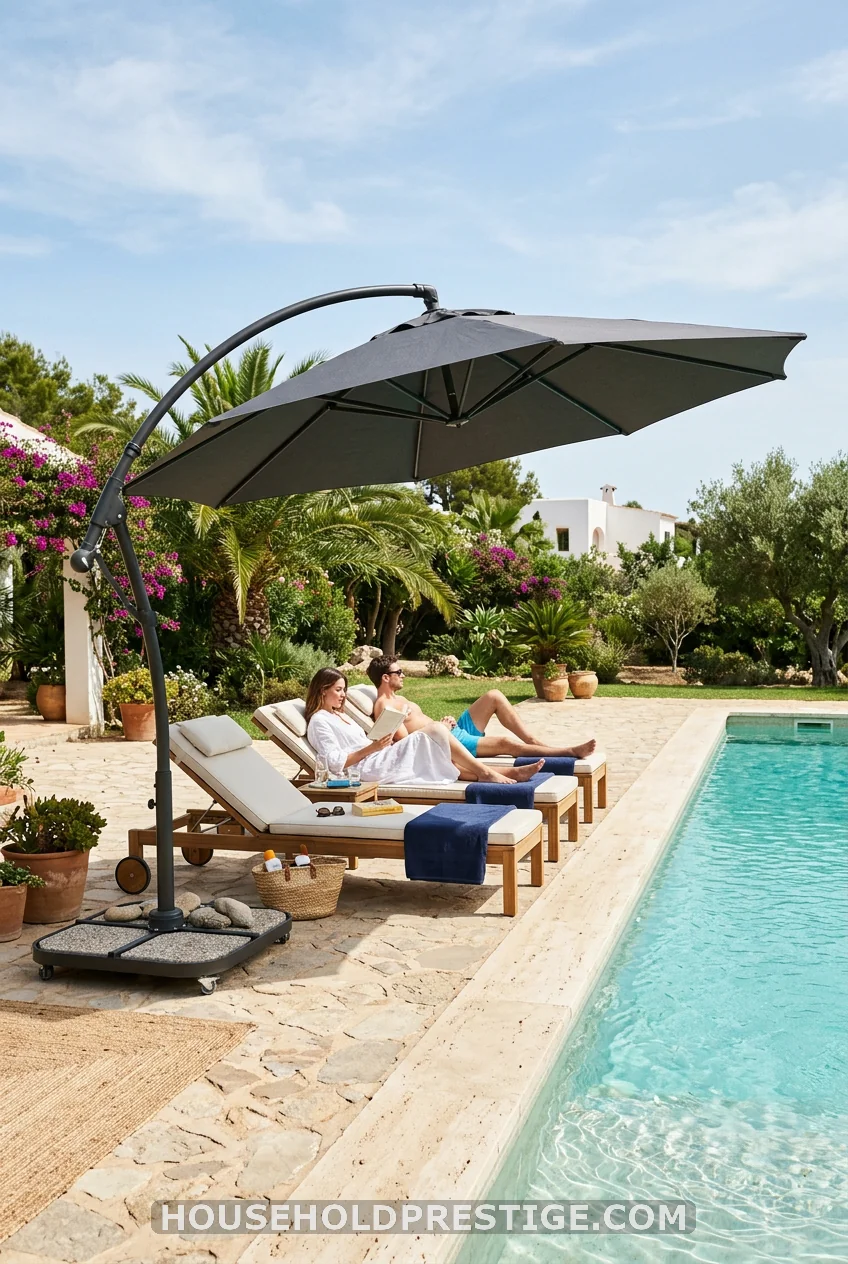
The cantilever umbrella hangs its canopy from a side pole, so nothing blocks your space. Roll the weighted base near the pool’s edge, swing the shade over the water, and tilt it as the sun moves. A 10-foot model runs $150 to $350. No install, no digging. The fastest shade on this list.
3. Pergola With a Retractable Canopy
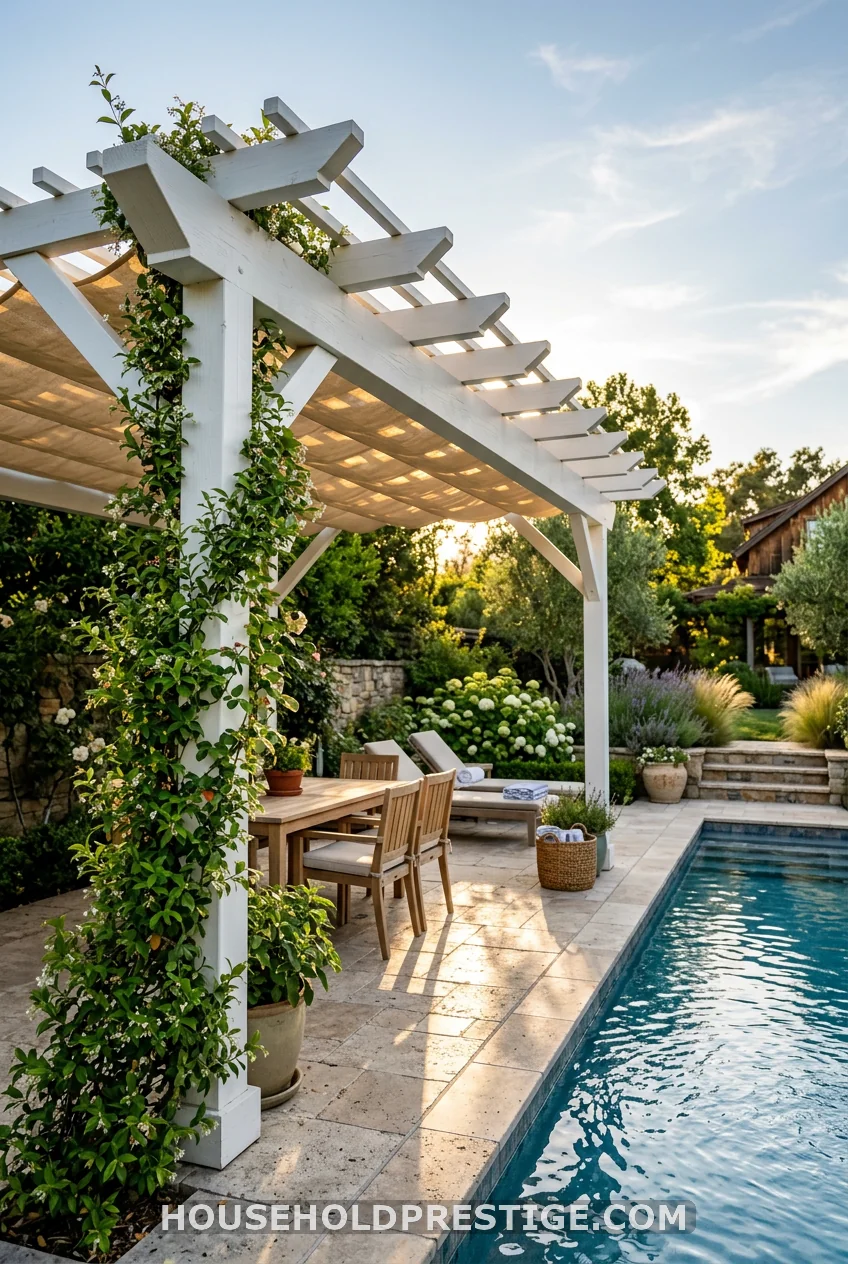
A bare pergola looks great but gives you stripes of shade, not real cover. Add a retractable canopy on cables, and you get the best of both: full sun when you want a tan, full shade when the heat spikes.
The canopy slides along wire tracks between the beams. You pull it closed in minutes by hand, or wire up a motor if you’d rather press a button. Expect to spend $2,000 to $5,000 for a built pergola with a quality canopy, more if you go motorized.
The payoff is flexibility. Morning swim in the sun, afternoon lounging in the shade, all from the same structure. It also doubles as an outdoor room, which is why it shows up in so many resort-style pool photos.
4. A Living Vine Canopy
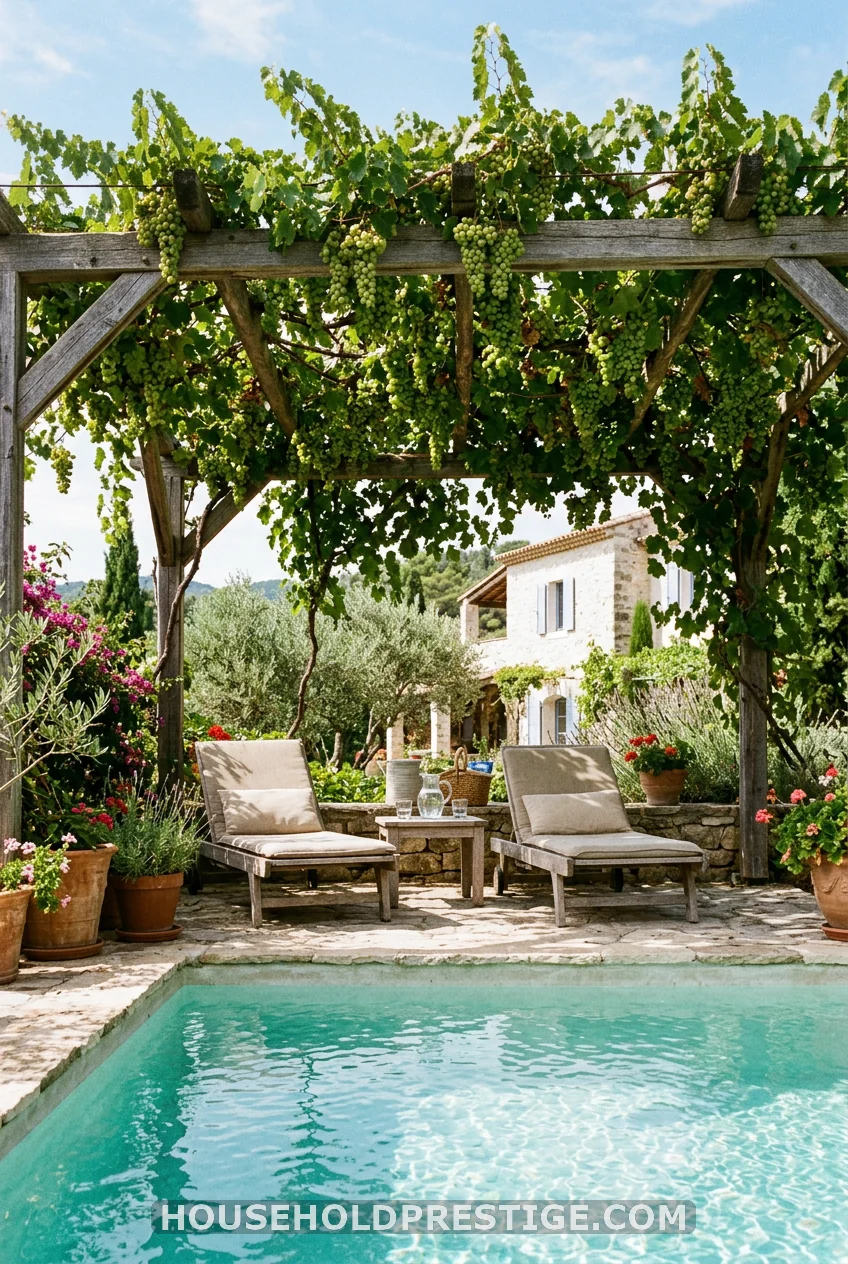
Grow your shade. Grape, wisteria, or trumpet vine trained over a simple frame builds a thick green canopy in two or three seasons. Deciduous vines drop their leaves in fall, so you get summer shade and winter sun without lifting a finger.
It’s the cheapest cover here once it fills in, and it cools the air by a few degrees through evaporation. The trade-off is patience and a bit of pruning. Plant now, lounge under it next summer.
5. A Poolside Cabana
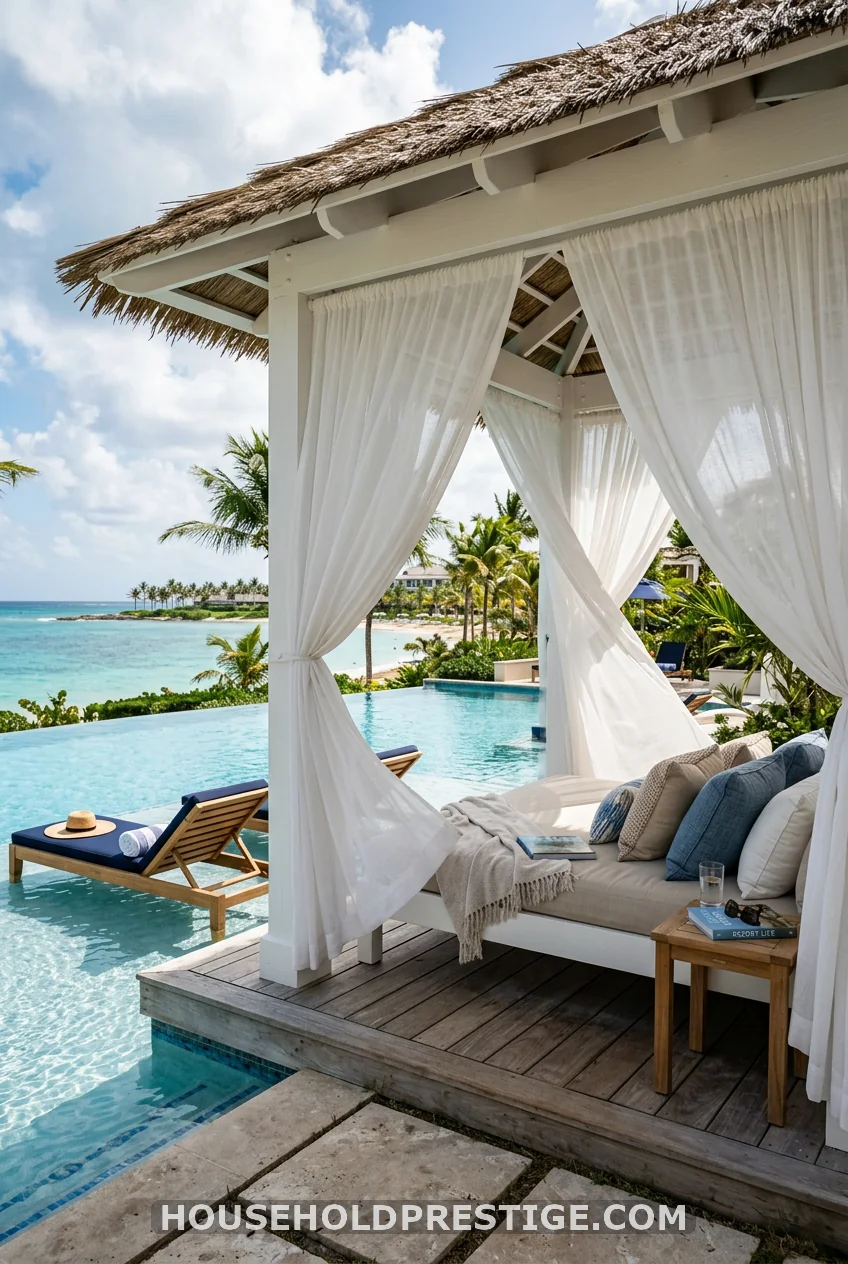
A cabana is the splurge that makes a backyard feel like a vacation. At its core, it’s a roofed structure with open sides and curtains you can draw for shade or privacy.
You’ve got two routes. A soft-top cabana is a steel or aluminum frame with a fabric roof and side curtains, sold as a kit for $300 to $1,500. A built cabana is a permanent, roofed structure, often matching your house, and runs $5,000 and up.
Match the roof style to your home so it reads as part of the property, not a tent that wandered in. That single detail separates a cabana that looks designed from one that looks temporary.
Furnish it with a daybed or a pair of loungers and weatherproof cushions. Now it’s not just shade. It’s the spot everyone fights over.
6. Bamboo or Palapa Tiki Roof
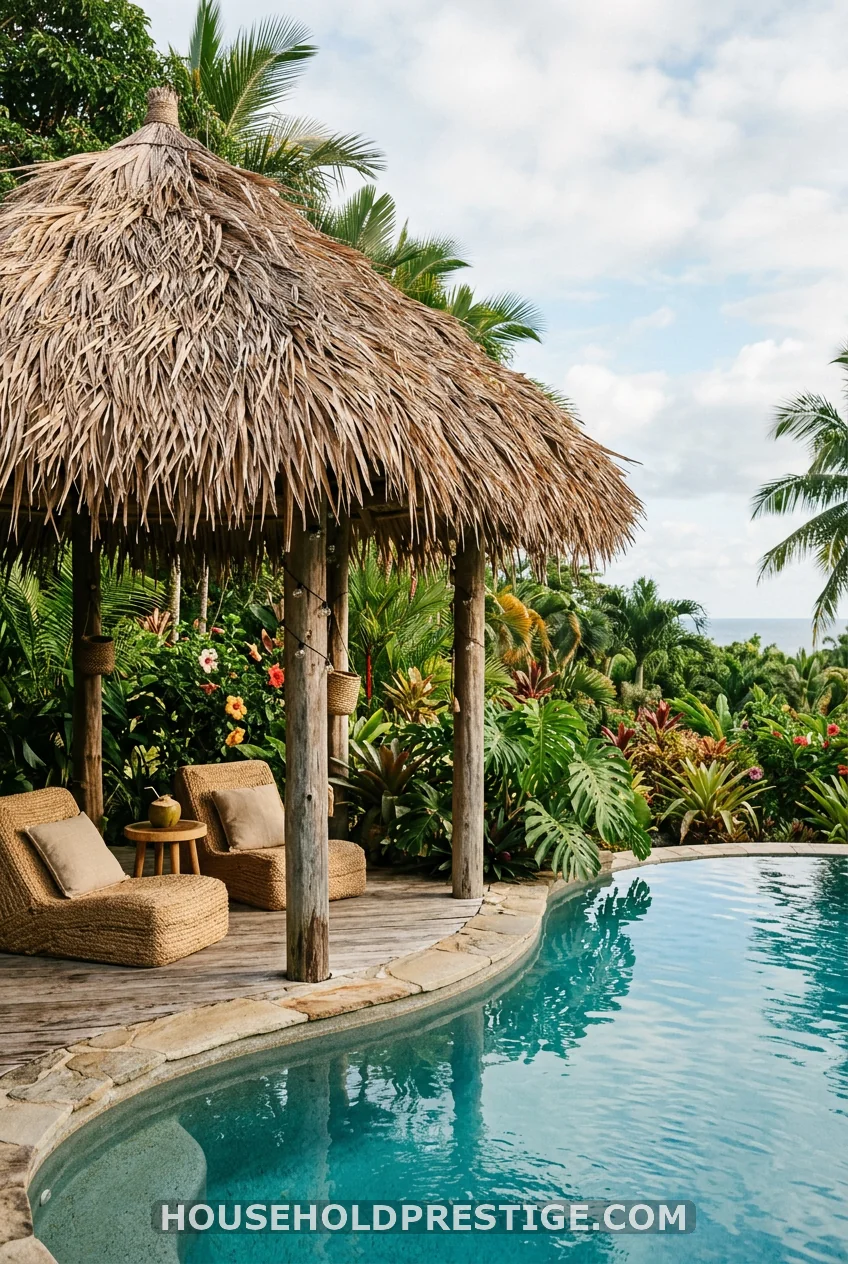
Thatched palm or bamboo gives instant tropical shade. The dried fronds block harsh sun while air moves through the gaps, so it stays cool underneath. Kits start around $400. Re-thatch every few years, and it lasts. Best for warm, dry climates where the thatch won’t stay damp.
7. DIY Drop-Cloth Curtain Panels
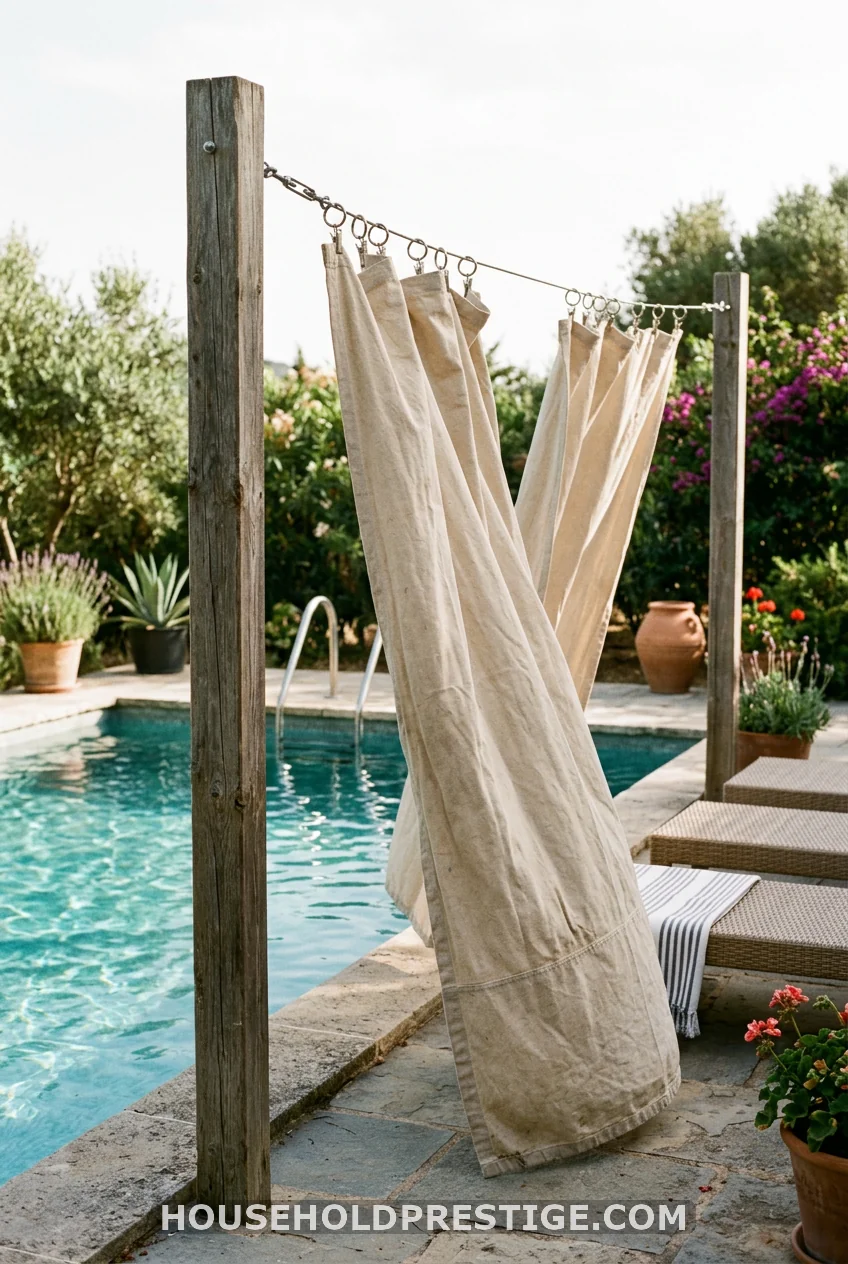
Here’s the under-$100 option that punches above its price. Run a stainless cable between two posts or your house and a post, then hang outdoor curtain panels or painter’s drop cloths from rings that slide along the cable.
Slide them open for sun, closed for shade or privacy. Canvas drop cloths cost about $20 each, the cable kit another $30, and the rings round it out near $80 total. Use a UV-rated outdoor fabric if you want it to last more than one summer, since untreated canvas fades and mildews.
It won’t survive a storm like a built structure, but for cheap, movable, good-looking shade on a small pool, nothing beats it.
8. Louvered Aluminum Pergola
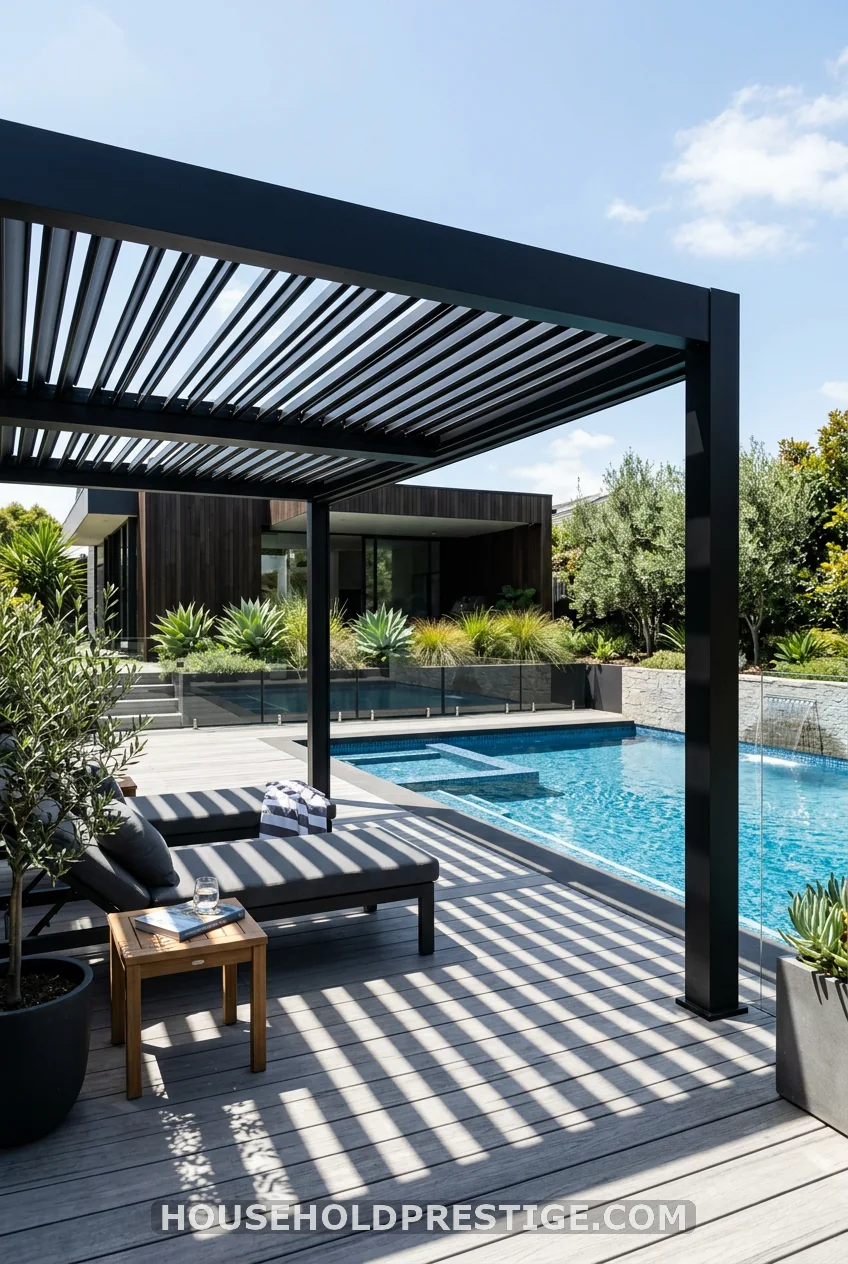
The premium cousin of the wood pergola. Aluminum slats rotate on a track, so you dial in exactly how much sun you want, then close them fully if rain rolls in. No fabric to replace, no rot, no repainting.
Cost reality
These start around $4,000 for a small freestanding unit and climb past $10,000 for large motorized models with rain sensors. It’s a real investment.
What you’re paying for is set-and-forget control and a structure that outlasts everything else here. For a modern pool you plan to keep, the math works over time.
9. The Umbrella Lesson (What Not to Do)
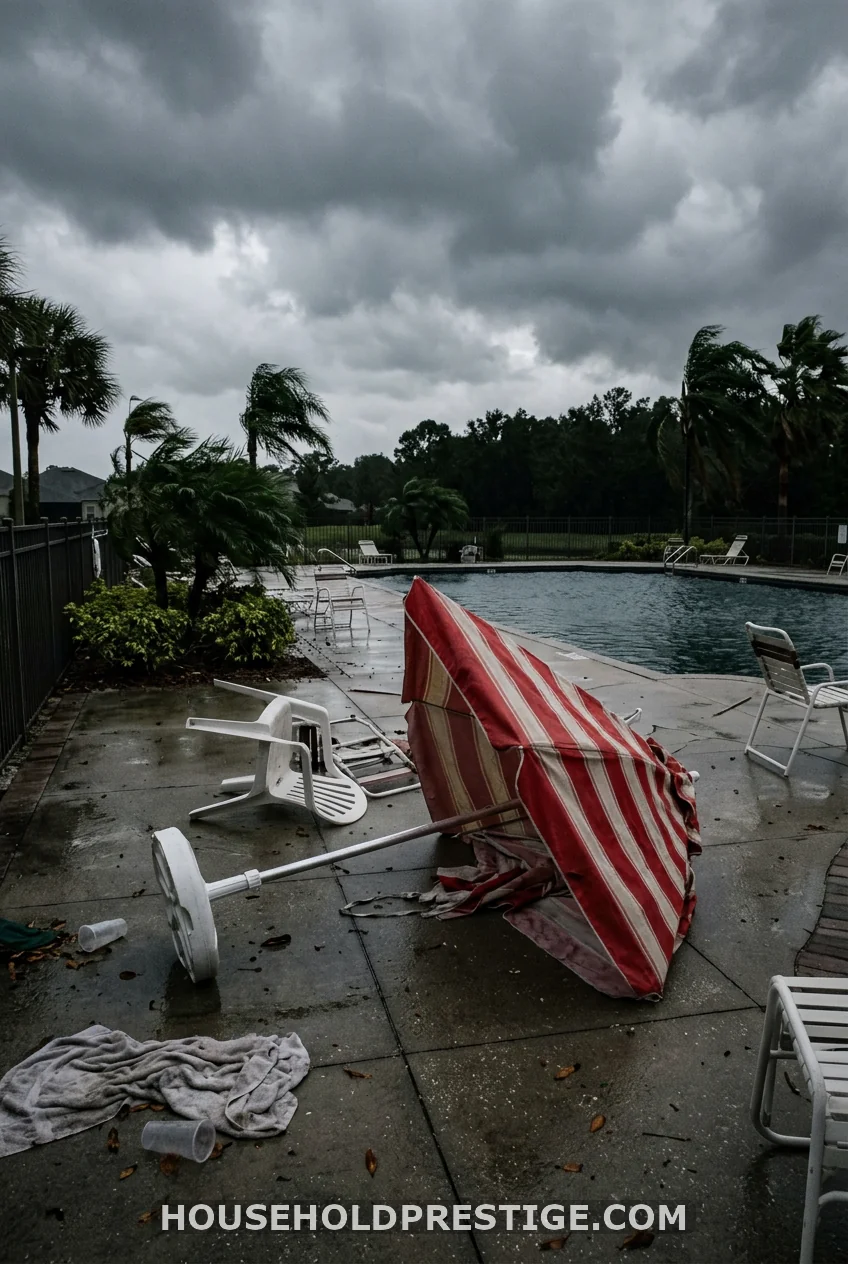
Let me save you the money I wasted. My first “solution” was three cheap market umbrellas from a big-box store. $40 each, in by lunch, looked fine.
By the next weekend, two had blown into the pool, and one had snapped at the pole. The bases were too light, the canopies caught wind like sails, and chasing them around the deck became a part-time job.
The problem wasn’t umbrellas. It was the wrong umbrellas. A proper poolside umbrella needs a base of at least 50 pounds, a wind-vented canopy, and a fiberglass or thick aluminum pole. That setup runs $200 and up, not $40.
I spent $120 on three umbrellas that lasted ten days, then spent the real money anyway. If you go the umbrella route, skip the cheap tier. Buy one good one instead of three bad ones.
10. Mature Shade Trees
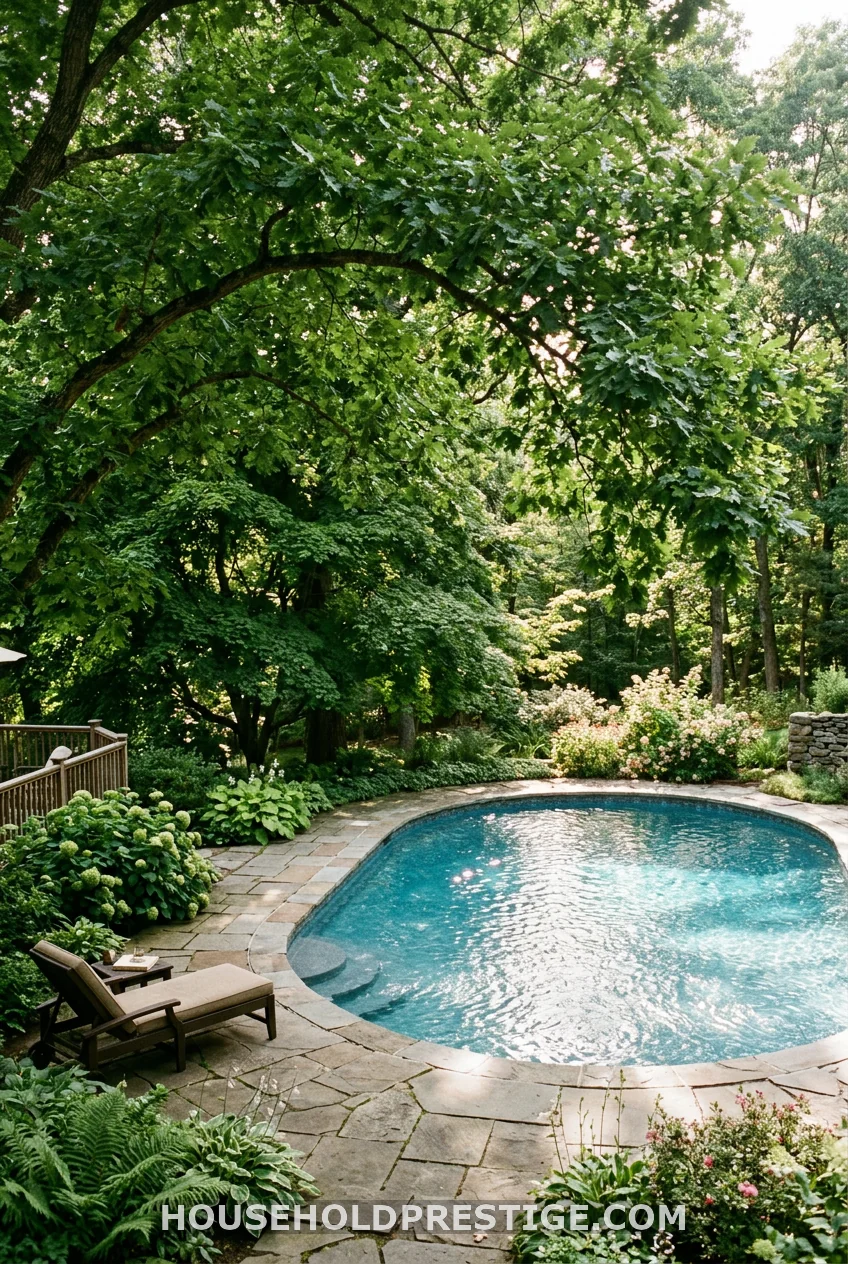
The oldest trick is going. A few well-placed trees on the west side cool the whole area and cost only the price of the saplings. Pick non-shedding types like olive or palm, so you’re not fishing leaves out daily. Slow, yes. But free shade that grows is hard to argue with.
11. Retractable Awning Off the House
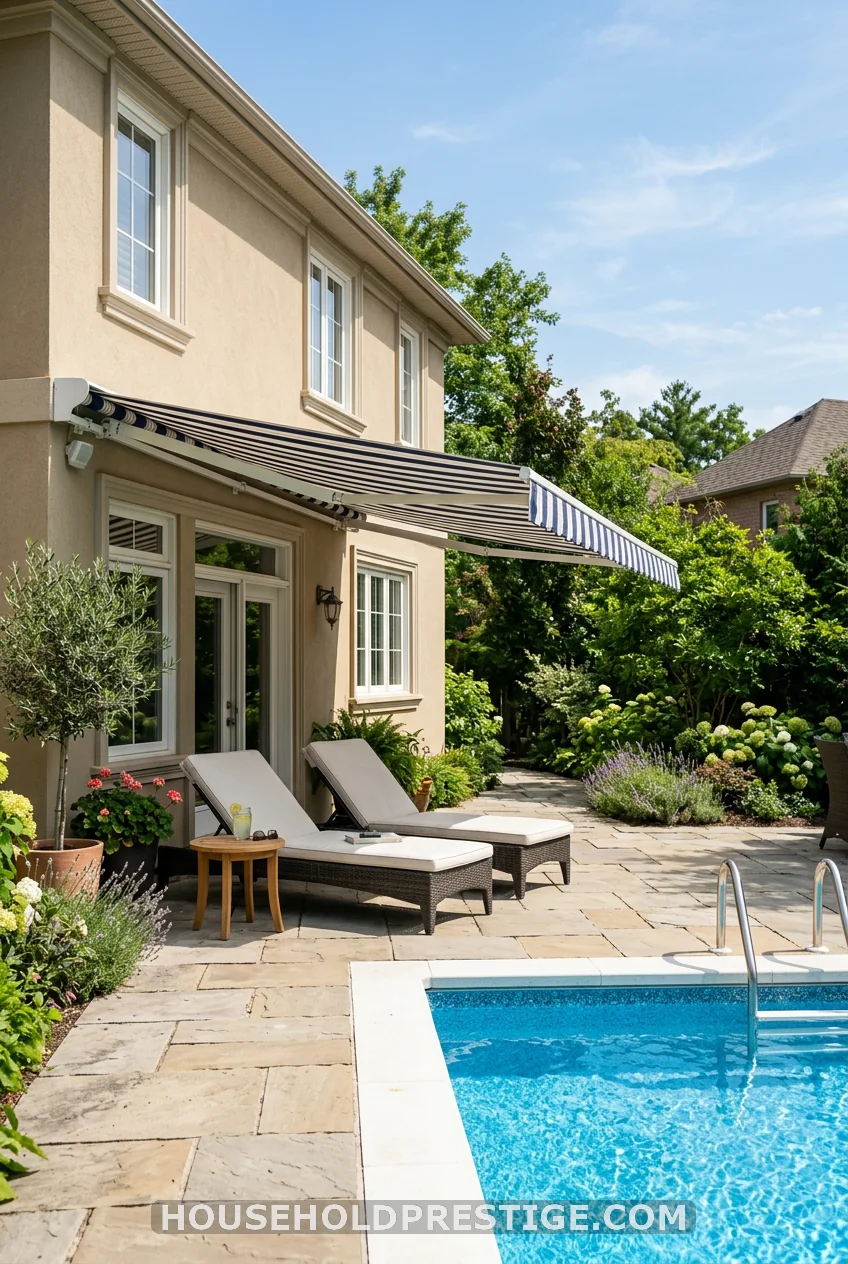
If your pool sits close to the house, an awning is the tidy answer. It mounts to the wall and rolls out over the deck and the near edge of the water, then retracts flush when you don’t need it.
Manual models start around $200; motorized ones with wind sensors run $1,000 to $3,000. Because it tucks away, it never clutters the view or fights the wind when it’s stored. Great for urban yards where floor space is tight.
12. Myth-Bust: “Any Shade Blocks the UV”
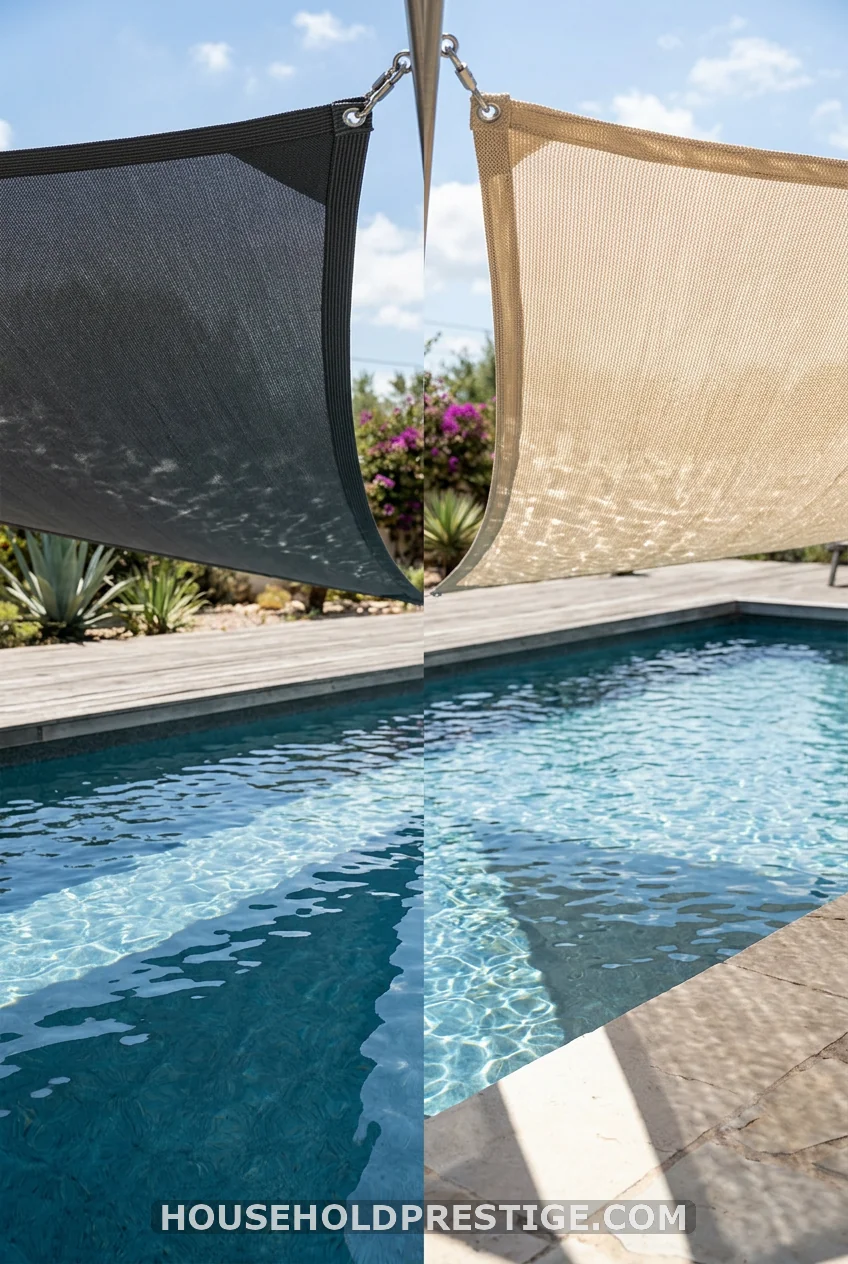
What most people think: if I’m sitting in the shade, I’m protected from sunburn.
The reality: shade cuts UV, but how much depends entirely on the fabric. A loose-weave or pale sail can let 40% or more of UV rays straight through, and water reflects them back up at you. People burn under thin shade all the time and blame the sunscreen.
What to do about it: check the UV block rating before you buy, not the look. Aim for 95% or higher. Darker, tightly woven HDPE blocks the most. And keep wearing sunscreen near the pool, even in the shade, because reflected light off the water still reaches you. Shade is your first layer, not your only one.
13. Above-Ground Pool Snap-On Canopy
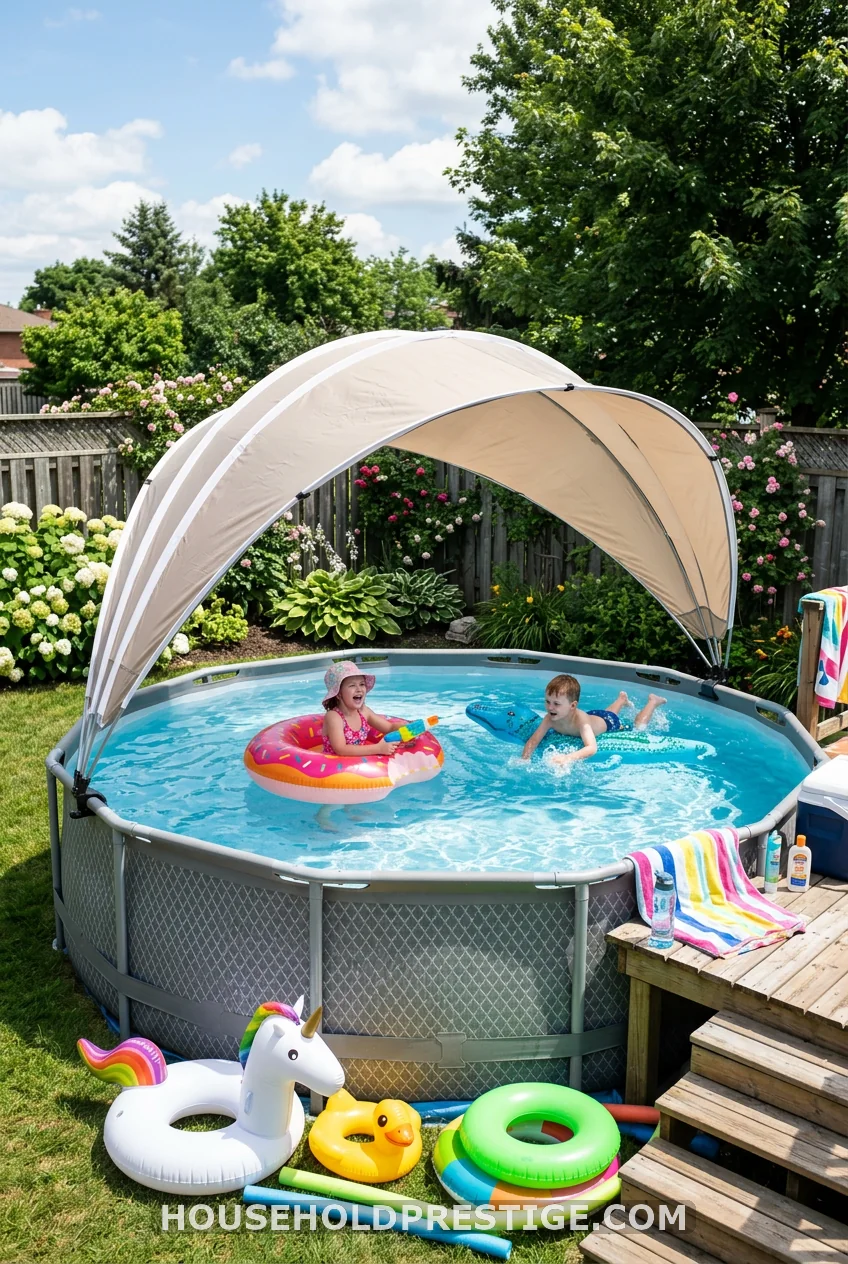
Got an Intex or a round above-ground pool? Skip the heavy structures. Clip-on canopies snap to the pool’s top rail and arch over part of the water. They run $50 to $150, set up in minutes, and pack away for storage. Sized to fit standard pools, they’re the easy win for renters and seasonal setups.
14. Freestanding Gazebo or Pavilion
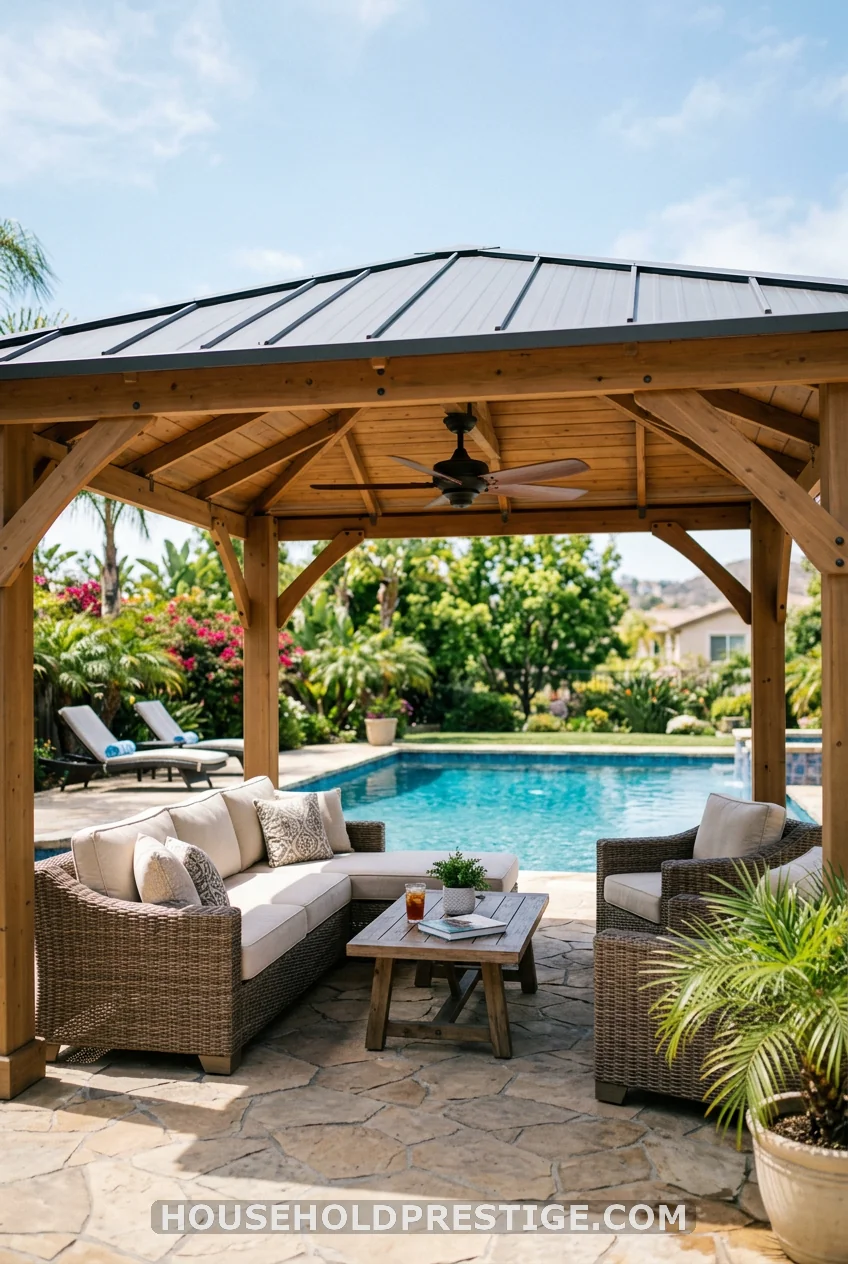
When you want a defined shaded room near the water, a gazebo delivers. It’s a standalone roofed structure, usually with a peaked hardtop or shingled roof and open sides.
Soft-top gazebo kits start at around $300. Hardtop aluminum or steel models run $1,500 to $4,000, and they handle wind and weather far better. Built timber gazebos go higher.
Add a ceiling fan and some lighting, and it works from a noon swim straight through to an evening by the water. It anchors the whole pool area visually, too.
15. Layer Two or Three Together
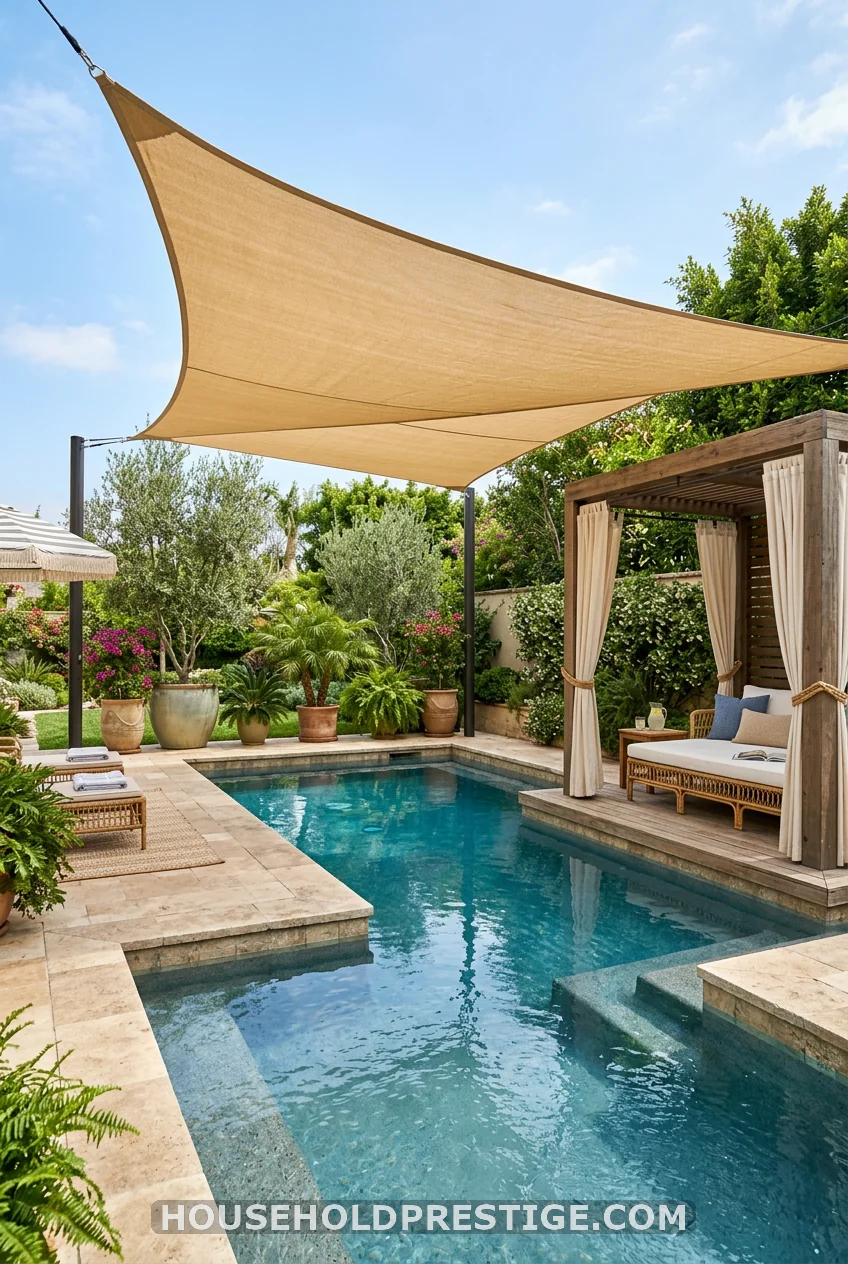
Here’s the move the best backyards make. No single cover handles a moving sun all day, so they combine. A sail over the water, an umbrella for the loungers, a tree on the west side for the late afternoon.
Layering means you’re always in shade somewhere as the sun travels. It also looks intentional and designed rather than like one big tent.
Start with the sail from idea #1 for your main coverage, then add a portable piece for wherever the shadow falls short. You don’t need all 15. You need the two or three that fit your yard, your sun, and your budget.
Bringing It Together
Your pool should be the best seat in the yard at noon, not a place you avoid until sunset. The fix is rarely complicated. A well-tensioned shade sail solves most pools for a couple of hundred dollars. A cabana or louvered pergola turns the splurge into a daily upgrade. And layering a few covers keeps you in the shade no matter where the sun sits.
Pick the one that matches your space and your budget, start there, and add as you go. The water’s waiting, and now you can stay in it.
Frequently Asked Questions
What is the cheapest way to shade a pool?
A shade sail is the best value, covering the most area for $150 to $300 installed yourself. For an even cheaper option, DIY curtain panels on a cable run under $100, and clip-on canopies for above-ground pools start around $50.
What is the best pool shade for windy areas?
A well-anchored, breathable HDPE shade sail handles wind best because air passes through the weave instead of pushing against a solid surface. Avoid lightweight umbrellas and soft-top structures in gusty spots, since they catch wind and tip or tear.
Do pool shade sails block UV rays?
Quality sails block 90 to 98% of UV, but the rating varies by fabric. Check for at least 95% UV blockage before buying, and remember water reflects light, so wear sunscreen near the pool even in the shade.
How much does it cost to put shade over a pool?
It ranges widely. DIY curtains and clip-on canopies start under $100, a shade sail runs $150 to $300, a soft cabana is $300 to $1,500, and built pergolas, louvered roofs, or permanent cabanas climb from $2,000 to $10,000 or more.
Can I install a shade sail myself?
Yes. With posts set in concrete and basic hardware, most homeowners install a single sail in a weekend. The key steps are pitching the sail so rain runs off, setting posts 2 to 3 feet deep, and tensioning the fabric drum-tight.